



Grab a random bag of screws from your shed and use them to hold up a structural beam — what could go wrong? Plenty, as it turns out. A surprising number of Australian construction projects run into serious trouble not because of poor design, but because the wrong fastener was used in a load-bearing application. This article will walk you through the key differences between structural and mechanical fasteners, the Australian standards that govern their use, the physics of how they transfer loads, and the practical selection criteria that keep your project safe, compliant, and built to last.
Table of Contents
- What are load-bearing fasteners?
- Australian standards for load-bearing fastener selection
- Mechanical principles of load transfer
- Choosing the right fastener for Australian conditions
- Common mistakes and expert tips
- Load-bearing fasteners in practice: project examples
- Get reliable fasteners for your next project
- Frequently asked questions
Key Takeaways
| Point | Details |
|---|---|
| Certified fasteners matter | Using standards-certified assemblies is critical for safety and compliance in Australian construction. |
| Material selection is project-specific | Choose fastener materials based on environment and project loads, such as 316 stainless for coastal works. |
| Correct installation prevents failure | Proper torque, edge distances, and nut quality ensure load-bearing fasteners perform reliably. |
| Cost and durability linked | Investing in stainless steel fasteners saves money in long-term corrosion-prone settings. |
| Real-world examples inform | Learning from Australian project case studies can help avoid common mistakes and improve outcomes. |
What are load-bearing fasteners?
A load-bearing fastener is any fastener that is specifically designed and rated to transfer structural loads between connected elements. This is not the same as a fastener that simply holds two pieces of material together. The distinction matters enormously on a worksite.
There are two broad categories you need to understand. Structural fasteners include high-strength bolts, post-installed anchors, and cast-in anchors used in steel and concrete connections. Mechanical fasteners include screws, nails, and staples used for non-structural joinery and cladding. As types of fasteners research confirms, these categories serve fundamentally different purposes and must never be swapped.
Load-bearing fasteners in Australian construction primarily include high-strength structural bolts covered by AS/NZS 1252, post-installed and cast-in anchors in concrete covered by AS 5216, and bolts for steel-timber connections. Using a mechanical fastener in place of a structural one does not just risk loosening — it risks catastrophic failure.
Here is a quick breakdown of where each type belongs:
- Structural bolts and anchors: Steel-to-steel connections, concrete-to-steel, post-installed anchors in slabs and walls
- Screws and nails: Cladding, internal linings, non-structural timber joinery
- Specialty fasteners: Products like bugle batten screws for roofing and batten fixing where load ratings are specified
Remember: Substituting a mechanical fastener for a structural bolt is not a cost-saving measure. It is a liability.
Australian standards for load-bearing fastener selection
Now that you know what load-bearing fasteners are, let’s see how standards shape their use and selection today.
Two standards dominate structural fastening in Australia. AS/NZS 1252 and AS 5216 cover structural bolting assemblies and concrete fastenings respectively. Compliance with these standards is not optional on regulated construction sites — it is a legal requirement and a professional obligation.
| Standard | Scope | Key requirement |
|---|---|---|
| AS/NZS 1252 | Structural bolting assemblies | Full assembly compliance: bolt, nut, washer |
| AS 5216 | Concrete fastenings | Design, installation, and seismic performance |
Compliance achieves three things: it gives you reliable, predictable performance; it protects you legally if something goes wrong; and it ensures durability over the life of the structure. Here is how to check for certification before you buy:
- Look for the standard number stamped or marked on the fastener or packaging.
- Request a certificate of conformance from your supplier.
- Verify that the bolt, nut, and washer are all from the same certified assembly — not mixed from different sources.
- Check that concrete anchors carry AS 5216 approval documentation.
- Never use fasteners from unmarked bulk bins for structural applications.
One of the most common mistakes on Australian sites is mixing components from different standards or different grades. An AS/NZS 1252 bolt paired with a non-compliant nut can fail at a fraction of its rated load.
Pro Tip: Always purchase and install the full certified assembly — bolt, nut, and washer together. Mixing components from different batches or suppliers voids the assembly rating and puts your project at risk.
Mechanical principles of load transfer
With standards covered, let’s dig into how fasteners physically transfer loads and avoid disaster.
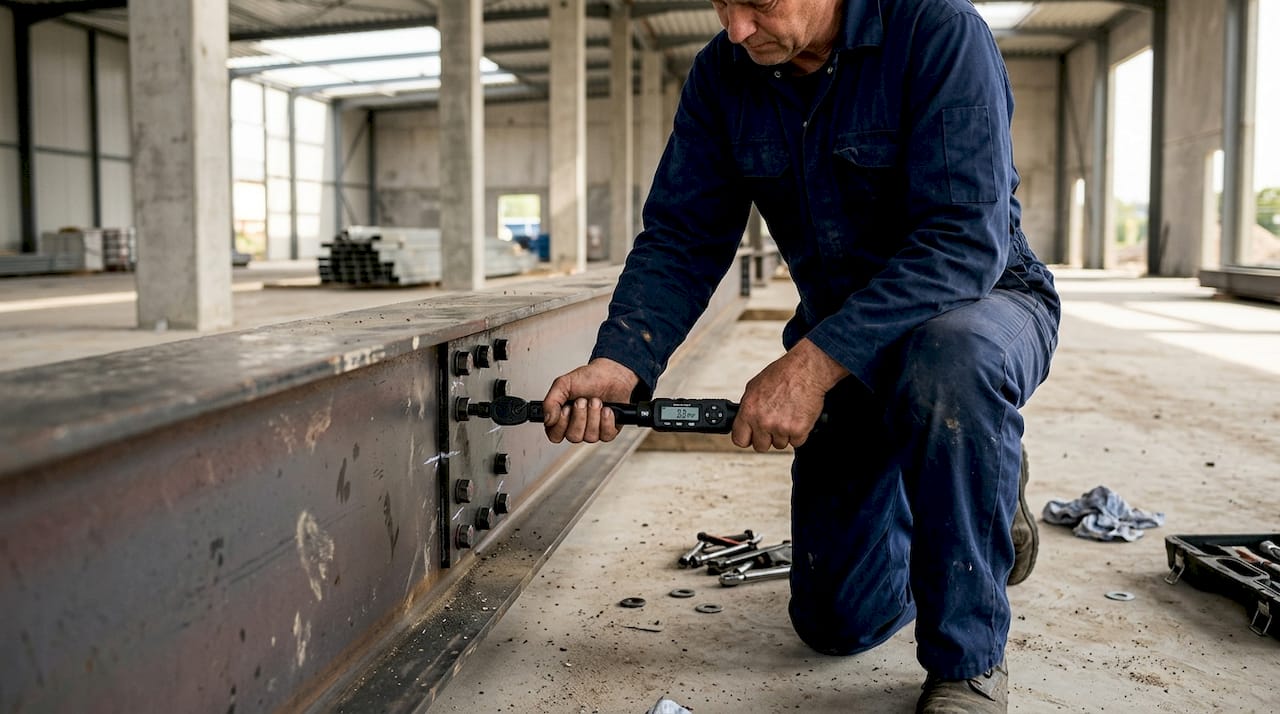
Structural bolts operate in one of two modes. In friction grip mode, the bolt is tensioned to a precise preload, which clamps the connected plates together so tightly that shear forces are transferred through friction alone. In bearing mode, the bolt shank itself bears against the hole edges to transfer load. Both modes are valid, but they require different installation procedures and different design checks.
Concrete anchors face a different set of challenges. According to AS 5216 mechanics, anchors must be designed to resist steel failure, pullout from the concrete, and concrete breakout — three distinct failure modes that each require separate calculations. Missing any one of them in your design is a serious error.
Here is a summary of the key load types every structural fastener must be checked against:
- Tension: Force pulling the fastener out along its axis
- Shear: Force acting perpendicular to the fastener axis
- Combined loading: Simultaneous tension and shear, which is the most common real-world condition
Real-world load data puts this in perspective. An M10 Grade 8.8 bolt delivers approximately 84 kN in tensile strength. That is substantial, but only if the bolt is installed to the correct torque. Under-torqued bolts lose their friction grip entirely. Over-torqued bolts can yield and lose preload over time.
Remember: Torque is not just a number on a spec sheet. It is the mechanism that activates the fastener’s rated capacity. A concrete nailer driving concrete nails into a slab still requires correct embedment depth to achieve rated pullout resistance.
Choosing the right fastener for Australian conditions
Understanding the mechanics, let’s look at practical selection — what works best for your project and environment.
Material grade is the first decision. Structural bolts range from Class 4.6 through to Class 10.9, with higher numbers indicating greater strength. For most structural steel connections, Class 8.8 is the standard workhorse. But strength grade alone does not tell the whole story.
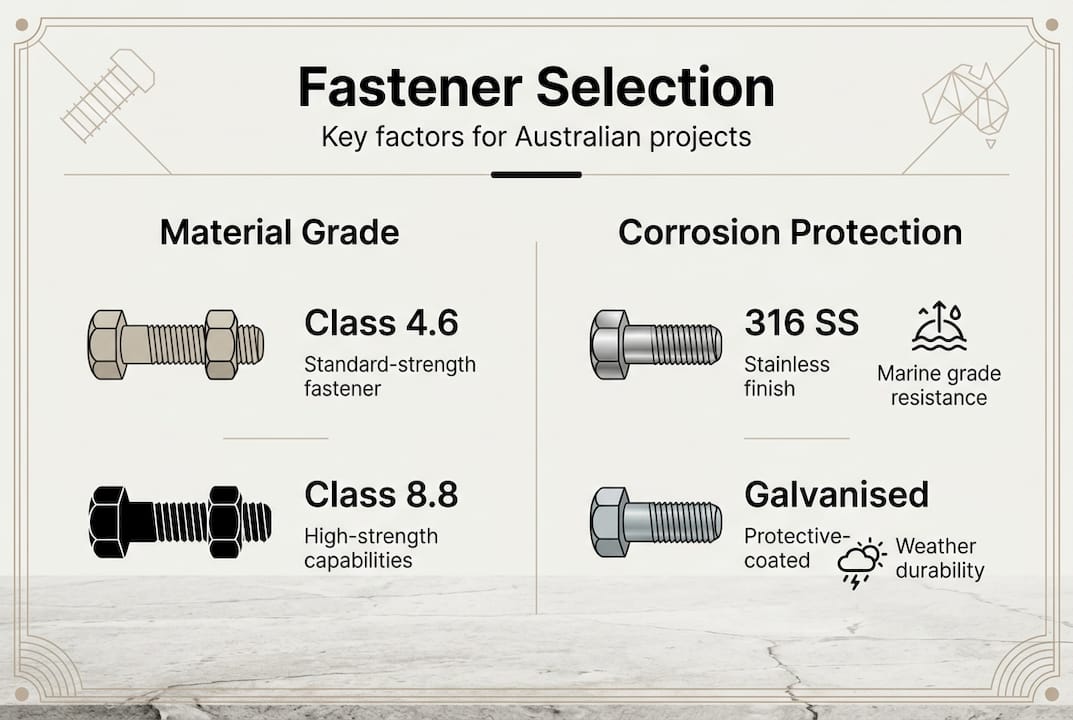
Corrosion resistance is equally critical, and coastal corrosion is a genuine threat in Australia. A Class 3 galvanised coating that performs well for 15 years inland can fail in as little as 3 to 5 years in a coastal environment. For anything within a few kilometres of the ocean, 316 stainless steel is the minimum acceptable specification.
Here is a practical selection checklist for Australian conditions:
- Coastal or marine: 316 SS fasteners only. No exceptions.
- Inland or sheltered: Class 8.8 with hot-dip galvanising is generally sufficient.
- Timber connections: Check for compatibility with treated timber chemicals, which can corrode standard galvanising.
- Concrete applications: Use anchors with AS 5216 approval and check edge distances carefully.
- High-movement or seismic zones: Verify that your anchor system is rated for cyclic loading.
For facade and cladding work, products like corrugated fasteners and coastal-rated fasteners are available in corrosion-resistant grades suited to Australian conditions. Always match the fastener specification to the exposure category of your project.
Cost is a real consideration, but think long-term. Stainless steel costs more upfront, but fastener issues in structural steelwork caused by corrosion can result in remediation costs that dwarf the original saving.
Pro Tip: Your project location is the single biggest driver of material choice. Before you order fasteners, confirm the exposure category of your site using AS/NZS 2312 or consult your engineer.
Common mistakes and expert tips
Having covered selection, here is what often goes wrong — and how to get it right every time.
The most frequent cause of structural fastener failure on Australian sites is not poor design. It is poor installation. Improper torque leads to bolt loosening, and poor-quality nuts cause thread stripping failures. Both are entirely preventable.
Here are the top mistakes to avoid:
- Incorrect torque: Always use a calibrated torque wrench. Never estimate by feel.
- Non-certified components: If it does not carry the standard marking, do not use it in a structural connection.
- Ignoring environment: Inland fasteners installed in coastal projects will corrode and fail prematurely.
- Improper storage: Fasteners stored in damp conditions can corrode before installation, compromising their rated capacity.
- Skipping seismic checks: In earthquake-prone regions, AS 5216 requires specific cyclic and seismic loading verification for anchors.
For timber framing applications, correct bugle batten screw installation and the use of rated frame and truss nails are just as important as bolt torque in steel connections.
Pro Tip: Before installation, inspect every fastener for surface damage, corrosion, or thread defects. A fastener that looks fine but has been stored incorrectly may already be compromised.
Load-bearing fasteners in practice: project examples
To wrap up, let’s ground these lessons with practical examples from Australian worksites.
Consider a structural steel facade on a coastal commercial building. The engineer specifies 316 SS bolts throughout. The contractor, looking to cut costs, substitutes Class 3 galvanised bolts. Within four years, visible corrosion appears at the connections. Remediation requires full scaffold access, bolt replacement, and repainting — a process that costs far more than the original stainless steel specification would have.
The numbers tell the story clearly. An M10 Grade 8.8 bolt provides approximately 84 kN tensile capacity, but only when correctly installed and maintained. Over a 30-year facade lifespan, using Class 3 fasteners can cost around $45,000 in maintenance and replacement, compared to roughly $12,000 for stainless steel over the same period.
| Scenario | Fastener type | 30-year cost estimate |
|---|---|---|
| Coastal facade | Class 3 galvanised | ~$45,000 |
| Coastal facade | 316 stainless steel | ~$12,000 |
| Inland structural steel | Class 8.8 hot-dip galvanised | ~$8,000 |
For timber-to-steel connections in residential construction, using hardened steel nails rated for the application ensures the connection performs as designed under both gravity and wind uplift loads. Substituting unrated nails is a common DIY mistake that can have serious consequences during storm events.
Key insight: The upfront cost difference between compliant and non-compliant fasteners is almost always smaller than the cost of a single remediation event.
Get reliable fasteners for your next project
You now have the knowledge to make informed, safe fastener choices for any Australian construction project. Putting that knowledge into practice starts with sourcing certified, corrosion-resistant products from a supplier who understands the demands of the industry.
At Aussie Nails and Fasteners Warehouse, we stock a wide range of products suited to structural and non-structural applications across Australia. From corrugated fasteners for cladding and joinery to concrete nails for slab and masonry work, every product in our range is selected for quality and reliability. Visit the Aussie Nails and Fasteners Warehouse to browse our full catalogue and find the right fastener for your next job. Our team understands Australian conditions and can help you match the right product to your project requirements.
Frequently asked questions
What is the difference between structural and mechanical fasteners?
Structural fasteners are rated for load transfer and must comply with Australian standards such as AS/NZS 1252. Mechanical fasteners like nails and screws are used for non-structural joinery and must never be substituted for structural bolts in load-bearing connections.
Do I need 316 stainless steel fasteners for coastal construction?
Yes. Class 3 coatings fail in as little as 3 to 5 years in coastal environments, compared to 15 years or more inland. 316 stainless steel is the minimum specification for any coastal or marine application in Australia.
How much tensile strength does an M10 Grade 8.8 bolt provide?
An M10 Grade 8.8 bolt delivers approximately 84 kN in tensile strength when correctly installed to the specified torque. Under-torquing significantly reduces the effective capacity.
What standard covers concrete anchors for structural Australian construction?
AS 5216 is the key Australian standard for the design and installation of fastenings in concrete, covering all failure modes including pullout, steel failure, and concrete breakout.
What are the signs of fastener failure in structural steelwork?
Improper torque and poor nuts are the leading causes of fastener failure. Watch for loosened bolts, visible thread stripping, surface corrosion, and any movement or cracking at structural connections.
Recommended
- CORRUGATED FASTENERS Electro Galvanised 10MM – Aussie Nails and Fasteners Warehouse
- CORRUGATED FASTENERS Electro Galvanised 13MM – Aussie Nails and Fasteners Warehouse
- Concrete Nails – Loose 4.0 X 65mm 15Kg Electro Galvanised – Aussie Nails and Fasteners Warehouse
- Concrete Nails – Loose 4.0 X 75mm 15Kg Electro Galvanised – Aussie Nails and Fasteners Warehouse