



TL;DR:
- Proper nail selection depends on timber type, moisture content, environment, and load requirements.
- Common Australian nails include framing nails, clouts, bullet head, galvanised, and specialty shank types.
- Using the correct, standards-compliant nails ensures structural integrity and meets Australian building codes.
Walk into any Australian hardware supplier or trade merchant and you’ll find dozens of nail types staring back at you from the shelves. For a lot of builders and keen DIYers, that wall of options creates genuine confusion. Pick the wrong nail and you’re not just looking at a wobbly joint — you’re potentially compromising the structural integrity of the entire build. Australia’s climate, from the humid tropics of Far North Queensland to the salt-laden coastal air of Western Australia, demands that you think carefully about corrosion resistance, timber species compatibility, and load requirements before you drive a single nail.
Table of Contents
- How to choose the right construction nail
- Common construction nail types in Australia
- Specialty nails and advanced features
- Comparison of nails: performance and applications
- What most guides miss about choosing construction nails
- Quality nails and tools for every Australian build
- Frequently asked questions
Key Takeaways
| Point | Details |
|---|---|
| Choose nails by application | Different tasks need unique nail types and finishes to ensure safety and longevity. |
| Australian standards matter | Always check AS 1720.1:2010 and related codes for compliant nail use and installation. |
| Ring shank for extra hold | Ring or spiral shank nails provide best grip in demanding conditions or exposed locations. |
| Proper penetration is vital | Nails should be long enough for at least 10 times their diameter penetration into the timber. |
| Never shortcut on structure | Do not substitute nails for bolts or anchors where structural or code requirements specify otherwise. |
How to choose the right construction nail
Now that you’ve seen why proper nail selection matters, let’s review the main factors to consider before diving into specific nail types.
Timber is not timber. A 90mm framing nail that works perfectly in a seasoned pine frame can split a green hardwood stud before you’ve even finished the swing. The species, moisture content, and thickness of your timber all directly influence which nail will perform and which will fail. Green (unseasoned) timber requires pre-boring to prevent splitting, and the joint group classifications under Australian standards directly affect the design capacity of every connection you make.
Nails in timber connections must comply with AS 1720.1:2010 for design capacity, and this standard considers joint groups from JD1 to JD6 for seasoned timber and J1 to J6 for unseasoned timber. Penetration depths must exceed 10 times the nail diameter (10D), and spacing requirements must be respected to avoid splitting or reduced capacity. This is not optional on a regulated build — it is a legal requirement for load-bearing connections.
Key factors to assess before selecting a nail:
- Timber species and joint group: Hardwoods like spotted gum and ironbark fall into different joint groups than radiata pine, and this changes the required nail diameter and spacing.
- Moisture content: Seasoned vs green timber changes the rules for pre-boring, shank type, and nail coating requirements.
- Location: Interior, exterior, or in-ground applications each demand different levels of corrosion resistance.
- Load type: Lateral loads, withdrawal loads, and shear loads all have different optimal nail geometries.
- Penetration depth: A minimum of 10D is a standard starting point, but specific connections may require more.
- Finish and coating: Galvanised, hot-dip galvanised, or stainless steel — each suits different environments.
Pro Tip: When you’re choosing right nail types for a project near the coast or in a high-humidity zone, always step up one level in corrosion resistance from what you think you need. A standard electro-galvanised nail that handles inland conditions perfectly can show surface rust within a year in a salt-air environment.
Common construction nail types in Australia
With the selection criteria covered, let’s explore the most common types of construction nails you’ll encounter on Australian job sites.
Nails are not a one-size-fits-all fastener. Each variety has been engineered with a specific application in mind, and understanding those applications helps you work faster, more safely, and in compliance with the relevant codes. Here is a breakdown of the types you’ll encounter most often on Australian builds.
Clout nails are characterised by their wide, flat head and short shank. They are primarily used to fix sheet materials like sarking, roof underlay, and plasterboard backing. The large head prevents the nail from pulling through the sheet material under load, which makes them particularly useful where the fastener needs to resist withdrawal forces without a washer.
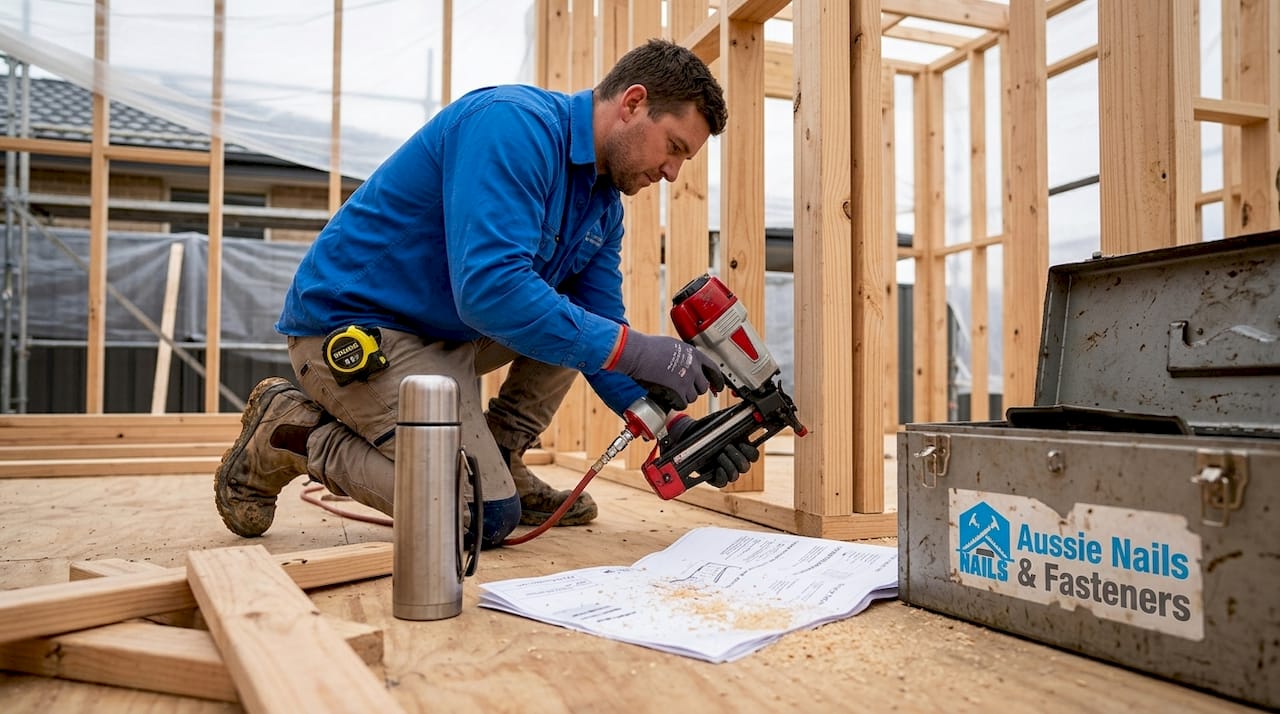
Framing nails are the workhorses of residential construction in Australia. Standard framing nail sizes are 75mm x 3.06mm or 3.15mm for 35mm timber, using two nails per joint, with galvanised versions required for exterior framing. You’ll also find 90mm framing nails used for thicker structural members, and our 90mm framing nails are a popular choice for wall framing and roof trusses. Framing nails come with smooth shanks for easy driving or ring shanks for increased withdrawal resistance.
Bullet head nails feature a small, tapered head that can be punched below the timber surface and filled. They are used in structural panels, decking, and any situation where the nail head needs to be concealed for aesthetic reasons, while still meeting structural requirements.
Galvanised nails are not a separate shape category — they are a coating classification. Hot-dip galvanised nails carry a thicker zinc coating than electro-galvanised varieties and are essential for exterior applications like decking, fencing, and structural cladding.
Panel pins and finishing nails are fine-gauge, small-headed nails used for detailed joinery, architraves, skirting boards, and any visible work where a discreet fastener is required.
| Nail type | Common sizes | Typical use | Shank type |
|---|---|---|---|
| Clout nail | 25mm to 40mm | Sarking, underlay, sheet fixing | Smooth |
| Framing nail | 75mm to 90mm | Wall frames, trusses, joists | Smooth or ring |
| Bullet head nail | 50mm to 75mm | Panels, decking, visible joins | Smooth |
| Galvanised nail | 30mm to 100mm | Exterior framing, decking, fencing | Smooth or ring |
| Panel pin | 15mm to 40mm | Architraves, joinery, trim | Smooth |
| Finishing nail | 40mm to 65mm | Skirting, visible interior work | Smooth |
There are several types of woodworking fastener types that cross over between these categories depending on the application, so it is worth reviewing specific product specs before committing to a large order.
Specialty nails and advanced features
Alongside standard nails, modern builds often demand specialty options. Let’s see which advanced nails offer the extra performance you might need.
Standard smooth-shank nails do a reliable job across a wide range of applications, but there are situations where they simply are not enough. High-wind zones, movement-prone structures, and aggressive corrosion environments all call for specialist fasteners that go beyond the basics.
Here is a numbered breakdown of the key specialty nail types worth knowing:
- Ring shank nails: The annular rings cut into the shank grip the timber fibres mechanically, dramatically increasing withdrawal resistance. These are essential in cyclone-rated construction zones across Northern Australia.
- Spiral shank nails: A helical twist along the shank causes the nail to rotate slightly as it is driven, locking it into the timber. Very effective in dense hardwoods and flooring applications.
- Masonry nails: Hardened steel nails designed to be hand-driven into concrete, brick, or mortar. Useful for lightweight fixings but not a substitute for proprietary anchors in load-bearing situations.
- Collated nails: Nails joined in strips or coils for use in pneumatic nail guns. They dramatically speed up production framing and roofing work, and they maintain consistent nail placement and depth.
- Stainless steel nails: Grade 304 or 316 stainless steel provides the highest level of corrosion resistance available in nail form. Grade 316 is the preferred choice within 300 metres of the coastline.
- Double hot-dip galvanised nails: Nails that have been galvanised twice to produce an extra-thick zinc coating. A cost-effective middle ground between standard galvanised and stainless steel.
Ring and spiral shank nails provide superior holding power compared to smooth shank varieties and are ideal for high-wind zones or movement-prone areas. However, specialty nails must never substitute for structural bolts or anchors in situations where codes require them, per AS/NZS 1252 and AS 5216.
| Nail type | Holding power | Corrosion resistance | Best environment |
|---|---|---|---|
| Smooth shank | Moderate | Depends on coating | Interior, sheltered |
| Ring shank | Very high | Depends on coating | High-wind, structural |
| Spiral shank | High | Depends on coating | Flooring, dense hardwood |
| Stainless steel | High | Excellent | Coastal, marine |
| Hot-dip galvanised | High | Very good | Exterior, decking |
| Masonry nail | Moderate | High (hardened) | Concrete, brick |
Pro Tip: For projects covered under essential fastener types, always check whether your collated nails are compatible with your nailer. Paper-collated and plastic-collated nails are not interchangeable, and using the wrong format can damage your tool and void the warranty.
Comparison of nails: performance and applications
To help you make a confident decision, here’s a direct comparison of nail types based on performance and recommended uses.
When you are pricing up a job and weighing your options, it helps to see nail performance figures side by side rather than hunting through data sheets. This table consolidates the most relevant characteristics for the nail types most commonly used on regulated Australian construction projects.
| Nail type | Withdrawal resistance | Shear resistance | AS 1720.1 compliance | Recommended use |
|---|---|---|---|---|
| Smooth framing nail | Moderate | Good | Yes, with correct penetration | Internal framing |
| Ring shank framing nail | Very high | Good | Yes | High-wind framing, LVL |
| Hot-dip galvanised | Moderate to high | Good | Yes | Exterior framing, decking |
| Stainless steel | High | Good | Yes | Coastal, marine, food-grade |
| Masonry nail | Low to moderate | Moderate | Not for structural use | Non-structural fixings |
| Collated (strip/coil) | Varies by shank | Varies | Yes, if correct spec | Production framing, roofing |
A practical example from the AS 1720.1:2010 standard: the characteristic capacity for a 2.8mm diameter nail in JD4 seasoned timber is 665N per nail. For a typical stud-to-plate connection using two nails, that equates to a design lateral load capacity of around 1.33kN before modification factors are applied. This kind of figure matters enormously on engineer-certified frames.
Key performance considerations for your nail selection:
- Withdrawal load capacity increases significantly with ring or spiral shanks compared to smooth shanks in the same timber species.
- Corrosion-related failures often take years to become visible, by which time structural damage is already well advanced beneath the surface.
- Collated nails used in pneumatic tools must be checked for head diameter and shank specification against the structural design — not all collated nails meet the diameter requirements of the design standard.
- Pre-boring requirements in unseasoned timber can reduce splitting risk but must be sized correctly (typically no larger than 0.9 times the nail diameter) to retain adequate holding power.
For a closer look at how different fastener materials perform under load, the best metal fastening solutions resource covers real-world performance data across a range of structural applications.
What most guides miss about choosing construction nails
Every guide on construction nails covers the basics: nail size, coating, and application type. What most of them skip over is the messy reality of working on actual job sites, where ideal conditions rarely exist and the pressure to move quickly can override careful thinking.
Timber variability is a genuine challenge. Even within the same delivery of structural pine, individual pieces can vary in moisture content, density, and resin content. A nail that sinks cleanly into one stud can split the next if there is a knot or a spike in moisture level. Experienced framers know to adjust their technique and sometimes their nail choice mid-frame, not because the specification was wrong but because the material dictated it.
The temptation to use what’s on hand is real. Leftover nails from a previous job seem like an easy solution when you’re short on supplies and the deadline is pressing. But mixing 3.15mm framing nails with 2.87mm offcuts from another project changes your design capacity calculations. If that frame gets inspected or an engineer certifies it later, you’ve created a compliance headache that takes far longer to resolve than a hardware run would have.
The consequences of substituting nail types go beyond aesthetics. As noted, mechanical nails must never substitute for structural bolts or anchors in situations governed by AS/NZS 1252 or AS 5216. We’ve seen first-hand how well-meaning shortcuts in structural connections can lead to costly rectification work, particularly in bracing frames and hold-down connections where the load paths are tightly engineered.
Our view is straightforward: match the nail to the job, buy enough of the right product before work starts, and keep a copy of the relevant AS 1720.1 connection data on site for any connection that carries significant load. The load-bearing code compliance standards exist for a reason, and they protect both the building and the people responsible for building it.
Quality nails and tools for every Australian build
Ready to get started on your next build? Here’s where to find quality construction nails and the expert advice to match.
At Aussie Nails and Fasteners Warehouse, we stock a broad range of construction nails that meet Australian standards — from hot-dip galvanised framing nails to stainless steel ring shanks and collated coil nails for pneumatic tools. We are Australian-owned, and we understand the specific demands that Australian building conditions place on fasteners.
Our range includes JITOOL, APlus, and Supco products across nail types, pneumatic tools, and complementary essential tools for production and trade use. Whether you need a specific nail size for a regulated structural connection or you’re stocking up for a large framing project, our nail and fastener range has you covered at competitive trade prices. Browse online or get in touch with our team for product advice tailored to your project requirements.
Frequently asked questions
What size nails do I need for framing in Australia?
For standard framing in Australia, 75mm x 3.06mm or 3.15mm nails are the go-to for 35mm timber, with two nails per joint recommended. Longer nails are typically required for thicker hardwood members.
Are galvanised nails mandatory for outdoor construction?
Galvanised or stainless steel nails are strongly recommended for all exterior applications to prevent corrosion. Galvanised nails for exterior use are considered standard practice on Australian job sites, and in corrosive environments, hot-dip galvanised or stainless steel are the minimum acceptable options.
How do Australian standards affect nail selection?
AS 1720.1:2010 compliance is mandatory for all load-bearing timber connections, covering penetration depth, nail diameter, joint group classifications, and spacing requirements. Pre-boring may also be required for unseasoned hardwood to prevent splitting and maintain holding power.
When should I use ring shank nails instead of smooth?
Ring or spiral shank nails are the right choice whenever you need maximum withdrawal resistance, particularly in high-wind construction zones, cyclone-rated builds, or any application where timber movement is likely. They are also preferred for LVL (laminated veneer lumber) connections.
Can I substitute nails for bolts in structural jobs?
No. Mechanical nails must never replace structural bolts or anchors in applications governed by AS/NZS 1252 or AS 5216. Nails and bolts serve fundamentally different structural roles, and any substitution in a regulated connection will likely fail both engineering review and building inspection.
Recommended
- Choosing the right nail types for durable Australian builds – Aussie Nails and Fasteners Warehouse
- Best woodworking fastener types for Australian projects – Aussie Nails and Fasteners Warehouse
- Essential fastener types for Australian construction: 8 key picks – Aussie Nails and Fasteners Warehouse
- Best metal fastening solutions for Australian projects 2026 – Aussie Nails and Fasteners Warehouse