



TL;DR:
- Choosing the correct fastener is essential for timber safety, durability, and compliance with Australian standards.
- Nails, screws, bolts, and wooden fasteners each serve different structural and joinery purposes.
- Australian climate and native hardwoods require specific fastener materials and installation practices for optimal results.
Choosing the wrong fastener can mean a deck that flexes underfoot, a cabinet joint that fails within months, or a framing connection that won’t pass inspection. In Australian woodworking, the stakes are real: our dense native hardwoods, coastal humidity, and strict building codes all shape which fastener belongs where. This guide walks you through the main fastener categories, compares their strengths and weaknesses, and gives you the practical knowledge to make confident choices on your next build. Whether you’re a seasoned tradie or tackling your first major DIY project, understanding fastener types is one of the most valuable skills you can develop.
Table of Contents
- Understanding the main woodworking fastener types
- Nails: Shear strength and framing essentials
- Screws: Superior holding and assembly versatility
- Bolts and dowels: Heavy-duty joinery and emerging wooden options
- Australian compliance: Standards and fastener choice for timber projects
- What most fastener guides overlook: The Australian context
- Find high-quality fasteners for your next project
- Frequently asked questions
Key Takeaways
| Point | Details |
|---|---|
| Know your fastener types | Understanding nails, screws, bolts, dowels and wooden fasteners ensures you select the best option for each project. |
| Match fastener to timber | Always consider timber joint group and density to avoid common assembly mistakes and maximise strength. |
| Prioritise compliance | Use fasteners in line with AS 1720.1 and AS 1684 standards for structural integrity and insurance. |
| Consider sustainability | Wooden fasteners are increasingly viable, offering recyclable options without sacrificing performance. |
Understanding the main woodworking fastener types
Before you can choose the right fastener, you need to know what’s actually available. The main woodworking fastener types include nails, screws, bolts, dowels, and emerging wooden fasteners, each suited to different loads, timber species, and assembly methods.
Here’s a quick breakdown of the primary categories:
- Nails: Driven into timber with a hammer or nail gun, nails are fast to install and excellent for framing and sheathing. They handle shear loads well but offer limited withdrawal resistance.
- Screws: Threaded fasteners that bite into timber fibres for strong withdrawal resistance. Available in coarse and fine thread variants to suit softwoods and hardwoods respectively.
- Bolts: Heavy-duty connectors used where structural loads demand maximum strength. Coach bolts and hex bolts are common in post-and-beam and pergola construction.
- Dowels: Cylindrical wooden or metal pins used for invisible joinery, alignment, and traditional furniture making.
- Wooden fasteners: A growing category of densified timber nails and dowels designed for sustainable, adhesive-free construction.
Understanding the fastener gauge guide is equally important, because diameter directly affects holding power and splitting risk. The right gauge for a 19mm pine board is very different from what you’d choose for 90mm hardwood framing. A solid grasp of fastener types overview gives you the foundation to apply the right tool in every situation, and following proven fastener installation tips ensures you get the most out of whichever type you select.
Nails: Shear strength and framing essentials
Nails are the workhorse of structural timber work. They’re fast, economical, and when chosen correctly, extremely effective. Nails provide shear strength but poor withdrawal resistance, making them ideal for framing where loads act perpendicular to the fastener rather than pulling it straight out. Ring shank and screw shank nails improve hold in both softwoods and hardwoods by increasing friction along the shank.
Key considerations when choosing nails:
- Ring shank nails: Best for flooring, decking, and applications where vibration or movement could loosen a smooth shank nail over time.
- Screw shank nails: Excellent for hardwood framing where the twisted profile grips dense fibres more effectively.
- Diameter matters: A thicker nail resists bending under shear but increases the risk of splitting in dry or fine-grained timber.
- Galvanised coating: Essential for outdoor and coastal projects where moisture and salt air accelerate corrosion.
For general framing, 75mm framing nails are a reliable go-to for standard stud walls and internal structures. For exposed or coastal applications, 90mm galvanised nails offer the extra protection your build needs. The nail vs screw debate often comes down to whether your joint needs to flex slightly under load or remain completely rigid.
When working on load bearing fasteners in structural frames, always confirm your nail schedule matches the engineering drawings. A single substitution can compromise the entire connection.
Pro Tip: In coastal Queensland or Western Australia, standard bright steel nails will rust within a season. Always specify hot-dipped galvanised or stainless steel nails for any outdoor or exposed application, regardless of whether the timber itself is treated.
Screws: Superior holding and assembly versatility
If nails win on speed, screws win on strength and control. Screws offer superior holding strength via their threads, making them ideal for joints that need to resist withdrawal forces. They’re also the preferred choice when you need to disassemble and reassemble a structure, since they can be backed out without damaging surrounding timber.
The main screw types you’ll encounter in Australian woodworking:
- Coarse thread wood screws: Best for softwoods like pine and radiata. The wide thread spacing grips the softer fibres without compressing them excessively.
- Fine thread wood screws: Designed for hardwoods like Spotted Gum, Blackbutt, and Ironbark. Closer threads provide more bite without splitting the dense grain.
- Coach screws: Large hex-head screws for structural timber connections, pergola posts, and heavy-duty brackets. Tightened with a spanner rather than a driver.
- Pocket screws: Used with a jig to create fast, strong butt joints in cabinet making and furniture assembly.
Pre-drilling is non-negotiable in Australian hardwoods. Without a pilot hole, even the best screw will split the timber or snap off before it’s fully seated. Follow proven screw installation tips to get clean, consistent results every time. And if something does go wrong, knowing how to approach screw troubleshooting will save you hours of frustration.
Pro Tip: Stop driving the screw the moment it seats flush. Over-tightening crushes the timber fibres around the head, reducing holding strength and leaving you with a fastener that feels tight but has actually lost its grip.
Bolts and dowels: Heavy-duty joinery and emerging wooden options
When loads get serious, nails and screws step aside for bolts. Bolts for heavy-duty timber connections deliver high tensile strength, and their spacing and end distances must comply with AS 1720.1 to achieve rated capacity. Getting these distances wrong doesn’t just reduce strength; it can cause splitting failures under load.
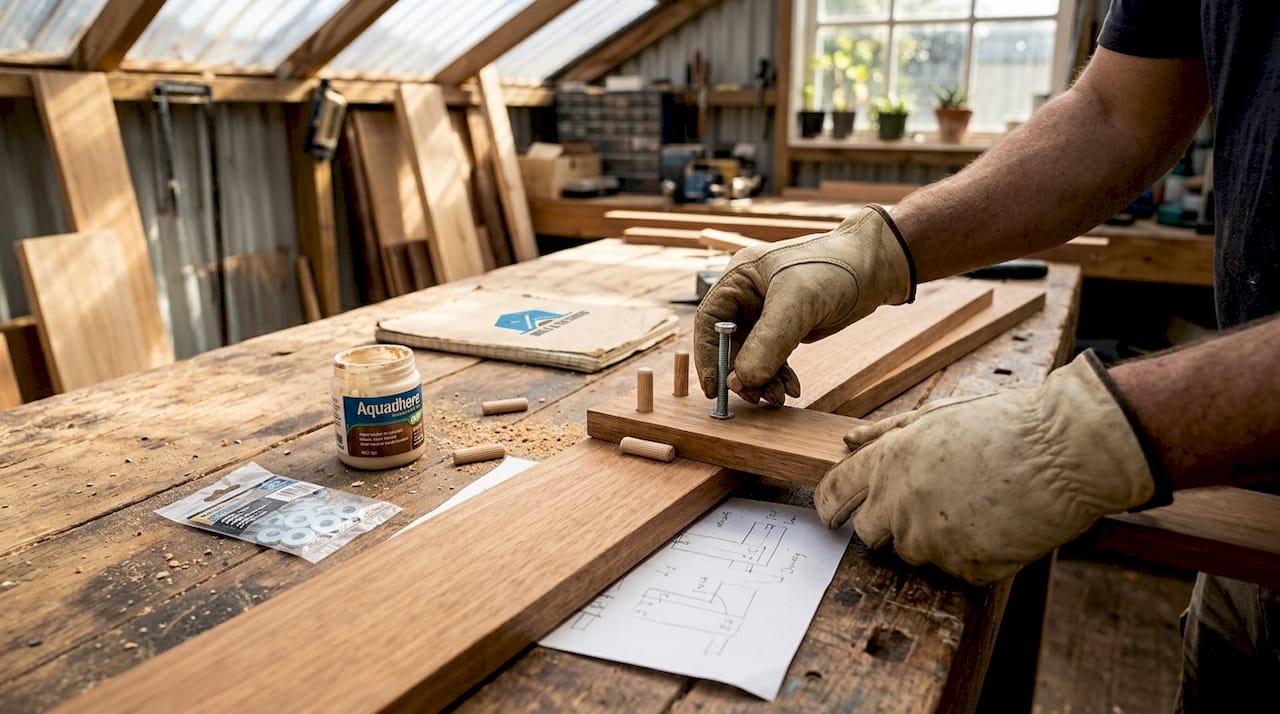
Here’s how bolts and dowels compare in practice:
| Feature | Structural bolts | Wooden dowels |
|---|---|---|
| Strength | Very high tensile and shear | Moderate shear, alignment focused |
| Sustainability | Steel, recyclable | Timber, fully renewable |
| Visibility | Exposed hardware | Completely hidden |
| Best application | Post-and-beam, pergolas, trusses | Furniture, cabinetry, traditional joinery |
| Installation | Requires drilling and hardware | Requires jig or careful marking |
Wooden fasteners are gaining serious attention in sustainable construction. Wooden fasteners rival metal in sustainability and recyclability, though they differ in flexibility and require specific testing rather than relying on Eurocode or NDS values. Wooden fastener research continues to show promising results, particularly for adhesive-free mass timber buildings where minimising embodied carbon is a priority.
For decorative or specialised joining applications, corrugated fasteners offer a unique solution for edge-to-edge timber connections in picture frames, tabletops, and mitre joints.
Australian compliance: Standards and fastener choice for timber projects
Compliance isn’t just paperwork. It’s the difference between a structure that performs safely for decades and one that fails under load or gets flagged during an insurance claim. Australian standards AS 1720.1 and AS 1684 govern structural design for screws, nails, and bolts, and set residential framing spans and fixing requirements respectively.
Key compliance considerations for Australian timber projects:
- AS 1720.1: Covers the structural design of timber connections including nail, screw, and bolt joint capacity calculations.
- AS 1684: Applies to residential timber framing, specifying member sizes, spans, and fastener schedules for wall frames, roof trusses, and floor systems.
- Joint group classification: Timber species are grouped from JD1 (densest, strongest) to JD6 (lightest). The joint group directly affects how many fasteners you need and what spacing is required.
- Fastener placement: Minimum edge and end distances prevent splitting and ensure full load transfer.
| Standard | Scope | Fastener types covered |
|---|---|---|
| AS 1720.1 | Structural timber design | Nails, screws, bolts, connectors |
| AS 1684 | Residential framing | Nails, bolts, framing anchors |
| AS 1684.4 | Framing in cyclonic regions | Cyclone ties, heavy-duty nails |
Always check the Australian fastener standards before specifying fasteners on any structural project. Following installation best practices ensures your connections meet both the letter and the intent of the standard.
Pro Tip: Before choosing a fastener, identify the joint group of your timber species. A JD1 hardwood like Ironbark needs far fewer fasteners to achieve the same capacity as a JD4 softwood like radiata pine. Getting this wrong means either over-engineering (wasting money) or under-engineering (risking failure).
What most fastener guides overlook: The Australian context
Most international fastener guides are written for temperate climates using plantation softwoods. Australia is neither of those things. Our conditions are genuinely different, and that shapes every fastener decision you make.
Salt air in coastal regions accelerates corrosion far faster than most guides acknowledge. A fastener rated for outdoor use in Victoria’s Dandenong Ranges will degrade within years on a Sunshine Coast deck unless it’s hot-dipped galvanised or stainless steel. Similarly, our native hardwoods are among the densest in the world. Treating Spotted Gum like European oak leads to split timber, broken fasteners, and failed joints.
The mistakes we see most often? Skipping pre-drilling in hardwoods, ignoring joint group when calculating fastener schedules, and using bright steel in exposed applications. Each one is avoidable.
There’s also the sustainability angle, which most guides dismiss too quickly. Densified wooden nails outperform standard metal fasteners in shear wall tests when diameter and sheathing are optimised. For mass timber and low-carbon builds, this matters. We think wooden fasteners will move from niche to mainstream within the next decade, and Australian builders who understand them now will have a genuine edge.
Find high-quality fasteners for your next project
Knowing your fastener types is only half the equation. Having access to quality, compliant products is what turns knowledge into results.
At Aussie Nails and Fasteners Warehouse, we stock everything from galvanised corrugated fasteners for furniture and decorative joinery through to heavy-duty framing nails and structural screws for professional builds. If you’re running a pneumatic nailer on site, the pallet coil nailer delivers fast, consistent results across a full range of timber types. We carry JITOOL, APlus, and Supco products trusted by Australian tradies and serious DIYers alike. Browse our full range online and get the right fastener for your next project, delivered to your door.
Frequently asked questions
Which woodworking fastener works best for Australian hardwoods?
Screws with fine threads and pre-drilled pilot holes are best for dense Australian hardwoods like Spotted Gum, as they grip without splitting the grain.
What Australian standards govern structural timber fasteners?
AS 1720.1 covers structural design for screws, nails, and bolts, while AS 1684 sets the residential framing and fixing requirements for wall frames, floors, and roofs.
Are wooden fasteners a good option for sustainable builds?
Yes. Wooden nails rival metal in sustainability and recyclability, and densified wooden nails can match metal shear performance when correctly specified for the application.
What causes thread stripping or fastener failure?
Over-tightening strips threads and crushes timber fibres, while using the wrong diameter for the timber density leads to withdrawal failure, particularly in softer species like pine.
Recommended
- Fastener installation guide: expert tips for Australian projects – Aussie Nails and Fasteners Warehouse
- Load-bearing fasteners guide for Australian construction – Aussie Nails and Fasteners Warehouse
- Understanding fastener gauge: a practical guide for construction – Aussie Nails and Fasteners Warehouse
- CORRUGATED FASTENERS Electro Galvanised 10MM – Aussie Nails and Fasteners Warehouse