



Grab the wrong gauge fastener on a job site and you will know about it fast. Timber splits, fixings pull loose, or your nail gun jams mid-run. These are not minor inconveniences; they cost time, materials, and sometimes the structural integrity of the whole job. Yet gauge is one of the most misunderstood specs in the fastener world, often confused with length or overall size. This guide cuts through that confusion, explains exactly what fastener gauge means, and gives you a practical framework for choosing the right one every time.
Table of Contents
- What does fastener gauge actually mean?
- Common fastener gauges and what they’re used for
- How fastener gauge affects strength, fit, and performance
- Selecting the right gauge for your project
- Australian standards, labelling and buying tips
- Find the right fastener for your next project
- Frequently asked questions
Key Takeaways
| Point | Details |
|---|---|
| Gauge means thickness | Fastener gauge is all about the diameter or thickness, not length. |
| Right gauge equals strong, safe work | Choosing the correct gauge ensures fasteners hold without splitting your material or failing in service. |
| Aussie standards matter | Always check the label and buy to Australian compliance for safe construction and smooth inspections. |
| Tool compatibility is key | Make sure your fastener gauge matches your tool or you risk jams and poor outcomes. |
What does fastener gauge actually mean?
Fastener gauge refers to the diameter or thickness of the fastener shank, not its length. This is where most of the confusion starts. When someone says they need a 75mm nail, they are describing the length. When they say 16 gauge, they are describing how thick that nail is. Both measurements matter, but they describe completely different things.
The gauge system can feel backwards at first. In most gauge scales used for nails and brads, a higher gauge number means a thinner fastener. So an 18G brad nail is thinner than a 16G brad nail. Screws, however, often follow a different convention where a higher gauge number indicates a larger diameter. Knowing which system applies to your fastener type is essential before you order.
“Incorrectly chosen fastener gauges can compromise connection strength and lead to project failure.”
Different trades reference gauge in different ways. Carpenters talk about brad and finish nail gauges. Roofers focus on shank diameter for clout nails. Framers care about the wire gauge of coil nails. A 3.3 gauge industrial coil nailer is built around a specific shank thickness, and feeding it the wrong gauge will cause jams or weak fixings. Understanding detailed fastener basics before you buy saves real money on site.
Common fastener gauges and what they’re used for
Construction standards rely on specified gauge ranges for safe fastening, and for good reason. Each gauge range suits a particular material type, load requirement, and tool. Here is a breakdown of the most common gauges you will encounter on Australian job sites and in DIY projects.
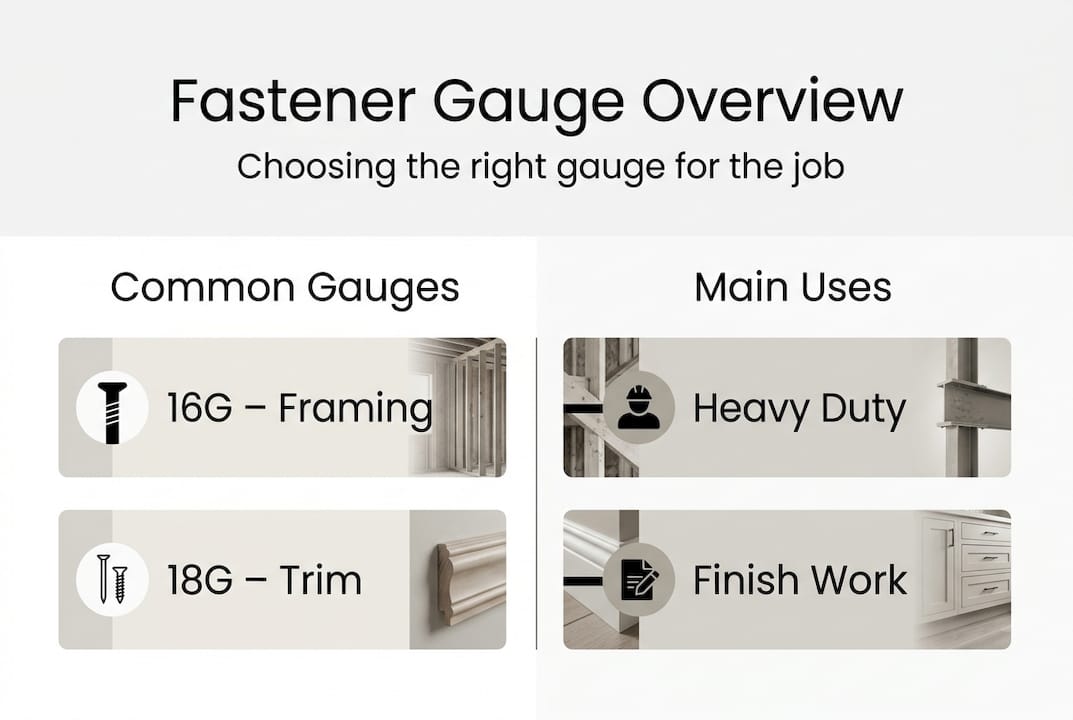
| Gauge | Approx. diameter (mm) | Typical application |
|---|---|---|
| 14G | 3.5 mm | Structural timber, batten screws, heavy fixing |
| 16G | 1.6 mm | Finish nails, door jambs, skirting boards |
| 18G | 1.2 mm | Brad nails, fine trim, light cabinetry |
| 20G | 0.9 mm | Staples, upholstery, light sheet goods |
| 3.3 wire gauge | 3.3 mm | Framing coil nails, structural work |
Here is how those gauges play out in real scenarios:
- 14G screws are the workhorse for structural timber connections. 14G batten screws are a staple on Australian roofing and cladding jobs. For longer runs, 14G x 100mm screws and 14G x 125mm screws give you the penetration depth needed for secure fixing into hardwood battens.
- 16G finish nails are the go-to for interior trim work where you need holding power without a visible head.
- 18G brads are ideal for delicate work like attaching thin mouldings or assembling furniture where splitting is a real risk.
- Staples in the 20G range suit light applications like house wrap, insulation batts, and upholstery.
One important callout: using an undersized gauge on structural connections is one of the most common causes of fastener failure in residential construction. The shank simply does not have enough cross-sectional area to resist shear forces over time, especially in cyclone or high-wind zones across northern Australia.
How fastener gauge affects strength, fit, and performance
Gauge determines both holding power and risk of splitting material, and these two factors pull in opposite directions. A thicker gauge gives you more shear strength and withdrawal resistance. But drive it into dry hardwood without a pilot hole and you will split the timber clean through.

Here is a practical comparison to keep in mind:
| Scenario | Too thin a gauge | Too thick a gauge |
|---|---|---|
| Softwood framing | Weak holding, nail bends | Good strength, low split risk |
| Hardwood decking | Pulls out under load | Splits timber, needs pilot hole |
| Fine trim work | Adequate, low split risk | Splits moulding, visible damage |
| Sheet goods (ply, MDF) | Pulls through face | Tears face veneer |
Tool compatibility is another critical factor. Nail guns and staplers are engineered around a specific gauge range. Feed a 16G nail into an 18G brad nailer and you will jam the tool, potentially damaging the driver blade. Check your tool’s specification plate before loading any new fastener type. This is not just about performance; it is about not wrecking a $400 tool.
For fastener gauge and joint reliability, the relationship between shank diameter and substrate density is what determines long-term performance. Corrugated fasteners are a good example of gauge in action. Corrugated fasteners 10mm suit light joinery, while corrugated fasteners 13mm give you more bite for heavier timber connections.
Pro Tip: Before committing to a full box of fasteners on a big job, drive five or six test fasteners into a scrap piece of the same material. Check for splitting, check the head sits flush, and check the holding feels solid. This two-minute test can save you from a costly mistake across hundreds of fixings.
Selecting the right gauge for your project
Timber type, thickness, and fastener gauge all affect final strength and appearance, so selection is never a one-size-fits-all decision. Here is a step-by-step method that works for both tradespeople and confident DIYers.
- Identify your material. Is it softwood pine, hardwood ironbark, engineered timber, or sheet goods like plywood? Hardwoods need thinner gauges or pilot holes to avoid splitting. Softwoods are more forgiving.
- Define the job type. Is this structural framing, finish work, or light assembly? Structural work demands heavier gauges with proven shear strength. Finish work prioritises a clean result with minimal splitting.
- Check your tool’s gauge range. Look at the spec plate or manual. Match the fastener gauge to what the tool accepts. Do not guess.
- Consider the environment. Outdoor or coastal applications need galvanised or stainless fasteners regardless of gauge. Gauge alone does not protect against corrosion.
- Check penetration depth. The fastener needs to penetrate the receiving material by at least the recommended depth for the gauge. For framing, 75mm framing nails and hot dip galvanised framing nails are standard for 90mm stud work, while 90mm framing nails give extra bite in thicker members.
For mixed-material scenarios, such as fixing timber battens into steel purlins or attaching hardwood to a concrete substrate, the gauge needs to suit the weakest material in the connection. Oversizing for the concrete side can split the timber before the fixing is even complete.
Pro Tip: When working with Australian hardwoods like spotted gum or blackbutt, always pre-drill with a bit that is slightly smaller than the fastener shank diameter. This prevents splitting while still allowing the fastener to grip tightly. It adds a minute per fixing but saves the timber.
Australian standards, labelling and buying tips
Australian construction standards require correct sizing and labelling of fasteners for compliance, and this matters when your work is subject to inspection. Knowing how to read Australian packaging correctly is a practical skill that protects you on site.
Here is what to look for when buying fasteners locally or online:
- Gauge is usually listed first, followed by length. A label reading “18G x 50mm” means 18 gauge, 50mm long. Do not confuse the two numbers.
- Check the wire diameter in millimetres if you are unsure about the gauge number. Reputable Australian suppliers list both the gauge and the actual diameter so you can cross-reference.
- Look for compliance markings on structural fasteners. Products used in load-bearing connections should meet relevant Australian Standards. Ask your supplier for documentation if the job requires it.
- Buy from suppliers who label clearly. Unlabelled bulk fasteners from unknown sources are a compliance risk. If a building inspector asks for the spec and you cannot provide it, that is a problem.
- For online orders, double-check the product description against your tool’s accepted gauge range before adding to cart. A quick check now prevents a return shipment later.
- Electro galvanised framing nails should clearly state the gauge, coating type, and length on the packaging. If any of those three are missing, ask before you buy.
Site safety and inspection readiness both depend on being able to demonstrate that the right fastener was used for the right application. Keeping your packaging or a product record on site is a simple habit that pays off during inspections.
Find the right fastener for your next project
Once you know the gauge you need, sourcing quality supply is straightforward. At Aussie Nails and Fasteners Warehouse, we stock a full range of gauges across nails, screws, brads, and staples, all clearly labelled with gauge, length, and coating type so you can order with confidence.
Whether you need corrugated fasteners 10mm for joinery or heavy-duty framing nails for structural work, our range covers every gauge and application you will encounter on an Australian job site. We also stock the full tools range to match, so you can get the right nailer or stapler alongside your fasteners. All products meet Australian compliance requirements, and our team knows the local standards inside out. Browse online or get in touch and we will help you match gauge to job, every time.
Frequently asked questions
How do I measure fastener gauge if it’s not labelled?
Use a digital calliper to measure the shank diameter, then cross-reference against a gauge conversion chart. Gauge is directly tied to physical diameter, so a precise measurement will give you the correct gauge number.
What’s the difference between 16G and 18G brads?
Brads vary in gauge for different strength and splitting risk profiles. 16G brads are thicker and stronger, suited to fixing trims or door jambs, while 18G brads are finer and better for delicate finish work where splitting is a concern.
Why do I need to match fastener gauge with my nail gun?
Tool compatibility is defined by fastener gauge, and each tool only accepts a set range. Using the wrong gauge causes jams, poor fixing quality, and potential damage to the tool’s driver mechanism.
Do building inspectors check fastener gauge?
Yes, for structural and load-bearing work, inspectors often verify that the correct fastener size and gauge was used. Code compliance includes correct fastener gauge as part of the overall safety assessment.
Can I use a thicker gauge for extra strength?
Thicker gauges do offer more strength, but oversized gauges can split timber or be incompatible with your tool. Always choose for balance between holding power and material compatibility rather than simply going as large as possible.
Recommended
- CORRUGATED FASTENERS Electro Galvanised 13MM – Aussie Nails and Fasteners Warehouse
- CORRUGATED FASTENERS Electro Galvanised 10MM – Aussie Nails and Fasteners Warehouse
- Bugle Batten Screw – 500PB 14G X 75mm Galvanised – Aussie Nails and Fasteners Warehouse
- Bugle Batten Screw – 500PB 14G X 100mm Galvanised – Aussie Nails and Fasteners Warehouse
- Ultimate Guide to Roof Fasteners, why it matters in Vancouver