



TL;DR:
- Mixed fastener packs combine various sizes and types of fasteners for convenience.
- They reduce downtime, clutter, and are ideal for small or ad hoc projects.
- Proper selection and organization of packs save time, money, and ensure project suitability.
You’re halfway through fixing the back deck on a Saturday afternoon, drill in hand, and you reach for a 10g batten screw only to find you’ve run out. Sound familiar? For Australian DIYers and tradies alike, that moment of rummaging through half-empty boxes, driving to the hardware store, and losing an hour of productive work is frustrating beyond measure. A mixed fastener pack solves this problem directly. This guide covers exactly what these packs contain, how to choose the right one, why they’re a smart investment, and the lesser-known pitfalls you’ll want to avoid before you buy.
Table of Contents
- What is a mixed fastener pack?
- Why choose a mixed fastener pack?
- Comparing fastener pack options: features and value
- Choosing the right pack for your project
- Maintaining and storing your fastener packs
- The truth about mixed fastener packs: what most guides miss
- Find your ideal fastener pack with Aussie Nails and Fasteners Warehouse
- Frequently asked questions
Key Takeaways
| Point | Details |
|---|---|
| Mixed packs save time | Having a range of fasteners on hand prevents project delays and keeps work moving smoothly. |
| Choose by project needs | Select packs based on the materials and sizes you most often work with for best results. |
| Organisation is essential | Staying organised with your fastener packs ensures everything is easy to find, safe, and ready to use. |
| Compare before buying | A quick side-by-side check of contents, price, and added tools will help you pick the most value-packed option. |
What is a mixed fastener pack?
A mixed fastener pack is a single packaged collection containing multiple types or sizes of fasteners, bundled together to serve a range of fastening tasks. Rather than buying five separate boxes of screws, nails, and bolts, you get a curated selection in one container. That’s the core idea, and it’s a genuinely practical one.
Most mixed packs include a combination of the following:
- Wood screws in multiple lengths (commonly 30mm, 50mm, and 75mm)
- Self-tapping screws for metal sheeting and light steel frames
- Hex bolts and nuts for structural joins and bracketed connections
- Flat-head nails for general timber work and framing
- Cup-head bolts for coach bolts used in pergolas or decking
- Wall plugs and anchors for masonry and concrete fixing
- Washers in standard sizes to distribute load across soft materials
Use cases range widely. A first-home buyer putting together flat-pack furniture, a carpenter repairing a weatherboard fence, or a builder fitting out a shed will all reach into a mixed pack and find something useful. Mixed fastener packs are designed for convenience and to suit a range of project needs, which is exactly why they’ve become a staple item in Australian workshops and utes alike.
Pro Tip: Before opening a new mixed pack, scan the contents list on the packaging against your current project’s fastener requirements. This quick check tells you whether the pack will cover you fully or whether you need to supplement with one or two specific items.
The variety within a good pack reflects the reality of modern construction and home improvement tasks, where no two jobs demand the same fastener. Understanding what’s included is the first step to knowing whether a mixed pack is the right call for you.
Why choose a mixed fastener pack?
Understanding what’s in a mixed pack leads to a key question: what advantages do these packs offer compared to buying individual fasteners? The answer comes down to time, convenience, and practicality across different job types.
Here are the four standout reasons tradespeople and DIYers choose mixed packs:
-
Less downtime mid-job. When you’re anchoring a pergola to a brick wall and need a masonry plug you didn’t plan for, a mixed pack often has you covered. A well-chosen mix means less downtime and a tidier workspace for tradies and DIYers. This is especially true on residential renovation jobs where the scope keeps shifting.
-
Ideal starter toolkit. For someone setting up their first workshop or trade toolbox, a mixed pack offers immediate coverage across many fastening scenarios without needing to research each type individually. You get a working baseline from day one.
-
Reduced on-site clutter. Carrying six separate boxes of fasteners means six lids to lose, six containers taking up tray space in the ute, and six opportunities to spill and scatter. A well-organised mixed pack reduces that to one labelled container.
-
Smarter for small or ad hoc jobs. If you only need a handful of bolts for a one-off task, buying a bulk box of 200 makes no economic sense. A mixed pack often gives you a usable quantity at a lower spend per project.
“The right fastener selection upfront turns a two-hour job into a 45-minute job. Mixed packs are one of the simplest ways to keep the right options on hand without overthinking it.” — Experienced site foreman, Queensland residential construction
Knowing when to lean on a mixed pack versus buying individual lines also depends on the job type. For guidance on when to use nails versus screws specifically, it’s worth reviewing advice on choosing screws or nails based on application, load, and material. Getting that decision right early saves rework later.
Comparing fastener pack options: features and value
To choose the right pack, it helps to see how leading options stack up in terms of features and value for money. Not all mixed packs are equal, and understanding what separates a good pack from a basic one makes a real difference when you’re spending your own money.
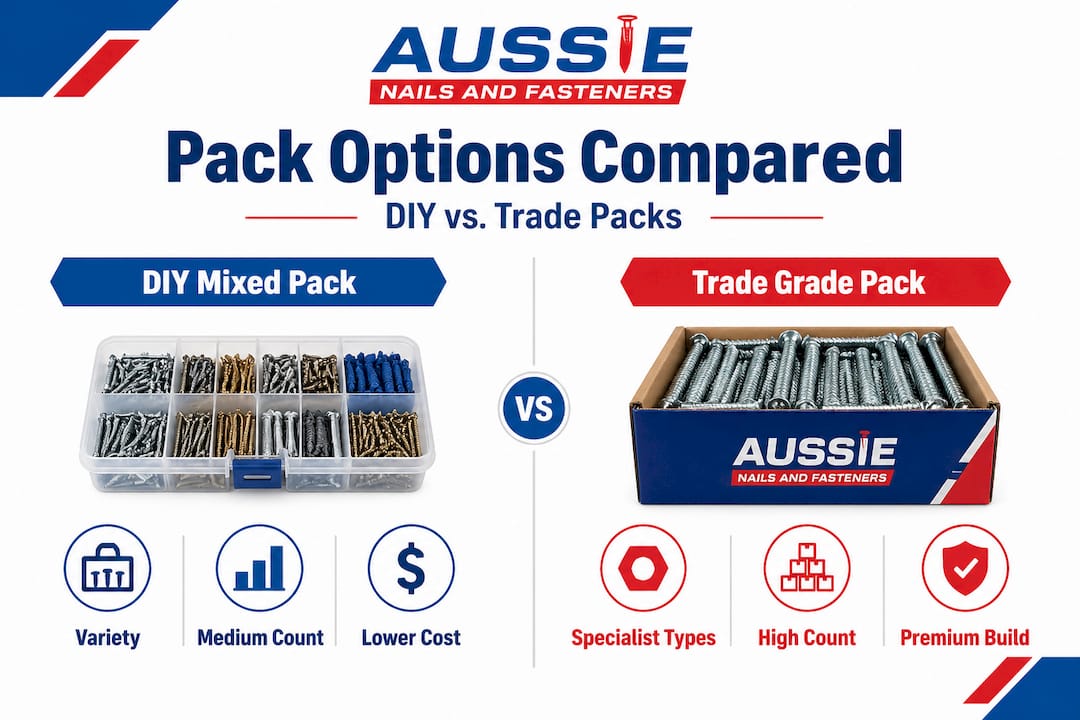
Here’s a comparison of common pack types available in the Australian market:
| Pack type | Typical contents | Best for | Approx. piece count | Price range |
|---|---|---|---|---|
| General DIY mixed pack | Wood screws, nails, wall plugs, washers | Home maintenance, flat-pack assembly | 100 to 200 pieces | $12 to $25 |
| Trade-grade mixed pack | Batten screws, hex bolts, self-tappers, anchors | Construction, framing, structural joins | 200 to 500 pieces | $30 to $65 |
| Specialty timber pack | Decking screws, coach screws, cup-heads | Decking, pergolas, fencing | 100 to 300 pieces | $20 to $50 |
| Masonry and metal pack | Masonry anchors, self-drilling screws, toggle bolts | Concrete, steel framing, commercial fit-out | 80 to 150 pieces | $25 to $55 |
| Combo pack with driver bits | Mixed screws, nails, and assorted driver heads | DIY enthusiasts wanting all-in-one | 150 to 300 pieces | $35 to $70 |
Comparing pack features helps match the right option to your project and budget. It’s a step many buyers skip in favour of grabbing whatever is on the shelf, only to find the pack doesn’t include the right size or material grade for the job.
Key factors that influence pack price and versatility include:
- Material quality: Zinc-plated, stainless steel, and galvanised fasteners all carry different price points but suit different environments. Coastal or high-humidity areas in Queensland or the Northern Territory demand corrosion-resistant grades.
- Brand reputation: Established brands offering heavy-duty fastener options tend to maintain tighter tolerances and better coating consistency.
- Included accessories: Packs that bundle in driver bits or hex keys, similar to what you’d find with mixed bit accessories, add immediate usability without the need for additional purchases.
- Container design: A pack with a well-labelled, reusable compartment tray is worth more in the long run than one in a flimsy plastic bag that splits open on first use.
Buying the cheapest pack often leads to poor outcomes, but the most expensive option isn’t always necessary either. Match the pack spec to your actual project requirements.
Choosing the right pack for your project
With an overview of the options, let’s make it actionable. Here’s a straightforward process for narrowing down the right pack for your situation:
-
Identify your materials. Are you working with timber, metal, masonry, or a mix? Timber projects like decking and framing need coarse-thread screws and structural bolts. Metal work demands self-tapping or self-drilling fasteners. Masonry needs anchors and plugs rated for the substrate. Match your fastener choices to material, load, and environment for the best results.
-
Estimate your volume. Are you fixing one fence paling or framing an entire addition? Small repairs need fewer pieces. Larger structural jobs warrant a trade-grade pack with higher quantities and larger fastener sizes.
-
Check load requirements. A mixed pack for outdoor structures, like a pergola or carport, needs to include fasteners rated for structural loads. Refer to fastener load recommendations before settling on a pack that might only be suitable for light-duty interior work.
-
Consider the environment. Outdoor or exposed locations, particularly in coastal areas, require galvanised or stainless fasteners to resist salt and moisture. A standard zinc-plated screw will rust through within 12 to 18 months in these conditions.
-
Decide: specialist or general? For a single-material project, a specialist pack (decking, masonry, metal) often gives better value per piece than a general mixed selection. For multi-material or ongoing work, general mixed packs provide better overall coverage.
Pro Tip: Choose packs that include spare compartment trays or resealable containers. Leftover fasteners can be sorted by size and stored neatly, reducing the number of loose items cluttering your workshop. This aligns with a well-organised home improvement workflow that saves time on every job that follows.
If your work involves power tool access, it’s also worth considering packs or accessories that include adapter accessories to switch between driver formats quickly on site without needing multiple tools.
Maintaining and storing your fastener packs
Once you’ve got your packs, proper upkeep makes all the difference. Proper organisation and storage of your fastener packs saves you money and time long-term, and it’s one of those habits that separates experienced tradies from those who constantly lose time searching for the right piece.
Here are the key practices to follow:
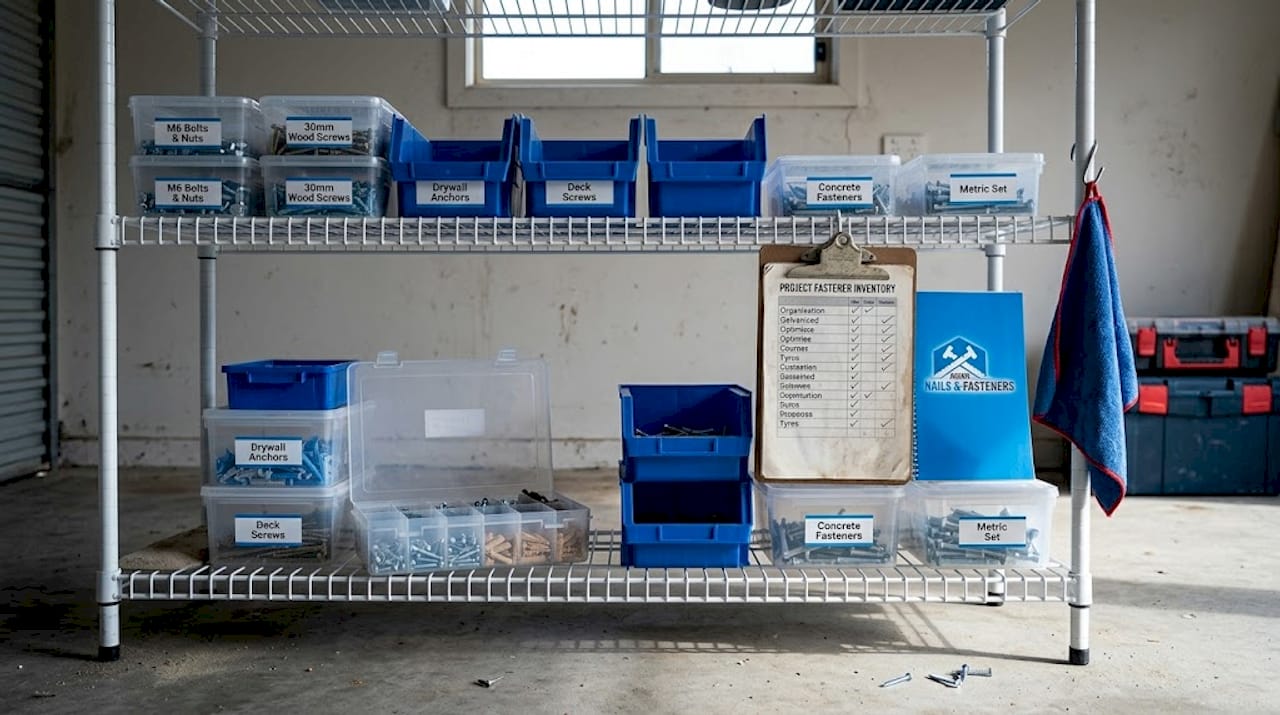
- Sort by type and size immediately. When you open a new pack, resist the urge to tip it all into a single drawer. Separate screws from nails, bolts from plugs, and group by size within each type. Ten minutes upfront saves twenty later.
- Use labelled containers. Recycled jars, compartment trays, and labelled ziplock bags all work well. Clear labels stating the size and type (e.g., “8g x 50mm wood screws”) mean you find what you need at a glance.
- Keep moisture out. Humidity is the enemy of any non-stainless fastener. Store packs in a dry environment, ideally in a sealed container with a small silica gel sachet to absorb residual moisture. A rust-free fastener grips better and holds longer.
- Inspect before use. Before using fasteners from an older pack, check for rust, thread damage, or corrosion. A degraded fastener can strip mid-installation, leaving you with a damaged surface and a broken screw head to extract. Neither outcome is fun.
- Reuse quality containers. A well-designed compartment tray can be refilled and reused across many projects. Check fastener storage tips to build a system that works with your workspace, whether that’s a mobile ute tray or a stationary workshop shelf.
Good storage habits aren’t just about tidiness. They directly affect how long your fasteners last, how quickly you can complete jobs, and how much you spend over time replacing degraded stock.
The truth about mixed fastener packs: what most guides miss
Here’s the part most buying guides gloss over entirely. Mixed fastener packs are excellent tools, but experienced tradies don’t rely on them for everything, and that’s an important distinction worth making honestly.
When you’re on a job that calls for 300 identical Tek screws, a mixed pack is the wrong tool entirely. Reaching into a general mixed pack and using a slightly wrong self-tapper because it’s what you have is exactly how fastener failures happen. Convenience should never override specification.
We’ve seen this on commercial sites where builders reach for something close rather than the correct grade or length, and that habit creates structural problems that only show up months later during an inspection or under load. The project-specific fastener solutions needed for those jobs should come from a dedicated bulk box, not a general mixed pack.
That said, the quality of mixed packs has improved significantly in recent years. Suppliers now offer curated packs built around specific project types, with better material grades and more thoughtful size selections. The era of a mixed pack meaning “random leftovers in a plastic tub” is mostly over in the premium segment.
The honest rule of thumb is this: use a mixed pack when variety is your primary need, and buy bulk single-type boxes when volume and precision are what the job demands. Knowing the difference is what separates a well-stocked workshop from a frustrating one.
Find your ideal fastener pack with Aussie Nails and Fasteners Warehouse
At Aussie Nails and Fasteners Warehouse, we’ve built our range specifically for Australian conditions, Australian projects, and the real demands of both professionals and weekend warriors.
Whether you need a general-purpose DIY selection or a high-spec trade-grade pack for structural work, our range covers it. Browse our full selection of assorted screws to find the right fastener for timber, metal, or masonry applications. Explore our all tools collection for pneumatic nailers, driver accessories, and more. As a proud Australian-owned supplier stocking JITOOL, APlus, and Supco products, we deliver quality you can count on across every fastener type and project size. Visit our full product range and find everything you need in one place.
Frequently asked questions
What types of fasteners are usually in a mixed pack?
Most packs include a variety of screws, nails, bolts, and sometimes wall plugs, catering to a broad range of DIY and trade jobs. Mixed packs typically feature multiple fastener types to give you immediate coverage across common project scenarios.
Are mixed fastener packs suitable for all materials?
Some packs target timber, while others include fasteners for metal or masonry, so always check the pack details for material compatibility. Material-specific fasteners are included in certain packs, making it important to match the pack spec to your actual substrate before buying.
How do I organise my mixed fastener pack for easy use?
Sort contents by type and size, use labelled containers, and keep the pack sealed to prevent rust or loss. Proper organisation helps with fastener longevity and accessibility, reducing the time you spend searching mid-job.
What is the main benefit of buying a mixed pack over single-type boxes?
The main advantage is versatility. You’ll have the right fastener at hand for many different jobs, reducing downtime. Mixed packs provide greater flexibility for multiple projects, making them an especially smart choice for home renovation, repairs, and general trade preparedness.
Recommended
- Master the workflow for home improvement fasteners – Aussie Nails and Fasteners Warehouse
- Top construction fastening tips for secure, lasting builds – Aussie Nails and Fasteners Warehouse
- Trade-grade fasteners: 5 essential qualities explained – Aussie Nails and Fasteners Warehouse
- Best woodworking fastener types for Australian projects – Aussie Nails and Fasteners Warehouse