



TL;DR:
- Fastener failures often result from overlooked standards, poor selection, or incorrect installation.
- Proper identification of materials, loads, and matching fasteners to standards is essential for durability.
- Correct installation techniques and corrosion protection are crucial for long-term structural performance.
Fastener failures are one of the most frustrating and costly problems in construction, whether you’re framing a deck or bolting structural steel. A single wrong choice, whether it’s the wrong grade, the wrong coating, or a rushed installation, can undo hours of quality work and create serious safety risks. Australian standards exist precisely to prevent these failures, yet they’re still overlooked on job sites every day. This article walks you through the practical, standards-backed fastening tips that experienced tradies and savvy DIYers rely on to get it right the first time, every time.
Table of Contents
- Understand fastener standards and why they matter
- Select the right fastener for your material and load
- Master installation: techniques for strength and reliability
- Prevent corrosion and long-term degradation
- Why ‘near enough’ just isn’t good enough in fastening
- Find quality fasteners and tools for your next job
- Frequently asked questions
Key Takeaways
| Point | Details |
|---|---|
| Follow Australian standards | Always specify fasteners that comply with relevant AS/NZS standards for safety and compliance. |
| Match fastener to material | Select the right fastener type and strength for each construction material and load requirement. |
| Install for reliability | Proper surface prep and tensioning are vital to prevent fastener failure. |
| Protect from corrosion | Use coatings and materials suited to your climate to maximise fastener life. |
Understand fastener standards and why they matter
Every reliable fastening job starts with knowing which standards apply and why they were written in the first place. Australian and New Zealand standards aren’t bureaucratic red tape. They’re the distilled result of real-world failures, engineering research, and decades of on-site experience. Ignoring them doesn’t save time. It creates liability.
The Australian fastener standards that matter most on construction sites include:
- AS/NZS 1252 covers high-strength structural bolting assemblies, specifying bolt, nut, and washer requirements for load-bearing connections
- AS 3566 sets requirements for self-drilling and self-tapping screws used in roofing, cladding, and light steel framing
- AS/NZS 4291 defines the mechanical properties of fasteners including tensile strength and hardness
- AS 5216 applies to post-installed fastenings in concrete, such as anchors and chemical fixings used in slabs and walls
- AS/NZS 2312 addresses corrosion protection coatings and their suitability for different exposure environments
These five standards cover the vast majority of construction fastening scenarios. Knowing which one applies to your job is the first step toward a connection that holds.
Why does compliance matter beyond ticking a box? Because substitutions and shortcuts are where failures begin. As one industry resource notes, specifying full assemblies (bolt, nut, and washer) to the correct standards is critical, and you should avoid substitutions without verification, as quality varies widely in the market.
“Specifying full assemblies to standards and avoiding substitutions without verification is non-negotiable. Quality varies widely, and the consequences of getting it wrong are severe.”
For a broader overview of what goes into each connection type, the guide to essential fastener types for Australian construction is a solid starting point. If you want to go deeper on what separates compliant from substandard products, the article on professional fastener standards explains the quality markers to look for.
Pro Tip: Always check the packaging or supplier documentation for the relevant standard mark before purchasing. If a product doesn’t clearly state compliance, ask for a test certificate or choose a supplier who can provide one.
Select the right fastener for your material and load
Once you understand the standards landscape, the next challenge is matching the right fastener to the job. Material type and load requirements are the two variables that matter most, and getting either one wrong is a recipe for early failure.
Here’s a straightforward process for making the right selection:
- Identify your substrate (timber, steel, concrete, or composite)
- Determine the load type (shear, tension, or combined)
- Check the relevant standard for that substrate and load combination
- Select the fastener grade and coating appropriate for the environment
- Verify the full assembly (bolt, nut, washer) meets the same standard
This process sounds simple, but bolted connection failures in steel roof trusses have been traced directly to undersized or undergraded bolts, non-compliance with AS/NZS 1252 and AS/NZS 5131, improper tensioning, and poor faying surface preparation. These aren’t exotic failure modes. They’re common mistakes that happen when selection is rushed.
| Material | Common fastener | Better choice for structural use |
|---|---|---|
| Timber framing | Standard wood screw | Structural LVL screw (AS 3566 rated) |
| Steel to steel | Grade 4.6 bolt | Grade 8.8 bolt (AS/NZS 1252 compliant) |
| Concrete anchor | Mechanical anchor | Chemical anchor (AS 5216 tested) |
| Light steel framing | Self-drilling screw | Hex head self-driller with corrosion coating |
For projects where loads are significant, the guide to choosing load-bearing fasteners provides detailed selection criteria. For the heaviest structural applications, the resource on heavy duty fasteners covers grades, sizes, and installation requirements in depth.
Pro Tip: Never mix grades or manufacturers within the same structural joint. A Grade 8.8 bolt paired with a Grade 4.6 nut creates an unbalanced assembly that can fail at loads well below what either component could handle individually.
Master installation: techniques for strength and reliability
Selecting the right fastener is only half the battle. How you install it determines whether that connection performs as designed or fails under load. Installation errors are just as common as selection errors, and often harder to spot.
Key steps for a reliable installation:
- Clean and prepare surfaces by removing mill scale, rust, paint, and moisture from faying surfaces before bolting
- Use the correct hole size as oversized holes reduce bearing capacity and allow movement under load
- Apply torque in stages rather than tightening to full load in a single turn, especially for multi-bolt patterns
- Inspect after tensioning by checking that bolt heads are flush, nuts are fully engaged, and washers are correctly positioned
- Mark completed bolts with a paint pen or marker so re-inspection is straightforward
The data below gives a practical reference for common structural fasteners:
| Fastener | Diameter | Proof load (kN) | Typical torque (Nm) |
|---|---|---|---|
| Grade 8.8 bolt | M12 | 47.5 | 85 |
| Grade 8.8 bolt | M16 | 88.5 | 210 |
| Grade 8.8 bolt | M20 | 137 | 420 |
| Self-drilling screw | 12g | N/A | 4 to 6 |
For more context on why installation technique matters as much as product choice, the installation failure reports from structural steelwork sites make sobering reading. Improper tensioning alone accounts for a significant proportion of connection failures, even when the correct fastener was specified.
Not all failures are visible after installation. Undertensioned bolts can look perfectly fine on the surface while allowing micro-movement that gradually loosens the connection. Routine inspection is not optional on structural work.
For more on keeping connections performing over time, the fastener durability guide covers inspection intervals and maintenance. If you’re working through unfamiliar specifications, the fastener terminology resource helps decode the language on data sheets and standards documents.
Pro Tip: Always use a calibrated torque wrench for structural bolts. A standard ratchet spanner gives no feedback on actual tension, and overtightening is just as damaging as undertightening.
Prevent corrosion and long-term degradation
A fastener that’s perfectly specified and installed can still fail years early if it’s not protected from the environment. In Australia, the corrosion challenge is real. Coastal salt spray, tropical humidity, acid sulfate soils, and chemical exposure from treated timber all attack unprotected metal fasteners.
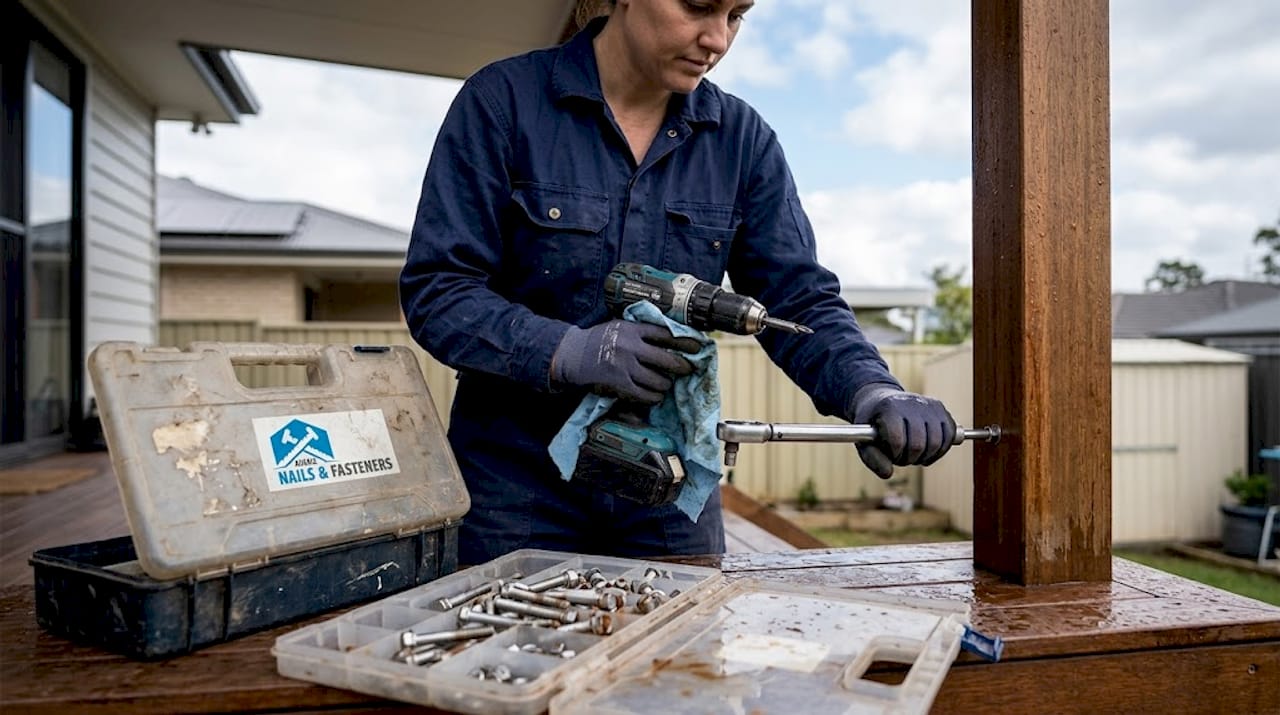
The corrosion protection standards under AS/NZS 2312 classify environments by corrosivity category and specify the minimum coating or material required for each. Matching your fastener coating to the actual site conditions is one of the highest-value decisions you can make.
Common environmental threats and the coatings that address them:
- Coastal and marine environments require hot-dip galvanised (HDG) or stainless steel (Grade 316) fasteners as a minimum
- Treated pine and hardwood contact demands Type 17 stainless or HDG to resist chemical attack from preservative treatments
- Acid sulfate soils found in low-lying coastal areas need stainless steel or heavily coated fasteners to avoid accelerated pitting
- Industrial and chemical exposure sites benefit from duplex coatings (zinc plus paint system) for extended service life
- Interior dry environments are the least demanding, where standard zinc-plated fasteners perform adequately
For a practical breakdown of which coatings suit which Australian project types, the guide to metal fastening solutions covers material selection in detail.
“Corrosion protection is just as vital as strength for outdoor and structural jobs. A fastener that rusts through in five years is a failure, regardless of how well it was installed.”
One often-overlooked mistake is using standard zinc-plated screws in contact with treated pine. The copper compounds in modern timber treatments are highly corrosive to zinc coatings, causing premature failure that can compromise decks, pergolas, and framing within a few years.
Why ‘near enough’ just isn’t good enough in fastening
After years of supplying tradies and builders across Australia, we’ve seen a pattern that plays out on sites of every size. Someone grabs a slightly shorter bolt, a different grade screw, or a budget fastener from an unknown supplier, reasoning that it’s “close enough” and the job will be fine. Most of the time, nothing obvious happens immediately. That’s the problem.
Fastener compromises rarely fail on day one. They fail under load, under weather, or under time. A deck that looked solid at handover starts pulling away from the house in year three. A roof truss connection that was “near enough” becomes a warranty claim after the first serious storm. These are real scenarios, not edge cases.
The experienced builders we work with have all learned this lesson, usually the hard way. They now treat fastener selection as non-negotiable, not a place to claw back a few dollars. The trade-grade fastener qualities that separate reliable products from cheap substitutes are worth understanding before you buy, not after a failure.
Following the standard by the book isn’t about being rigid. It’s about building things that last and protecting your reputation.
Find quality fasteners and tools for your next job
Ready to put these fastening tips into practice? Sourcing from a reputable supplier is the step that ties everything together. Knowing the right standard and technique means nothing if the product in your hand doesn’t meet spec.
At Aussie Nails and Fasteners Warehouse, we stock a curated range of fasteners and tools built for Australian conditions and compliance requirements. Browse our full selection of screws for Australian construction, from structural timber screws to self-drilling options for steel framing. Our construction tools range includes everything you need to install fasteners correctly the first time. Every product we carry is backed by our commitment to quality, so you can build with confidence on every job.
Frequently asked questions
What are the main Australian standards for construction fasteners?
The main standards are AS/NZS 1252 for high-strength structural bolts, AS 3566 for self-tapping screws, AS 5216 for post-installed concrete fastenings, and AS/NZS 2312 for corrosion protection coatings.
How do I prevent bolt failure in my projects?
Use bolts that meet the correct grade and standard, apply manufacturer-specified torque with a calibrated wrench, and ensure faying surfaces are clean and properly prepared before assembly.
What is the best way to protect fasteners from corrosion in Australia?
Match your fastener coating to the site’s corrosivity category and verify AS/NZS 2312 compliance for corrosion protection, paying particular attention to coastal, treated timber, and acid soil environments.
Is it safe to substitute one fastener brand for another?
Only if the substitute fully matches the grade, standard, and assembly requirements, since quality varies widely across the market and non-compliant substitutions are a leading cause of connection failures.
Recommended
- Essential fastener types for Australian construction: 8 key picks – Aussie Nails and Fasteners Warehouse
- Fastener installation guide: expert tips for Australian projects – Aussie Nails and Fasteners Warehouse
- Understand fastener durability: Build stronger Australian projects – Aussie Nails and Fasteners Warehouse
- Master the workflow for home improvement fasteners – Aussie Nails and Fasteners Warehouse