



TL;DR:
- Trade-grade fasteners meet Australian standards and have verified mechanical properties and certifications.
- Certification documents, mill certificates, and batch traceability confirm fastener compliance and quality.
- Using non-certified fasteners risks structural failure, inspection issues, and legal liabilities.
Not all fasteners are created equal, and on a building site, that gap in quality can be the difference between a structure that stands for decades and one that fails inspection. Many builders and DIYers assume that a bolt is a bolt, or that any screw from the hardware shelf will do the job. That assumption is costly. In Australia, trade-grade fasteners carry specific mechanical properties, dimensional tolerances, and certification requirements that general-purpose hardware simply does not meet. This guide breaks down exactly what trade-grade means, how certification works, and how to choose the right fastener for every project, whether you’re a seasoned tradie or tackling your first structural renovation.
Table of Contents
- What does ‘trade-grade’ mean for fasteners?
- How trade-grade fasteners are certified in Australia
- Trade-grade versus standard fasteners: What sets them apart?
- Selecting the right trade-grade fastener for your project
- A perspective you won’t get from the packaging
- Get trade-grade fasteners and expert advice
- Frequently asked questions
Key Takeaways
| Point | Details |
|---|---|
| Standards are essential | Only fasteners meeting AS/NZS standards can be truly considered trade-grade in Australia. |
| Certification means safety | Trade-grade fasteners require verifiable documentation for compliance and reliable performance. |
| Don’t risk structural failure | Using non-trade-grade fasteners may compromise safety and breach building codes. |
| Choose for your project | Select fasteners by load, environment, and type to ensure the right trade-grade product every time. |
What does ‘trade-grade’ mean for fasteners?
Many don’t realise there are crucial differences between what you buy at a hardware chain and what’s specified on site. The term ‘trade-grade’ is not just marketing language for something that looks heavier or feels more solid in your hand. It refers to a defined set of performance and compliance requirements that fasteners must meet before they’re considered suitable for construction use in Australia.
At its core, trade-grade means the fastener has been manufactured to meet recognised Australian and New Zealand standards. These include AS/NZS 1252, which covers high-strength bolts for structural steel, and AS/NZS 5216, which relates to anchor systems. Fastener quality and standards go well beyond surface appearance. A trade-grade fastener must demonstrate consistent mechanical properties, including yield strength (the load at which the fastener begins to deform permanently) and proof load (the maximum load it can handle without permanent stretch).
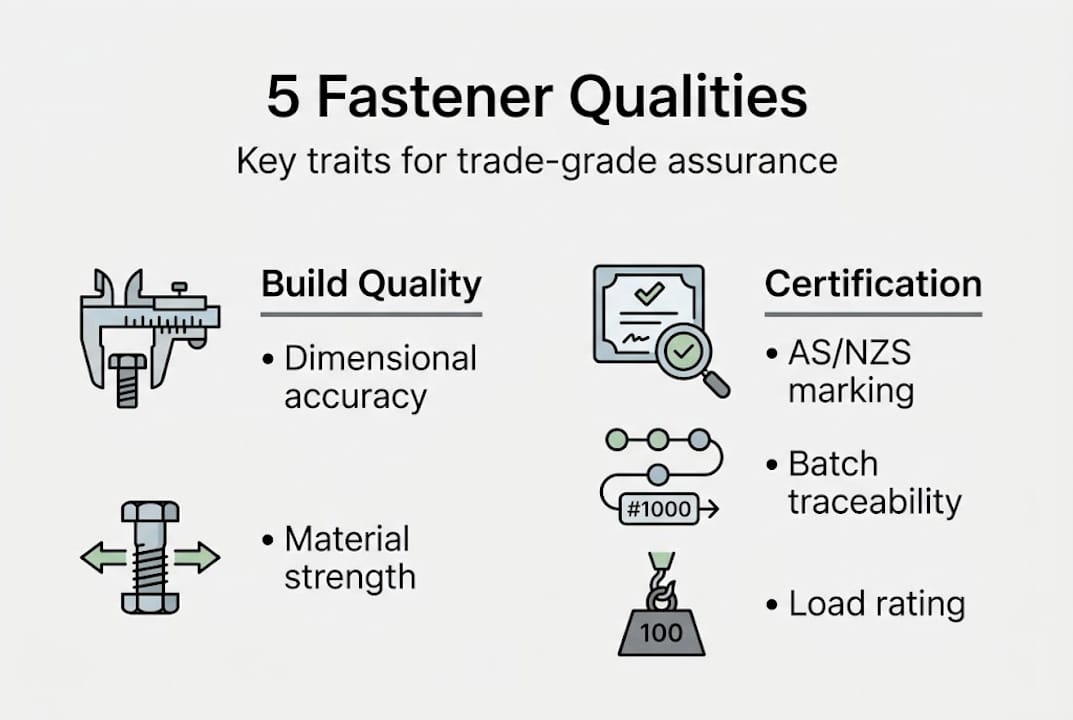
Dimensional accuracy is equally important. A bolt that is even slightly oversized or undersized can create dangerous play in a structural joint, reduce clamping force, or strip threads under load. Trade-grade fasteners are manufactured within tighter tolerances than general-purpose equivalents, meaning every unit in a batch performs predictably.
As AS/NZS standards require, trade-grade fasteners must comply with defined tolerances, mechanical properties, and fit-for-purpose criteria. This is not optional on compliant building projects. It is a baseline requirement.
Here is a summary of essential trade-grade attributes:
- Standards compliance: Manufactured and tested against AS/NZS specifications
- Certification: Backed by mill certificates and third-party test results
- Dimensional accuracy: Consistent sizing within defined tolerances
- Mechanical properties: Verified yield strength, tensile strength, and proof load
- Traceability: Batch numbers that link each fastener to its production and test records
- Coating integrity: Corrosion protection verified to relevant standards for the intended environment
When these attributes are present, you have a fastener you can trust under load, in an inspection, and over the life of the structure.
How trade-grade fasteners are certified in Australia
Now that you know what defines trade-grade, let’s look at how you can identify and verify these fasteners for your own projects.
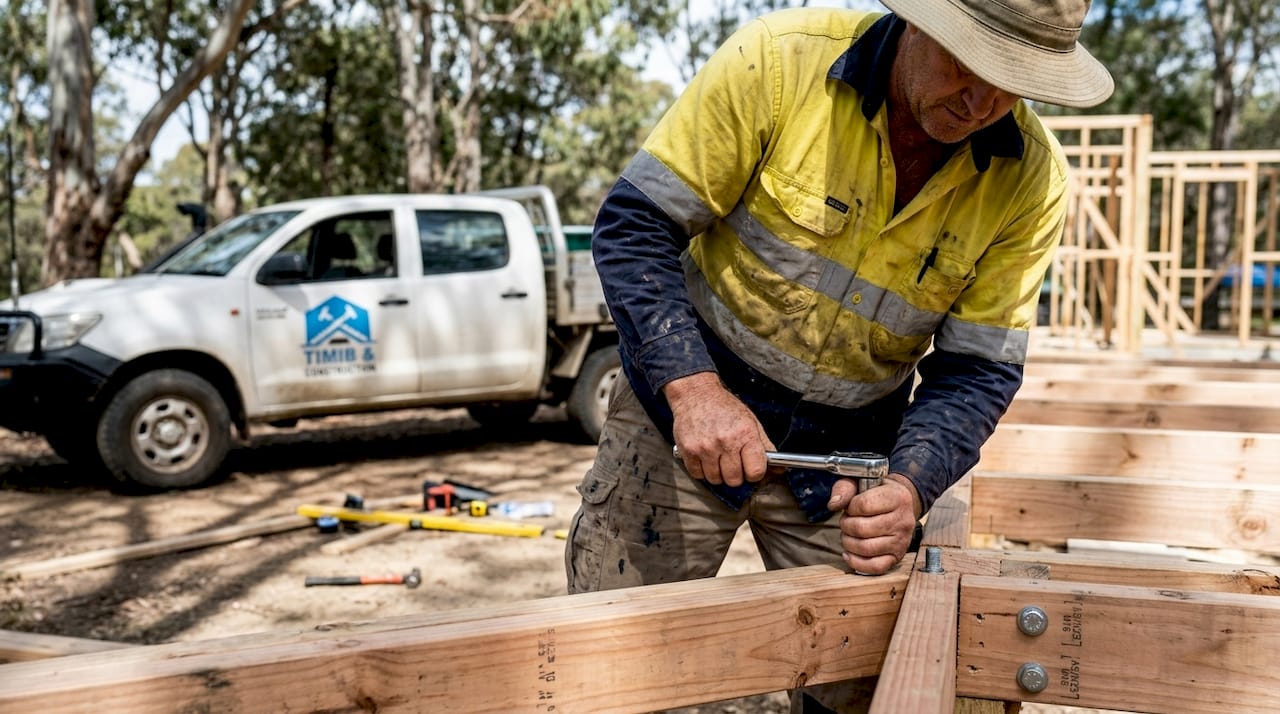
Certification is the process that turns a manufacturer’s claim into a verifiable fact. For trade-grade fasteners in Australia, this process starts at the mill. Every compliant batch should come with a mill certificate, a document that records the chemical composition, mechanical test results, and dimensional checks for that specific production run. Without this document, you have no way to confirm what you’re actually installing.
Beyond the mill certificate, look for batch numbers stamped or labelled on the packaging. These numbers allow full traceability, meaning if a fastener is ever questioned during a building inspection or audit, you can trace it back to its exact production batch and test results. Certifications and testing provide this traceability and compliance for safety-critical building projects, and they are increasingly expected on both large commercial builds and smaller residential jobs.
For structural anchors, look for a European Technical Assessment (ETA) or equivalent Australian approval. This confirms the anchor has been independently tested and approved for specific load conditions and base materials.
Traceable paperwork is not bureaucratic overhead. It is the only way to prove, after the fact, that a fastener met the standard required for the job. On a building site, that documentation can be the difference between a passed inspection and a costly rework.
Here is a numbered checklist for confirming a batch is trade-grade before use:
- Request the mill certificate from your supplier before ordering
- Confirm the certificate references the relevant AS/NZS standard
- Check that batch numbers on packaging match the certificate
- Verify mechanical test results (yield strength, tensile strength) are within spec
- Confirm coating or finish is rated for your project’s environment
- Check that the supplier can provide documentation for audits if required
Pro Tip: Always ask your supplier for the mill certificate and batch traceability records before the fasteners arrive on site. Reputable suppliers will have these ready. If a supplier hesitates or cannot provide them, that tells you everything you need to know about the product’s quality.
For essential fastener types used in Australian construction, and for guidance on load-bearing fasteners, proper certification is non-negotiable.
Trade-grade versus standard fasteners: What sets them apart?
You’ve seen the paperwork and standards; next, let’s break down the real day-to-day differences between trade-grade and generic fasteners.
The performance gap between trade-grade and standard fasteners is not always visible to the naked eye, which is exactly what makes substituting them so dangerous. Consider a residential deck connection using non-certified bolts. Under dynamic load, such as a group of people jumping or a heavy piece of furniture shifting, a bolt with lower yield strength or inconsistent dimensions can stretch, loosen, or shear without warning.
Tighter tolerances and verified mechanical properties ensure reliability under load, and this is what separates a trade-grade fastener from a generic one. Understanding fastener gauge is one piece of the puzzle, but grade and certification complete the picture.
| Feature | Trade-grade fastener | Standard fastener |
|---|---|---|
| Standards compliance | AS/NZS certified | Not tested to standard |
| Dimensional tolerance | Tight, verified | Variable |
| Mechanical properties | Tested, documented | Unverified |
| Documentation | Mill cert, batch number | None typically provided |
| Structural suitability | Yes, for load-bearing use | Not recommended |
| Cost per unit | Moderate to higher | Lower |
| Long-term reliability | High | Unpredictable |
The cost difference per unit is real, but it is small compared to the cost of a failed inspection, structural rework, or, in the worst case, a safety incident. [Fastener durability](https://nailsfasteners.com.au/blogs/news/fastener durability guide australian projects) over the life of a project is always the better investment.
Always use trade-grade fasteners in these situations:
- Structural steel connections where bolts carry shear or tension loads
- Timber framing in load-bearing walls, floors, and roofs
- Masonry anchoring for brackets, handrails, and structural supports
- Any project requiring a building permit or inspection
- High-corrosion environments such as coastal or industrial sites
- Commercial or multi-residential construction of any scale
Selecting the right trade-grade fastener for your project
Knowing what sets trade-grade apart, the next step is choosing the right fastener for your specific project needs.
The right trade-grade fastener depends on four key questions. First, what load will it carry? Shear loads, tension loads, and combined loads each require different fastener grades and configurations. Second, what is the environment? Coastal sites, chemical exposure, and high-humidity areas demand corrosion-resistant coatings such as hot-dip galvanising or stainless steel. Third, what materials are being joined? Timber, masonry, and steel each have specific fastener requirements. Fourth, what does the code require? Check your engineer’s specification or the relevant Australian Standard before selecting.
Preload and yield strength per AS/NZS standards help ensure fastener suitability for Australian structural joints, and these values should always be confirmed against your project’s design loads.
The table below maps common project types to recommended trade-grade fastener categories:
| Project type | Material | Recommended fastener type |
|---|---|---|
| Timber framing | Structural timber | Joist hanger nails, structural screws (AS/NZS rated) |
| Deck construction | Hardwood or treated pine | Stainless steel or hot-dip galvanised bolts |
| Steel connections | Structural steel | AS/NZS 1252 high-strength bolts |
| Masonry anchoring | Concrete or brick | ETA-approved chemical or mechanical anchors |
| Cladding and roofing | Sheet metal | Self-drilling screws with corrosion-rated coating |
For a structured fastener selection workflow, start with the load and environment, then confirm the standard, then check the documentation. For [metal fastening solutions](https://nailsfasteners.com.au/blogs/news/best metal fastening solutions australian projects) and [woodworking fastener types](https://nailsfasteners.com.au/blogs/news/woodworking fastener types australian projects), the same principle applies: match the fastener to the application, and verify the grade before installation.
Pro Tip: Never mix grades within a structural connection. Using a single non-compliant fastener in a bolt group can redistribute load unevenly across the remaining fasteners, increasing failure risk across the entire joint.
Always check the grade marking on the fastener head or shank before installation. Trade-grade bolts carry grade markings such as 8.8 or 10.9 stamped directly onto the head. If there is no marking, do not use it in a structural application.
A perspective you won’t get from the packaging
Beyond the technical specs, experience on site tells the truest story. We’ve seen the consequences when trade-grade requirements are ignored, and they are never small problems. A failed inspection on a structural connection means pulling out fasteners, reordering certified stock, and rescheduling trades. That cost dwarfs any saving made by buying uncertified bolts.
The uncomfortable truth is that cheaper fasteners are only cheaper until something goes wrong. Experienced builders know this. They ask for paperwork not because they enjoy admin, but because that documentation protects them legally, professionally, and financially.
For DIYers, the same logic applies. A deck that passes inspection today and holds safely for twenty years is worth far more than one that saves you thirty dollars at the hardware store. Following [expert fastener installation tips](https://nailsfasteners.com.au/blogs/news/fastener installation guide expert tips australian) and using certified products is the only approach that makes sense when safety is on the line. Your reputation, and your project’s integrity, depend on it.
Get trade-grade fasteners and expert advice
If you’re ready to guarantee your project’s reliability and compliance, start with the right fasteners.
At Aussie Nails and Fasteners Warehouse, we stock a curated range of trade-grade screws and structural fasteners to suit both professional and DIY applications. Our team understands Australian standards and can help you confirm the right product for your specific job. We also carry a full selection of quality tools to support accurate, compliant installation. Whether you need certified bolts for a structural steel connection or corrosion-rated fixings for a coastal deck, you’ll find what you need when you browse all fasteners on our site. Reach out to our team for advice on compliant fastener solutions for any project.
Frequently asked questions
How can I quickly spot if a fastener is not trade-grade?
Check for AS/NZS grade markings on the fastener head and ask your supplier for mill certificates and batch numbers. Absence of these is a clear red flag, as certifications and mill certificates are the baseline for traceability and compliance.
Do all structural applications in Australia require trade-grade fasteners?
Yes, building codes and engineering specifications require AS/NZS-compliant fasteners for any safety-critical or load-bearing connection, regardless of project size.
Is using non-certified fasteners legal if the inspector doesn’t check?
No. Compliance is required by law regardless of whether an inspector physically checks every fastener. Using uncertified fasteners exposes you to legal liability and can void your insurance, as traceability and compliance are required for all safety-critical projects.
Can I get trade-grade fasteners for DIY home projects?
Absolutely. Trade-grade fasteners are available for DIY applications and provide the reliability and peace of mind that general-purpose hardware simply cannot match on structural or safety-relevant home improvement jobs.
Recommended
- What makes a professional fastener: quality, standards, and selection – Aussie Nails and Fasteners Warehouse
- Understand fastener durability: Build stronger Australian projects – Aussie Nails and Fasteners Warehouse
- Essential fastener types for Australian construction: 8 key picks – Aussie Nails and Fasteners Warehouse
- How to troubleshoot fastening issues: 5 practical steps – Aussie Nails and Fasteners Warehouse