



TL;DR:
- Choosing fasteners requires understanding material grades, standards, and application demands to ensure safety and performance.
- Australian Standards compliance and proper property class markings are essential for verifying fastener quality.
- Investing in professional-grade fasteners prevents costly failures, delays, and maintains structural integrity.
Grab a handful of bolts from two different suppliers and they might look identical. Same size, same thread, same shiny finish. But one could be rated for structural loads and the other could fail under the same conditions. Most construction professionals assume fasteners are interchangeable commodities, but this assumption costs projects money, delays, and in serious cases, safety. Choosing the right fastener is not just about picking the correct size. It is about understanding material grades, Australian Standards compliance, and the specific demands of your application. This guide gives you the practical knowledge to make that call confidently every time.
Table of Contents
- Understanding the role of fasteners in construction
- Australian Standards: The non-negotiable benchmark
- Critical features of a professional fastener
- How to select the right fastener for each application
- Why professional fasteners are worth every cent: A hard-earned lesson
- Trusted fastener solutions for Australian pros
- Frequently asked questions
Key Takeaways
| Point | Details |
|---|---|
| Standards matter | Fasteners must meet Australian Standards to be considered professional and safe for construction work. |
| Verify features | Look for class markings, coating type, and certified documentation before installing any fastener. |
| Match to application | Choose the right fastener type and grade by considering load, material, and exposure conditions. |
| Documentation protects you | Always request proof of standards compliance to avoid costly remediation. |
| Professional grade pays off | Using compliant fasteners reduces long-term risks and supports your reputation on site. |
Understanding the role of fasteners in construction
Fasteners are not just connectors. They are structural elements that transfer load between components, resist movement, and hold assemblies together under real-world forces. A bolt in a timber frame is not just keeping two pieces of wood touching. It is actively managing tension, shear, and sometimes seismic forces depending on your build location. That is a fundamentally different job from what a generic hardware store bolt is designed to do.
Professional fasteners ensure structural performance and safety across the life of a building. This is not marketing language. It reflects the engineering reality that a fastener’s grade, material, and coating must match the forces and environment it will face. A coastal residential build, for example, demands corrosion-resistant coatings that a standard zinc-plated bolt simply cannot provide over time.
The structural roles fasteners play include:
- Load transfer: Moving forces from one structural member to another without deformation or slip
- Seismic resistance: Maintaining connection integrity during ground movement, which is critical in earthquake-prone zones across Australia
- Weatherproofing: Sealing penetrations in roofing and cladding to prevent moisture ingress
- Tension holding: Keeping pre-stressed connections tight under dynamic loads like wind and vibration
- Shear resistance: Preventing lateral movement between joined components
When a non-compliant or generic fastener is used in any of these roles, the consequences are not always immediate. Corrosion can develop quietly over months. A connection under-rated for shear might hold for years before a high-wind event exposes the weakness. By then, the cost of remediation far exceeds what the correct fastener would have cost. Understanding load-bearing fasteners and their specific requirements is the first step toward making better decisions on site.
Pro Tip: When specifying fasteners for structural applications, always request the manufacturer’s test data and property class documentation. If a supplier cannot provide it, that tells you everything you need to know about the product’s quality.
For metal-to-metal connections in particular, the grade and surface treatment of a fastener directly affects joint longevity. Explore metal fastening solutions suited to Australian conditions to avoid costly replacements down the track.
Australian Standards: The non-negotiable benchmark
Not every fastener on a shelf is equal, and some may not comply with the standards required for professional construction work in Australia. This is where AS/NZS standards become your most important reference point.
Compliance with AS/NZS 1252, 4291, and 1214 ensures professional-grade performance and safety across structural, mechanical, and corrosion-resistance requirements. These standards define everything from thread tolerances and tensile strength to coating thickness and testing methods.
Here is a quick reference to the key standards and what they cover:
| Standard | Application | Key requirement |
|---|---|---|
| AS/NZS 1252 | High-strength structural bolts | Proof load, tensile strength, nut compatibility |
| AS/NZS 4291 | Property class bolts (metric) | Mechanical properties by class (e.g., 8.8, 10.9) |
| AS/NZS 1110/1111 | ISO metric bolts and screws | Dimensional tolerances, thread form |
| AS/NZS 1214 | Hot-dip galvanised coatings | Coating mass, adhesion, corrosion resistance |
Property class 8.8 bolts, for instance, must deliver at least 800 MPa tensile strength. That is not a guideline. It is a minimum threshold that determines whether the bolt can perform safely in its intended role. Using a bolt that looks similar but lacks this certification is a gamble with the structure’s integrity.
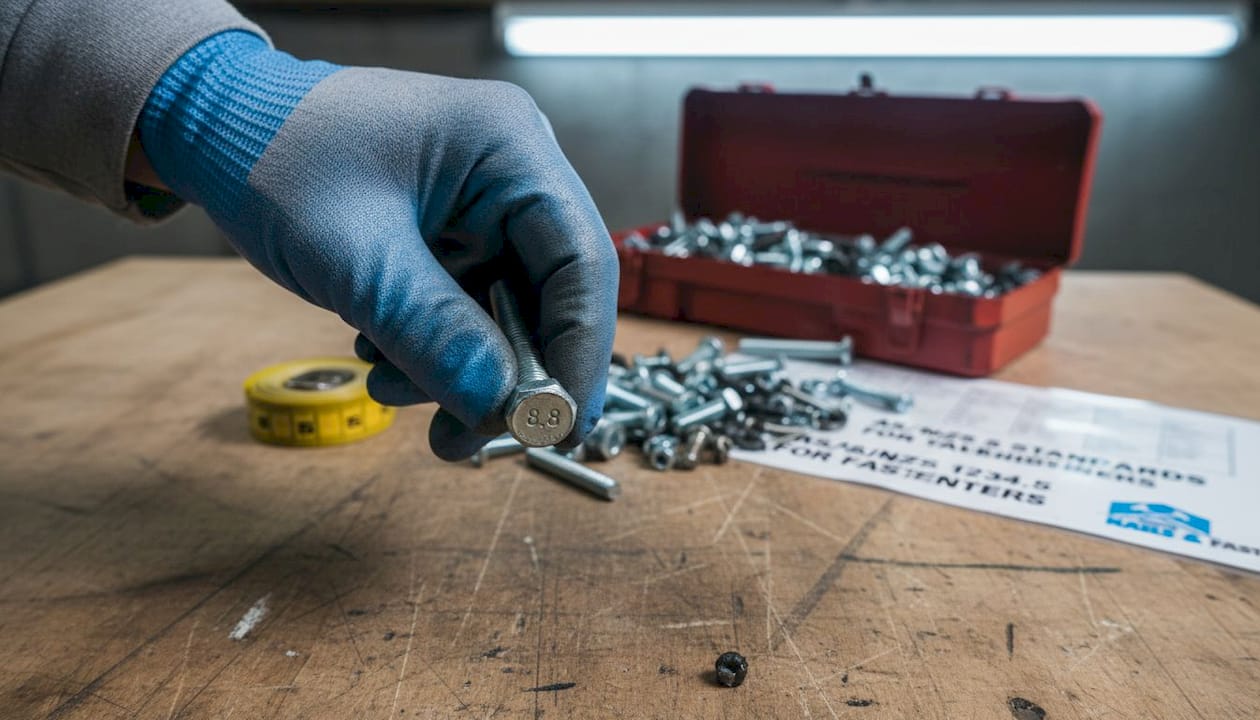
Reading certification markings is straightforward once you know what to look for. The property class number is stamped on the bolt head. The manufacturer’s identification mark should also appear. If either is missing, treat the fastener as unverified and do not use it in structural applications.
“A fastener without visible class markings and traceable documentation is not a professional fastener, regardless of how it looks.”
For guidance on applying this knowledge during installation, refer to these fastener installation tips that cover torque requirements, inspection checks, and documentation best practice.
Critical features of a professional fastener
Standards set the minimum. But what separates a truly professional fastener from one that just scrapes compliance? The answer lies in the specific features you can verify before a single screw is driven.
Property class 4.6, 8.8, and 10.9 are specified in AS/NZS standards for professional use, and each class carries different mechanical expectations. Class 4.6 suits general-purpose connections. Class 8.8 is the go-to for structural steel. Class 10.9 is reserved for high-load applications where failure is not an option.
| Feature | Professional fastener | Generic fastener |
|---|---|---|
| Property class marking | Stamped on head | Often absent |
| Tensile strength | Tested and certified | Unknown or unverified |
| Thread quality | Precision-formed to tolerance | Variable, may strip under load |
| Coating | Compliant with AS/NZS 1214 | May not meet corrosion standards |
| Documentation | Full certification supplied | Rarely available |
Here is how to confirm a fastener’s credentials on site:
- Check the head marking. The property class number and manufacturer’s symbol must be clearly stamped. No marking means no traceability.
- Review the documentation. Ask for the test certificate or compliance declaration. Match the lot number on the packaging to the certificate.
- Inspect thread form. Run a nut along the thread by hand. It should move smoothly without binding or wobbling. Rough threads indicate poor manufacturing tolerances.
- Verify the coating. Hot-dip galvanised coatings have a distinctive rough, matte appearance. Electroplated coatings are smoother and thinner. Know which your application requires.
- Match to the specification. Cross-reference the fastener’s class, length, and diameter against the engineer’s specification or relevant standard before installation.
For timber applications, the selection process has its own nuances. Understanding woodworking fasteners and how gauge affects holding power is essential for framing and joinery work. Similarly, the fastener gauge guide provides practical reference for matching gauge to material thickness.
How to select the right fastener for each application
Applying your knowledge of standards and features, here is how to choose the right fastener each time without guesswork.
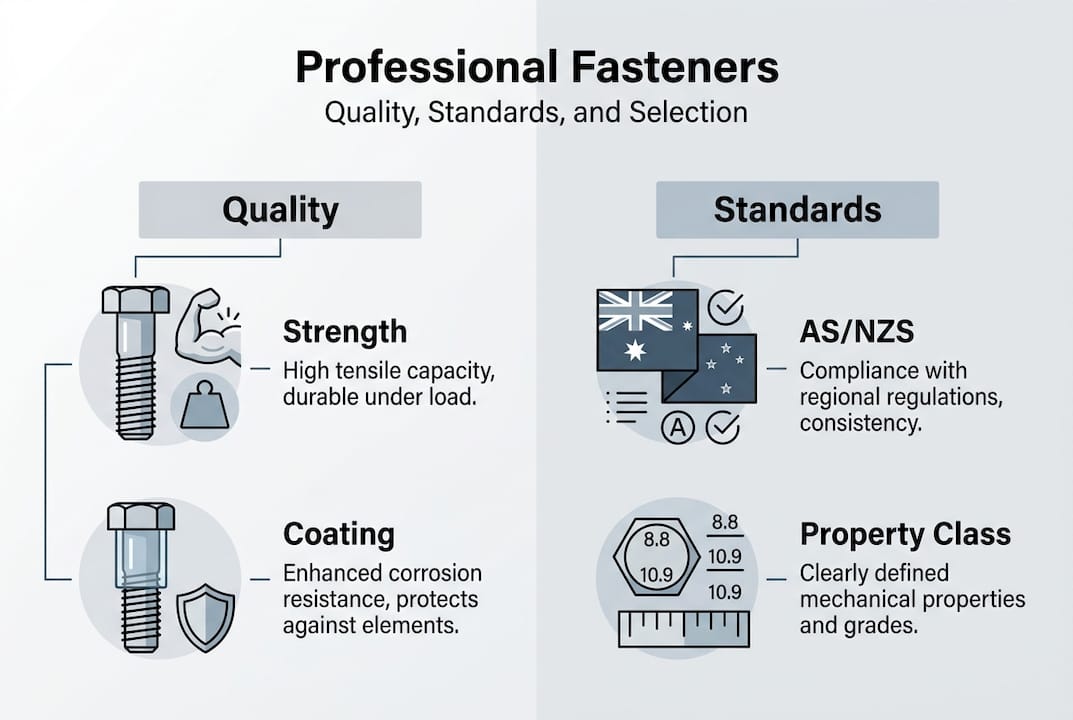
Selecting the proper bolt property class for structural applications, such as 8.8 for structural steel connections, maximises both safety and long-term performance. The selection process starts with understanding the load type, the environment, and the materials being joined.
Here is a practical reference for common Australian construction scenarios:
- Structural steel connections: Class 8.8 bolts to AS/NZS 1252, hot-dip galvanised for exposed locations
- Timber framing: Stainless steel or galvanised nails and screws rated for the timber treatment class (e.g., H3 or H4 treated pine)
- Roofing and cladding: Self-drilling screws with EPDM washers and corrosion-resistant coatings for weathertight performance
- Coastal or marine environments: Grade 316 stainless steel fasteners to resist chloride-induced corrosion
- Concrete anchoring: Expansion bolts or chemical anchors rated for the base material and load, with engineer sign-off for structural applications
The most common mistakes on site involve mixing property classes within the same connection, over-tightening bolts beyond their proof load, and using indoor-rated fasteners in exposed or wet areas. Over-tightening is particularly damaging because it can stretch the bolt beyond its yield point, permanently reducing its clamping force.
Pro Tip: When in doubt about fastener selection for a critical connection, consult a structural engineer before proceeding. The cost of that conversation is trivial compared to the cost of a failed connection or a non-compliant build.
If you encounter problems after installation, such as loosening connections, corrosion staining, or stripped threads, a structured approach to fastening troubleshooting will help you identify the root cause and resolve it efficiently.
Why professional fasteners are worth every cent: A hard-earned lesson
Here is the uncomfortable truth that experienced contractors know but rarely say out loud: the cheapest fastener on the quote is rarely the cheapest fastener on the job.
We have seen projects where non-compliant bolts were used to save a few dollars per connection. The savings looked good on paper right up until the inspection, the rework, or worse, the failure. Remediation costs on a structural connection can run to thousands of dollars once you factor in labour, access, and delays. The original saving evaporates instantly.
Beyond the financial argument, there is a reputational one. In Australia’s construction industry, your name is attached to every building you work on. Using compliant, traceable fasteners is not just about passing inspection. It is about being able to stand behind your work years later without anxiety.
The workflow for home improvement fasteners shows that even on smaller residential jobs, the discipline of choosing correctly pays dividends. Professional fasteners have become the baseline expectation for serious contractors across Australia, not an optional upgrade. Treat them that way from the start.
Trusted fastener solutions for Australian pros
Armed with the knowledge of what makes a fastener professional, sourcing the right gear should be straightforward.
At Aussie Nails and Fasteners Warehouse, we stock AS/NZS-compliant fasteners and professional tools built for the demands of Australian construction. Whether you need corrugated fasteners 13mm for joinery work, a full range of professional tools for pneumatic and fastening applications, or a broad screws range covering structural, roofing, and timber applications, we have it in stock and ready to ship. We carry trusted JITOOL, APlus, and Supco products, and our team understands what compliance means on a real job site. Order in bulk or by the box. We make it easy to get the right fastener to the right job without the runaround.
Frequently asked questions
What do the property classes 4.6, 8.8, and 10.9 mean on a fastener?
These numbers indicate the fastener’s mechanical strength. Property class 8.8 means a minimum tensile strength of 800 MPa and a yield strength of 640 MPa, as defined in AS/NZS 4291. Higher numbers mean greater strength.
How can I check if a fastener is AS/NZS compliant?
Look for property class markings stamped on the bolt head, request the manufacturer’s test certificate, and match the grade and coating details to the relevant AS/NZS standards for your application.
Why should I avoid generic or unmarked fasteners?
Unmarked fasteners have no traceable certification, meaning their tensile strength, coating quality, and thread tolerances are unknown. Using them in structural applications creates safety risks, potential code non-compliance, and costly remediation.
What are the minimum documentation requirements for a professional fastener in Australia?
You should receive a compliance certificate referencing the relevant AS/NZS standard, confirmation of property class, and details of the coating type and specification. Lot traceability is also expected for structural applications.
Recommended
- Understanding fastener gauge: a practical guide for construction – Aussie Nails and Fasteners Warehouse
- Load-bearing fasteners guide for Australian construction – Aussie Nails and Fasteners Warehouse
- Master the workflow for home improvement fasteners – Aussie Nails and Fasteners Warehouse
- Best woodworking fastener types for Australian projects – Aussie Nails and Fasteners Warehouse