



TL;DR:
- Nails are suited for load-bearing, structural timber applications due to their flexibility and high strength.
- Staples are ideal for fastening thin, flexible materials like insulation or fabric because they are faster to install.
- Choosing the correct fastener depends on material type, environmental conditions, and whether rework is necessary.
Grab a nail gun and a staple gun side by side, and they look like they solve the same problem. Many builders, carpenters, and weekend DIYers treat nails and staples as interchangeable, reaching for whichever tool is closest. That habit costs time, money, and occasionally a structurally compromised job. The truth is that nails and staples behave very differently under load, across different materials, and in varying Australian conditions. This guide breaks down exactly what separates them, when each performs best, and how to make the right call on your next project.
Table of Contents
- What are nails and staples in construction?
- Core performance differences: Strength, speed and suitability
- Choosing the right fastener for every task
- Common mistakes and expert tips for fastener success
- Why there’s no one-size-fits-all: Our take on nails and staples
- Get the right fasteners and tools for your next build
- Frequently asked questions
Key Takeaways
| Point | Details |
|---|---|
| Nails suit structural jobs | Nails allow timber movement and hold best where long-term structural strength is required. |
| Staples excel on surface jobs | Staples deliver speed and holding power for thin, flexible, or layered materials but are not for load-bearing. |
| Choose by application | Selecting the right fastener depends on the specific material, load, and finish required for the project. |
| Expert testing pays off | Testing and adapting fasteners for each unique job yields better, longer-lasting results. |
What are nails and staples in construction?
Let’s get the fundamentals right before comparing performance. These two fasteners look different, behave differently, and are engineered to solve different problems.
A nail is a cylindrical metal shaft, usually steel, with a sharp point at one end and a flat head at the other. You drive it straight down into the material, and the shaft grips through friction and compression. Nails come in dozens of variations designed for different nail types and purposes, from framing nails for structural timber work to finishing nails for trim that needs a barely visible head.
A staple is a U-shaped metal fastener. It has two pointed legs and a flat crown that bridges across the top. When driven, both legs penetrate the material simultaneously while the crown presses down across the surface. The crown is the key difference because it spreads holding force across a wider area. As noted in woodworking communities, staples hold thin materials better for thin, layered, or flexible applications like fabric, insulation, or non-structural cladding precisely because that crown distributes force rather than concentrating it at a single point.
Here’s where each fastener typically shows up in Australian construction and DIY:
Nails are commonly used for:
- Structural timber framing and wall frames
- Roof battens and rafters
- Decking and flooring boards
- Fence construction
- Concrete formwork
- General carpentry and trim work
Staples are commonly used for:
- Upholstery and fabric applications
- Sarking, foil insulation, and vapour barriers
- Mesh and shade cloth installation
- Lightweight cladding and non-structural sheeting
- Cable and conduit securing
- Packaging and display work
Both fasteners are available in stainless steel, galvanised, and bright-finish versions. Galvanised and stainless options matter enormously in coastal or high-humidity Australian environments where corrosion can cause fastener failure long before the material itself gives out. You can read more about using staples in construction to understand the full range of applications and sizing conventions.
Core performance differences: Strength, speed and suitability
With clear definitions in mind, here’s how nails and staples actually perform on site.
| Feature | Nails | Staples |
|---|---|---|
| Holding strength | High, especially in shear and withdrawal | Moderate, strong in surface grip |
| Installation speed | Fast with nail gun, moderate by hand | Very fast, even faster than nails |
| Flexibility under load | Ductile, bends before pulling out | Rigid, may pull out under tension |
| Best for | Structural, load-bearing, timber framing | Fabric, insulation, thin sheeting, mesh |
| Removal and rework | Harder to remove cleanly | Generally easier to remove |
| Material suitability | Hardwood, softwood, LVL, engineered timber | Sarking, foil, upholstery, netting |
| Visible finish | Can be countersunk and filled | Crown often visible or felt on surface |
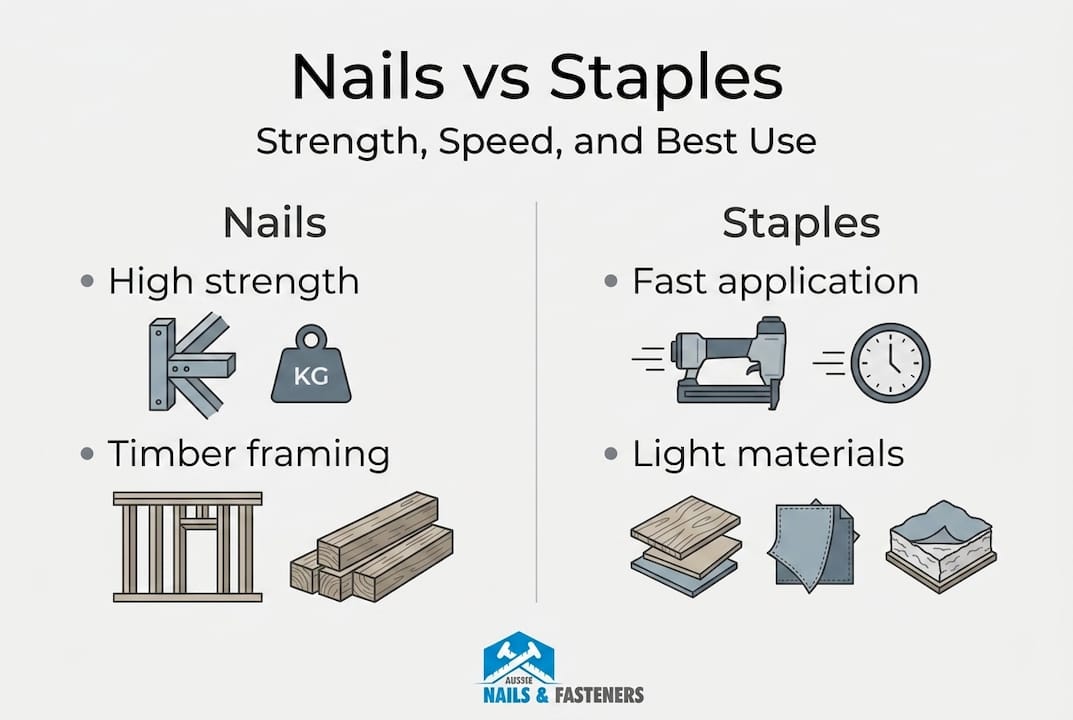
The most critical performance difference comes down to ductility. Nails are slightly flexible under load, which is exactly what you want in timber framing. Australian timber moves. It swells with humidity, shrinks in dry heat, and shifts under structural loads. Nails allow timber movement while maintaining hold, whereas staples are rigid and can work loose or pull out if the material around them shifts repeatedly.
Staples, on the other hand, are outstanding for tasks where speed is essential and loads are distributed across a large surface. Laying down sarking on a roof, for instance, is dramatically faster with a staple gun because you’re covering wide areas of thin, flexible material quickly. The crown prevents the staple from tearing through under normal conditions.
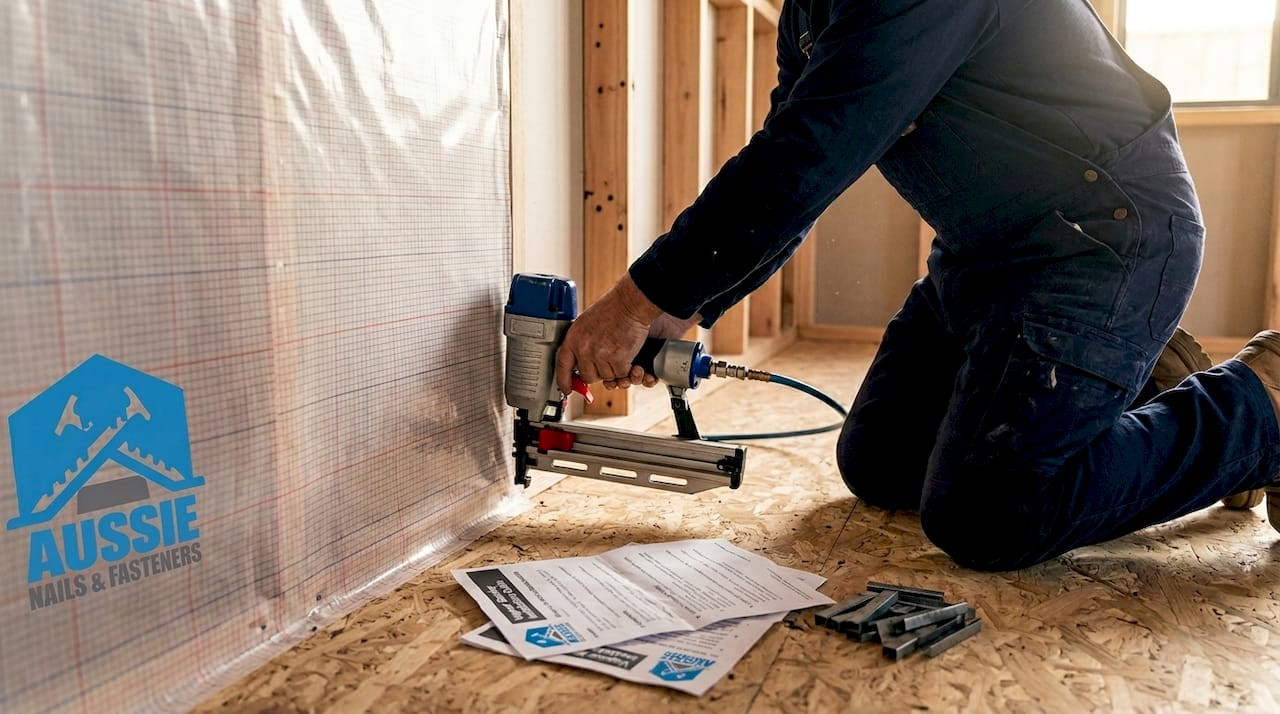
Pro Tip: Never use staples for structural load-bearing connections. Even oversized staples in hardwood will fail under dynamic loads that a correctly sized framing nail handles without issue.
One area worth understanding is that the building fastening tips experienced tradespeople follow consistently point to one reality. Faster isn’t always better. Speed gains from stapling large areas of insulation are real and significant. Speed gains from stapling wall frames instead of nailing them are an illusion because you’ll pay for it later in callbacks and remediation.
Choosing the right fastener for every task
Knowing the strengths of each helps, but next you need to choose correctly for your specific task.
Here’s a step-by-step approach to getting that decision right every time:
-
Identify the load type. Is this connection load-bearing, structural, or purely a surface or retaining application? If anything structural, go with nails. If you’re simply holding a membrane, mesh, or fabric in place, staples are your tool.
-
Assess the material thickness and flexibility. Thin, flexible materials like foil sarking or upholstery fabric tear around a single nail head under vibration or movement. The wide crown of a staple spreads the load and prevents tearing. Thick, solid timber needs the withdrawal resistance of a nail.
-
Consider the exposure and environment. Coastal builds, outdoor structures, and high-humidity areas like Queensland and northern Western Australia demand galvanised or stainless fasteners for both nails and staples. In these environments, a standard bright steel staple will rust and fail within a couple of years.
-
Think about final appearance. Trim work, cabinetry, and feature cladding all need a clean finish. Fine nails like brads or finish nails can be punched below the surface and filled. Staple crowns sit on the surface and, depending on the application, can be visible and unsightly.
-
Factor in whether you may need to rework. Staples are much easier to remove if a mistake occurs, making them preferable for upholstery and light-duty work where speed and correction both matter. Nails driven into hardwood are significantly harder to back out without damaging the material.
-
Match fastener size to material density. Driving a 50mm framing nail into 6mm ply without pre-drilling is a recipe for splitting. Equally, a short staple into thick foam insulation won’t reach the substrate and will hold nothing. Woodworking fastener types and sizing charts take out the guesswork here.
Common real-world examples in Australian construction:
Installing cladding: Stainless or galvanised nails are the correct choice for most cladding situations. They penetrate the cladding and bite into the framing behind, providing long-term hold against wind loads. Staples are sometimes used for non-structural decorative sheeting only.
Fixing sarking and vapour barriers: Staples every 150 to 200 mm along the overlap is standard practice. The crown stops tear-through. Nails would damage the membrane and create water ingress points.
Upholstery and furniture: Fine-gauge staples are the go-to for chair seats, lounges, and headboards because they grip fabric cleanly and can be removed with a flathead screwdriver or staple lifter without wrecking the timber frame underneath.
Timber wall framing: Framing nails, typically 90mm or 75mm depending on timber thickness and local building code requirements, are mandatory. No staple is an acceptable substitute in this application.
Pro Tip: Always test your chosen fastener on a scrap offcut of the actual material first. A quick pull test by hand tells you immediately if the fastener has adequate grip or if you need to go up in size or change type entirely. This takes two minutes and saves hours of remediation.
Common mistakes and expert tips for fastener success
Finally, even experienced tradies and DIYers slip up. Here are the most common mistakes and practical fixes when using nails or staples.
Most common fastener mistakes on site:
- Over-driving nails: Setting the driver pressure too high causes nail heads to sink below the surface, reducing holding strength and damaging timber fibre. Adjust your compressor and run a test strip before starting.
- Using the wrong staple leg length: Too short and the legs don’t reach the substrate. Too long and they punch through entirely or splay out, reducing crown-to-surface grip. Match leg length to material thickness plus 6 to 10mm penetration into the substrate.
- Applying staples to structural timber: This is the most costly mistake. A staple cannot replicate the shear resistance and ductility of a nail in a framed wall or floor system.
- Ignoring corrosion rating: Using bright steel fasteners outdoors in coastal areas fails faster than almost any other fastener error. Always check the corrosion rating against the environment and treated timber specification.
- Mismatching staple crown width to material: Narrow-crown staples are for trim and tight joinery. Wide-crown staples are for sarking and sheeting. Using a narrow crown on sarking leads to tear-through under wind suction.
- Skipping the pattern: Both nails and staples need consistent spacing to perform. Irregular spacing creates stress concentrations that cause premature failure at the gaps.
Understanding how specialty fastenings work in detail can help you avoid specification errors that only show up weeks or months later. Similarly, a solid fastener installation guide covers the tool settings, air pressure, and technique details that make the difference between a job that lasts and one that fails early.
Expert note: Crown width and staple leg length are the two most critical variables when selecting a staple for thin or non-structural materials. A wider crown prevents tear-through on membranes and foil, while leg length determines how well the fastener anchors into the substrate below. Get these two measurements right and staple performance is excellent. Get them wrong and you’ll be pulling staples and starting over.
When correcting staple errors, use a proper staple remover or flathead screwdriver angled under the crown. Pulling straight up tears the material. Prying from one side at a time releases the legs cleanly. For nails, a cat’s paw or nail puller with a timber buffer protects the surface while giving you enough leverage to extract even a deeply driven nail.
Why there’s no one-size-fits-all: Our take on nails and staples
After years of supplying fasteners to builders, tradies, and enthusiastic DIYers across Australia, we’ve noticed a pattern. The jobs that go wrong don’t usually fail because of poor workmanship. They fail because someone grabbed the convenient fastener rather than the correct one.
It’s a mistake to always favour one type over the other. We’ve seen experienced builders who won’t touch a staple gun on principle, driving nails into sarking and punching holes through membranes that then leak. We’ve also seen enthusiastic first-time renovators staple everything in sight, including wall frame bracing that absolutely needed nails driven to code.
The notion of a “best fastener” is really a trap. It pushes people toward comfortable habits instead of considered choices. Australian conditions add another layer of complexity because the country has such extreme variation. A Queensland build on a coastal block in high wind zones demands completely different fastener specifications than a dry-climate Adelaide heritage renovation or a cool Tasmanian deck project.
Fastener speed is genuinely tempting. Staples are fast. There’s no argument about that. But speed only adds value when the application is appropriate. Speed on the wrong application creates hidden liability. That said, we’re also not suggesting you nail every sarking sheet and add half a day to every roof frame job when staples are the correct, code-acceptable choice.
Here’s what real-world experience actually teaches: a split in cheap pine from a poorly sized nail ruins the job just as decisively as a staple that pulled through sarking in a storm. Both errors come from skipping the material assessment step. Always match fastener type and size to the actual material through testing, not through assumptions based on what’s in the gun already.
Look at the essential fastener types available and take the time to understand what each is designed to do. The right choice is rarely the most expensive fastener. It’s the one matched correctly to the job.
Get the right fasteners and tools for your next build
Understanding the difference between nails and staples is only half the equation. Having the right fasteners and tools on hand is what turns that knowledge into a clean, lasting result.
At Aussie Nails and Fasteners Warehouse, we stock a wide range of professional nails, staples, and pneumatic tools from trusted brands including JITOOL, APlus, and Supco. Whether you’re framing walls, fixing sarking, finishing trim, or tackling upholstery, we have the exact fastener for the job. You can browse professional tools or shop all fasteners from our full online range, with competitive pricing for both tradespeople and DIYers. If you’re comparing fastener options further, take a look at how nails and staples stack up against quality screws for your specific build requirements. We’re here to make sure you get the right fastener the first time.
Frequently asked questions
Which is stronger for timber framing: nails or staples?
Nails are generally stronger and more suitable for load-bearing timber framing because they allow the wood to move naturally while maintaining hold. Nail ductility in timber means the connection flexes without failing under dynamic structural loads.
Can staples be used for structural work?
Staples are not recommended for structural work because they may pull out under tension and lack the ductility of nails. Staple rigidity in timber makes them prone to pull-out failure when material movement occurs.
Are staples really faster to install than nails?
Yes, staples are generally much faster to install, especially for thin or layered materials, making them a favourite for speed-focused tasks. Staple installation speed is particularly evident when covering large areas of sarking, mesh, or insulation.
Which is easier to remove if a mistake is made?
Staples are generally easier and quicker to remove than nails, which helps correct errors in non-structural projects. The crown sits on the surface and can be pried loose cleanly, as woodworking communities consistently note when correcting staple mistakes.
Recommended
- Screws vs nails checklist: How to choose the right fastener – Aussie Nails and Fasteners Warehouse
- Complete guide to fastening staples: construction and DIY – Aussie Nails and Fasteners Warehouse
- Essential fastener types for Australian construction: 8 key picks – Aussie Nails and Fasteners Warehouse
- Top construction fastening tips for secure, lasting builds – Aussie Nails and Fasteners Warehouse