



TL;DR:
- Nails are ideal for framing due to their shear strength and faster installation.
- Screws provide superior pull-out resistance and are better for joinery and decks.
- Always select fasteners based on material, load, environment, and Australian standards.
Grab the wrong fastener and you risk more than a wobbly joint — you risk a failed inspection, a callback, or worse, structural failure down the track. Every project, from a deck rebuild in Brisbane to a wall frame in Melbourne, hinges on this single decision: screws or nails? The choice affects shear strength, pull-out resistance, speed, cost, and even compliance with Australian building standards. This article works through the key selection criteria, breaks down the pros and cons of each fastener type, delivers a head-to-head checklist comparison, and tackles the special scenarios where the rules get complicated.
Table of Contents
- Key criteria: What to consider before picking a fastener
- Nails: Pros, cons, and best uses
- Screws: Pros, cons, and ideal scenarios
- Screws vs nails: Head-to-head checklist comparison
- Why the best choice isn’t always obvious: Insider lessons from the site
- Get fasteners that meet the checklist every time
- Frequently asked questions
Key Takeaways
| Point | Details |
|---|---|
| Assess your project needs | Choosing between screws and nails depends on load, material, and compliance. |
| Nails suit high shear tasks | Nails are ideal for framing and speed, but have less pull-out strength. |
| Screws offer easy removal | Screws excel in decking, cabinetry, and situations requiring future disassembly. |
| Check Australian standards | Always ensure your fasteners comply with applicable Australian codes and guidelines. |
| Use a checklist for selection | A checklist streamlines decision-making and boosts project reliability. |
Key criteria: What to consider before picking a fastener
Before you reach for the nail gun or drill, you need a clear picture of what the job demands. Skipping this step is how tradies end up with callbacks and DIYers end up with sagging decks. The checklist starts here, with five foundational questions every builder should ask.
- Material type: Are you fastening softwood, hardwood, steel, or engineered timber? Each responds differently to screws and nails.
- Load requirements: Is the joint under shear load (sideways force) or pull-out load (tension)? Durability and load-bearing needs strongly influence fastener choice.
- Environmental conditions: Coastal projects demand corrosion-resistant fasteners. Galvanised or stainless steel is non-negotiable near saltwater.
- Speed of construction: Nails, especially with a pneumatic gun, go in fast. Screws take more time but offer more control.
- Removability: Will this structure ever need to be disassembled or adjusted? Screws win here, every time.
Compliance with Australian standards is not optional. The Australian fasteners guide outlines requirements that affect everything from corrosion class to embedment depth. Getting this wrong can void insurance or fail a building inspection.
Good fastening tips for secure builds always begin with understanding the substrate. For example, LVL (laminated veneer lumber) and structural plywood behave very differently from dressed pine, and the wrong fastener can split, corrode, or simply fail to hold. Equally, matching your fastener to the essential fastener types available for your application saves time and money before work even starts.
Pro Tip: When working with treated pine (H3 or H4 rated), always use hot-dipped galvanised or stainless steel fasteners. The preservative treatment is highly corrosive to standard bright steel, and failure can happen within months in wet conditions.
With these criteria locked in, you have the foundation to evaluate nails and screws on their actual merits for your specific job.
Nails: Pros, cons, and best uses
Nails are the workhorse of Australian construction. Walk onto any large framing site and you will hear nail guns firing constantly. There is a good reason for that.
Advantages of nails:
- Speed: A pneumatic nail gun drives a nail in under a second. For high-volume framing, this is a genuine productivity multiplier.
- Shear strength: Nails flex slightly under lateral load, which is exactly what a wall frame needs during wind events or seismic movement.
- Cost-effectiveness: Nails are cheaper per unit than screws, and the labour saving compounds on large jobs.
- Vibration resistance: Because nails grip through friction, they can actually hold better in joints subject to constant vibration.
Disadvantages of nails:
- Low pull-out resistance: Nails can work loose over time, especially in dynamic loads or repeated moisture cycling.
- Difficult to remove: Pulling a nail cleanly without damaging the timber takes skill and time.
- No adjustment: Once a nail is in, it is in. There is no backing it out and repositioning cleanly.
- Splitting risk: Hand-driving large nails in dry hardwood without pre-drilling can split the timber.
“Nails are preferred for framing due to their shear strength” — a principle that underpins Australian wall framing and bracing standards.
For practical guidance on selecting the right nail types for durability, it helps to understand that not all nails are equal. Framing nails, joist hanger nails, clouts, and ring shank nails each serve a different purpose. A nail selection guide can help you match the nail profile to the application before you load the magazine.
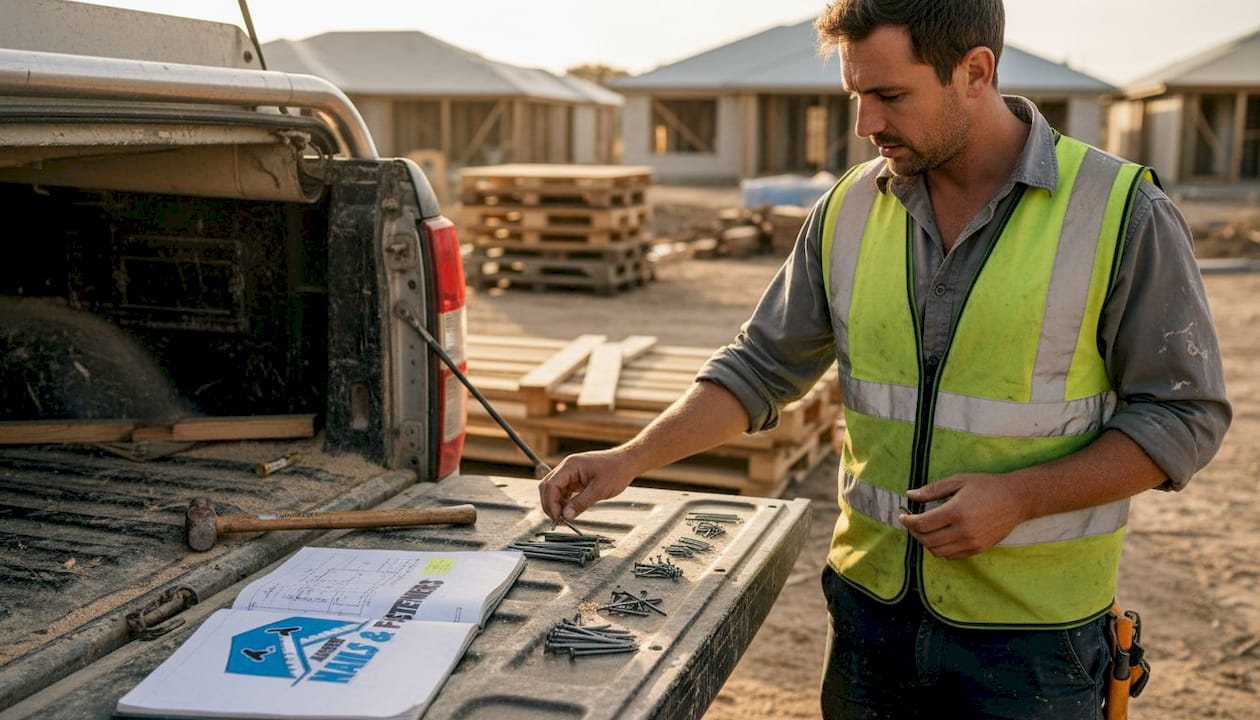
Best applications for nails include structural wall framing, roof framing, cladding, bracing, and subfloor installation. Anywhere speed matters and shear load is the primary force, nails are hard to beat.
Screws: Pros, cons, and ideal scenarios
Screws bring a different set of capabilities to the site. They cost more and go in slower, but in the right situation, there is no substitute.
Advantages of screws:
- Pull-out resistance: The thread profile bites into the timber, resisting upward or outward force far better than a smooth shank nail.
- Removability: Back a screw out cleanly and you can reposition or replace a component without damage.
- Precision: Screws allow controlled installation, which matters in cabinetry, decking, and finished joinery.
- Longevity in exposed conditions: Quality screws with the right coating outlast nails in applications where moisture cycling is constant.
Disadvantages of screws:
- Cost: Screws are typically more expensive per fastener than equivalent nails.
- Installation speed: Even with a cordless drill or impact driver, screws take longer per joint than nails with a gun.
- Brittleness under shear: Hardened screws can snap under the lateral force that a nail would flex through. This is critical in framing.
- Cam-out and stripping: Incorrect bit selection or worn tips can strip the drive recess, making removal difficult.
Pro Tip: When fastening hardwood decking with screws, always pre-drill a clearance hole slightly larger than the shank diameter. This prevents splitting and allows the screw to pull the board tight without the thread catching in the top board.
Screws offer high pull-out resistance, making them ideal for decking and joinery, particularly in applications where boards will expand and contract seasonally. Knowing the full range of woodworking fastener types available helps you pick not just screws versus nails but the right screw head, thread, and coating for each task. For long-term performance in outdoor builds, the fastener durability guide is essential reading before you specify anything near moisture or treated timber.
Top screw applications include decking, cabinetry, door and window installation, removable structures, and any joinery where alignment adjustments may be needed post-installation. A full breakdown of types of screws is worth reviewing if you are newer to the trade.
Screws vs nails: Head-to-head checklist comparison
With each fastener assessed individually, here is how they stack up side by side.
| Criteria | Screws | Nails |
|---|---|---|
| Shear strength | Lower (can snap) | Higher (flex under load) |
| Pull-out resistance | High | Low to moderate |
| Installation speed | Slower | Fast (especially pneumatic) |
| Removability | Easy | Difficult |
| Cost per unit | Higher | Lower |
| Best for | Decking, cabinetry, joinery | Framing, cladding, bracing |
| Corrosion options | Wide range available | Wide range available |
| Compliance complexity | Medium | Medium to high |
Quick decision process for common job scenarios:
- Identify the primary load type. Shear load points to nails. Pull-out load points to screws.
- Check the material. Hardwood, LVL, or treated timber may require specific fastener specifications.
- Confirm environmental exposure. Coastal or wet areas require corrosion-rated fasteners regardless of type.
- Review the relevant Australian standard. AS 1684 (residential timber framing) and AS 3600 both specify fastener requirements. Compliance with Australian fastener standards may determine your choice before any other factor.
- Consider future access. If the structure may need adjustment or demolition, screws save time and timber.
- Check the fixings and tie-downs guideline for Queensland-specific requirements, particularly in cyclone regions.
For complex or unusual applications, specialty fastenings such as structural screws, joist hanger nails, and hurricane ties may be required, and reviewing professional fastener quality standards ensures you are specifying compliant products from the start.
Why the best choice isn’t always obvious: Insider lessons from the site
Checklists are essential, but they do not capture everything. Here is the reality: even experienced tradies debate screws versus nails on jobs where the textbook answer seems obvious. Weather changes things. Timber condition changes things. And what happens six months post-handover can change everything.
We have seen projects where a tradie followed the framing nail specification to the letter, only to find that an unusually wet season caused nail-pops across an entire wall because the timber was greener than spec. A quick switch to ring-shank nails mid-job saved the outcome. No checklist told him to do that. Experience did.
The bigger lesson is this: fastener technology evolves faster than most builders realise. New screw profiles, improved coatings, and updated AS/NZS standards regularly shift what is best practice. Staying current with secure fastening lessons learned from real-world builds is just as important as reading the spec sheet. Trust the checklist as a starting point, then trust your read of the actual conditions in front of you.
Get fasteners that meet the checklist every time
You now have the criteria, the comparisons, and the perspective to make confident fastener decisions on any job. The next step is sourcing products you can actually rely on.
At Aussie Nails and Fasteners Warehouse, we stock the full range of screws, nails, staples, and installation tools that match every scenario in this checklist. Browse our shop screws range for compliant, corrosion-rated options suited to decking, framing, joinery, and more. Need the right gear to drive them in? Our tools for installation collection covers pneumatic guns, cordless drivers, and accessories from JITOOL, APlus, and Supco. We supply trade quantities fast, so your project never waits on fasteners.
Frequently asked questions
When should I use screws instead of nails?
Use screws for decking, cabinetry, and whenever pull-out resistance or easy removability is critical. Screws provide excellent pull-out strength and removability, making them the clear choice for joinery and finished carpentry.
What fastener is best for wall framing in Australia?
Nails are typically preferred for wall framing due to their shear strength and compliance with Australian building practices. Nails are preferred for framing because they flex under lateral loads rather than snapping, which is essential for structural integrity.
How do I ensure compliance with Australian fastener standards?
Always check the packaging for relevant AS/NZS standards and consult Australian building guidelines when uncertain. Compliance with Australian fastener standards is essential, particularly in cyclone and bushfire-prone zones where specific ratings apply.
Is it okay to mix screws and nails in the same project?
Mixing is often acceptable for different tasks, but always match the fastener type to the specific load and material requirements. Matching fastener type to material and load is crucial to maintaining structural performance and compliance across the whole build.
Recommended
- How to troubleshoot fastening issues: 5 practical steps – Aussie Nails and Fasteners Warehouse
- Essential fastener types for Australian construction: 8 key picks – Aussie Nails and Fasteners Warehouse
- Top construction fastening tips for secure, lasting builds – Aussie Nails and Fasteners Warehouse
- Best woodworking fastener types for Australian projects – Aussie Nails and Fasteners Warehouse