



TL;DR:
- Durability depends on environmental factors, material compatibility, and proper installation, not just strength.
- Australian climate requires selecting fasteners with appropriate coatings and materials to combat corrosion.
- Proper installation and matching fastener grade to application are critical to prevent premature failure.
Choosing the strongest fastener on the shelf feels like the safe option. But in Australian construction, that instinct can lead to premature failures, costly rework, and even safety risks. Durability is not simply a measure of how much load a fastener can handle before it snaps. It depends on material compatibility, environmental exposure, property class, and correct installation. Misunderstanding these factors is one of the most common reasons projects fail at the fastening point. This guide breaks down what durability actually means for fasteners, how Australian conditions shape your choices, and how to avoid the mistakes that catch even experienced tradespeople off guard.
Table of Contents
- What defines fastener durability
- Materials and environmental impact on durability
- Strength grades and real-world performance
- Common pitfalls in selecting fasteners for durability
- Why Australian projects must rethink durability
- Build with confidence: Shop quality fasteners
- Frequently asked questions
Key Takeaways
| Point | Details |
|---|---|
| Strength isn’t everything | A stronger fastener isn’t always more durable if ductility or environment are ignored. |
| Corrosion is crucial | Australian projects must prioritise corrosion resistance to avoid premature failures. |
| Match grade to project | Select the right fastener property class and material based on your specific application. |
| Avoid mixing metals | Combining different metal fasteners can trigger galvanic corrosion and reduce lifespan. |
| Proper installation matters | Correct buying and fitting ensures maximum durability and reliability for your construction. |
What defines fastener durability
Most people use the words “strength” and “durability” as if they mean the same thing. They do not. Strength describes how much force a fastener can withstand before it deforms or breaks. Durability describes how well it maintains that performance over time, under real conditions, in the field.
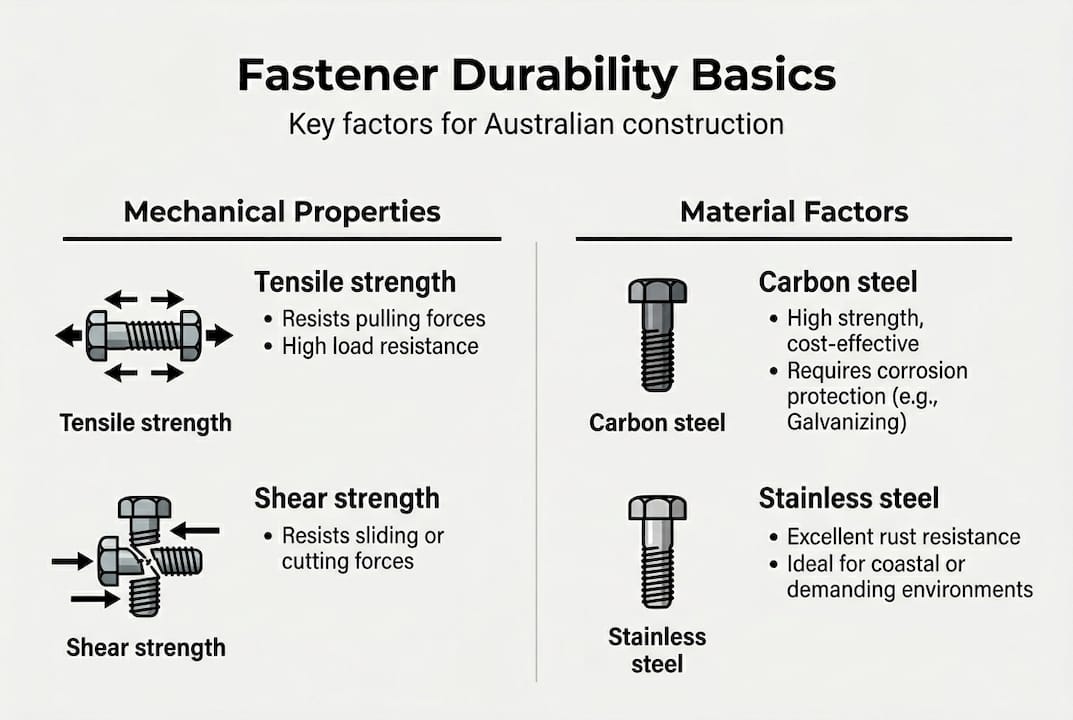
When engineers assess fasteners, two mechanical properties matter most. Tensile strength is the maximum pulling force a fastener can resist along its axis before it fails. Shear strength is its resistance to lateral forces acting across its body. Both are critical depending on how the fastener is loaded in your application. A bolt holding a bracket to a wall primarily resists shear. A bolt clamping two flanges together resists tension. Getting this wrong means choosing a fastener optimised for the wrong type of force entirely.
Property classes are the standardised system used to communicate these mechanical properties. In Australia, these are governed by AS/NZS 4291.1, which defines classes such as 4.6, 8.8, 10.9, and 12.9. The first number represents tensile strength in units of 100 MPa, and the second number represents the yield ratio (the point at which permanent deformation begins). So an 8.8 bolt has a tensile strength of approximately 800 MPa and a yield ratio of 80 per cent.
| Property class | Tensile strength | Typical use |
|---|---|---|
| 4.6 | ~400 MPa | General, low-load applications |
| 8.8 | ~800 MPa | Structural, high-strength connections |
| 10.9 | ~1000 MPa | Heavy-duty mechanical applications |
| 12.9 | ~1200 MPa | Extreme-load, precision engineering |
Here is where the confusion begins. A 12.9 bolt is stronger than a 4.6 bolt, but that does not automatically make it more durable for your project. Durability in the field involves:
- Resistance to fatigue over repeated loading cycles
- Tolerance of misalignment during installation
- Compatibility with surrounding materials
- Resistance to environmental degradation
Understanding fastener quality standards gives you a clearer picture of how these properties are tested and verified before a fastener reaches your site. And if you are still getting across the basics, the fastener gauge guide is a practical starting point for matching fastener size to application.
“Durability is not what a fastener can do on day one. It is what it can still do reliably on day one thousand.”
Materials and environmental impact on durability
Once you understand property classes, the next variable is material. And in Australia, this is where the real decisions get made. Our climate ranges from tropical humidity in the north to salt-laden coastal air around every major city, to dry inland heat that causes expansion and contraction cycles. Each environment attacks fasteners differently.
Carbon steel is the most common fastener material. It offers excellent tensile and shear strength, is widely available, and is cost-effective. But without surface treatment, it corrodes quickly in moisture-rich or coastal environments. Galvanised carbon steel adds a zinc coating that provides a sacrificial barrier against rust, significantly extending service life outdoors.
Stainless steel is often seen as the premium choice, and for corrosion resistance, it genuinely is. However, stainless steel has lower strength and fatigue resistance than high-tensile carbon steel. In high-load structural applications, this trade-off matters. Stainless is not a universal upgrade. It is the right choice for corrosive environments where load demands are moderate.
| Material | Corrosion resistance | Tensile strength | Best environment |
|---|---|---|---|
| Carbon steel | Low | High | Dry, indoor |
| Galvanised steel | Medium | High | Outdoor, sheltered |
| Stainless steel (304/316) | Very high | Moderate | Coastal, wet, marine |
One of the most destructive and underappreciated risks is galvanic corrosion. This occurs when two dissimilar metals are in contact in the presence of an electrolyte (such as moisture). The less noble metal corrodes rapidly. A classic example is using aluminium cladding with steel fasteners in a coastal environment. The aluminium degrades around the fastener at an accelerated rate, weakening the connection long before the fastener itself appears to fail. Choosing the right metal fastening solutions for your substrate is not optional. It is essential.
Pro Tip: In coastal or high-humidity zones, always specify 316-grade stainless steel rather than 304. The additional molybdenum content in 316 provides meaningfully better resistance to chloride-induced corrosion, which is the dominant threat within a few kilometres of the ocean.
Proper fastener installation tips also play a role here. Even the best corrosion-resistant fastener will fail early if it is overtightened, cross-threaded, or installed without appropriate washers that isolate dissimilar metals.
Strength grades and real-world performance
There is a tempting logic that says: if a project is critical, use the highest-strength fastener available. On paper, it sounds responsible. In practice, it can introduce new failure modes that a moderate-grade fastener would never have.
Here is why. Higher-strength bolts, particularly those rated 10.9 and above, are less ductile and fatigue faster in bending than lower-grade alternatives. Ductility is the ability of a material to deform without fracturing. In dynamic loading situations, where vibration, thermal cycling, or shifting loads are present, a more ductile fastener can absorb energy and redistribute stress. A brittle, ultra-high-strength bolt may snap without warning under the same conditions.
Consider these real-world scenarios:
- Structural steel connections: An 8.8 bolt is the standard for most structural applications. It provides the strength needed for load-bearing connections while retaining enough ductility to tolerate minor misalignment during erection.
- Mechanical equipment mounting: A 10.9 bolt may be specified for precision flanges where preload is critical, but the installation must be exact. Misalignment tolerance is minimal.
- Timber framing and decking: Lower-grade fasteners with galvanised or stainless coatings outperform high-tensile options because corrosion resistance and ductility matter far more than raw tensile capacity.
- Automotive and machinery: 12.9 bolts appear here, but they require torque-to-yield procedures and are rarely appropriate for general construction.
For anyone working on load-bearing fastener applications, understanding the fatigue and ductility trade-off is as important as reading the load tables. And for home improvement fasteners, the lesson is simpler: match the grade to the actual demand, not to a vague sense of “better safe than sorry.”
Pro Tip: When in doubt about grade selection for a structural connection, consult the engineer’s specification rather than defaulting to the highest available grade. Over-specification can be just as problematic as under-specification.
Key insight: A 10.9 bolt used in a slightly misaligned connection can fail faster than a correctly installed 8.8 bolt under the same load. Fit and installation matter as much as grade.
Common pitfalls in selecting fasteners for durability
Even experienced builders make consistent mistakes when selecting fasteners. The consequences range from annoying (surface rust staining) to serious (structural connection failure). Knowing the patterns helps you avoid them.
Prioritising strength over corrosion resistance is the most common error in Australian conditions. Empirical project data shows that in harsh climates, corrosion resistance consistently outperforms initial tensile strength as the dominant factor in long-term durability. A high-tensile bolt that corrodes within three years has zero durability value.
Common pitfalls to watch for:
- Using standard carbon steel fasteners in outdoor or coastal applications without galvanising or stainless specification
- Mixing metals without isolation washers or compatible coatings
- Overtightening high-strength bolts, which strips threads and reduces clamping force
- Under-torquing fasteners, which allows vibration-induced loosening over time
- Ignoring manufacturer torque specifications for coated or stainless fasteners (which differ from bare steel values)
Installation errors are a significant contributor to premature failure. A fastener installed at the wrong torque, even if it is the correct grade and material, will not perform as designed. Thread engagement length matters too. A bolt that only engages two or three threads instead of the specified minimum is dramatically weaker than the grade rating suggests.
“Selecting the right fastener is only half the job. Installing it correctly is the other half, and it is where most durability is lost.”
Pro Tip: Always check the thread engagement length against the fastener’s diameter. A general rule is that full engagement should be at least 1.5 times the bolt diameter in steel, and more in softer materials like aluminium or timber.
If you are already seeing problems on site, knowing how to troubleshoot fastener issues quickly can prevent minor problems from becoming structural concerns.
Why Australian projects must rethink durability
Here is the uncomfortable truth that most fastener guides skip over: the conventional wisdom imported from European or North American standards does not always translate cleanly to Australian conditions. Our coastal exposure, UV intensity, and temperature swings create an environment where corrosion is often a faster and more dangerous enemy than mechanical overload.
We have seen projects where engineers specified high-tensile 10.9 bolts for prestige and perceived safety, only to find significant corrosion-induced failure within five years because the coating specification was inadequate. Meanwhile, a neighbouring structure using correctly specified 8.8 galvanised fasteners was still performing without issue at the ten-year mark.
The empirical evidence is clear: stronger is not always better, and stainless is not always the answer either. The right fastener is the one that balances strength grade, material, coating, and installation for the specific demands of your site. For anyone working on load-bearing connections in challenging Australian environments, this reframing is not just useful. It is essential for long-term project integrity.
Build with confidence: Shop quality fasteners
Understanding durability theory is only valuable when you can act on it. At Aussie Nails and Fasteners Warehouse, we stock a wide range of corrosion-resistant fastening options specifically suited to Australian conditions, from coastal builds to inland construction.
For projects where corrosion protection matters, our electro galvanised fasteners offer a reliable barrier against rust in outdoor and sheltered applications. If you need versatile options for timber and panel work, our corrugated fasteners deliver consistent holding power. Whatever your project demands, browse our full range to find the right fastener for your environment, grade, and application. Our team understands Australian conditions and can help you match product to project with confidence.
Frequently asked questions
How do I choose the right fastener for Australian conditions?
Weight corrosion resistance for your specific climate and material compatibility ahead of raw strength. Project data confirms that in harsh Australian climates, corrosion resistance is the dominant factor in long-term fastener durability.
What happens if different metals are mixed in fastener selection?
Mixing dissimilar metals in the presence of moisture triggers galvanic corrosion, which rapidly degrades durability and structural integrity, particularly in outdoor or coastal environments.
Are high-strength fasteners always more durable?
No. Higher-grade fasteners such as 10.9 and 12.9 fatigue faster in bending and tolerate less misalignment, meaning they can fail sooner than moderate grades when conditions are not perfectly controlled.
Is stainless steel always the best choice for durability?
Stainless steel leads on corrosion resistance but has lower strength and fatigue resistance than high-tensile carbon steel. The right choice depends on your environment and the actual loads involved.
Recommended
- Best metal fastening solutions for Australian projects 2026 – Aussie Nails and Fasteners Warehouse
- Best woodworking fastener types for Australian projects – Aussie Nails and Fasteners Warehouse
- Fastener installation guide: expert tips for Australian projects – Aussie Nails and Fasteners Warehouse
- Load-bearing fasteners guide for Australian construction – Aussie Nails and Fasteners Warehouse