



TL;DR:
- Specialty fastenings are purpose-built, load-rated components that meet strict standards and suit specific applications. Using the correct fastener ensures structural integrity, safety, and compliance, reducing costly failures. Proper installation and careful selection based on load, environment, and standards are critical for lasting, safe constructions.
Most tradespeople and DIY enthusiasts assume that once you’ve got a bolt in hand, the hard part is done. That assumption has caused more structural failures, costly rework, and compliance headaches than almost any other mistake on site. Specialty fastenings are not just a premium version of a standard bolt. They are purpose-built, load-rated, and standards-certified components that determine whether your build stands safely for decades or becomes a liability. Understanding which specialty fastening to use, and why, is one of the most practical skills you can develop on any Australian construction project.
Table of Contents
- What are specialty fastenings and why do they matter?
- Key types of specialty fastenings used in Australian projects
- How to choose the right specialty fastening for your project
- Best practices for installing specialty fastenings
- The overlooked reality: why engineering the fastening is as important as engineering the structure
- Find the right specialty fastenings and tools for your next project
- Frequently asked questions
Key Takeaways
| Point | Details |
|---|---|
| Not all bolts are equal | Specialty fastenings are essential for demanding or high-stakes construction, delivering safety and compliance where generic bolts can’t. |
| Choose by application | Match the fastening type to your project’s load, vibration, and compliance needs for best results. |
| Installation matters | Correct installation and adherence to rated loads and standards are critical for safety and longevity. |
| Expert tips prevent failure | Following professional advice and standards can help you avoid costly mistakes and rework. |
What are specialty fastenings and why do they matter?
A specialty fastening is any fastener engineered specifically to meet demanding performance criteria that a generic bolt, screw, or nail simply cannot satisfy. Where a standard fastener is designed for general use across a wide range of applications, a specialty fastening is built for a precise purpose: a specific load range, environment, vibration frequency, or compliance standard.
Think of it this way. A standard M12 bolt might hold two pieces of timber together perfectly well on a garden deck. But put that same bolt into a tilt panel connection or a high-vibration industrial frame, and you’re asking it to perform well outside its design envelope. That’s where things go wrong.
The Australia industrial fasteners market is valued at AUD 2.6 billion, with externally threaded fasteners dominating construction applications. That scale reflects just how critical proper fastening selection is across the industry.
Specialty fastenings are typically defined by three key criteria:
- Designed for purpose: Each product is engineered for a specific application, not adapted from a general catalogue.
- Certified to standards: They meet Australian and international standards, such as AS 3850 for tilt panel construction.
- Rated for specific performance: Load capacity, vibration resistance, and chemical or weather exposure are all quantified and tested.
Common applications in Australian construction include tilt panel erection, structural steel connections, seismic zone builds, and high-vibration machinery mounts. You’ll find a solid overview of essential fastener types that covers the broader landscape if you’re still building your knowledge base.
The risks of getting this wrong are serious. Premature fastener failure can compromise structural integrity, trigger legal exposure for builders and engineers, and result in expensive rework. Understanding fastener terminology is the first step toward making confident selections.
“The difference between a specialty fastening and a generic bolt isn’t price. It’s the engineering behind every millimetre of that component.”
When the wrong fastener is used in a critical connection, the failure often doesn’t happen immediately. It creeps in over months, under load cycles, until something gives. That’s the hidden danger.
Key types of specialty fastenings used in Australian projects
Now that you know why specialty fastenings matter, let’s look at the main types and where they fit on site.
Australian construction sites rely on several families of specialty fastenings, each solving a distinct problem. Knowing which family fits your application saves time, money, and risk.
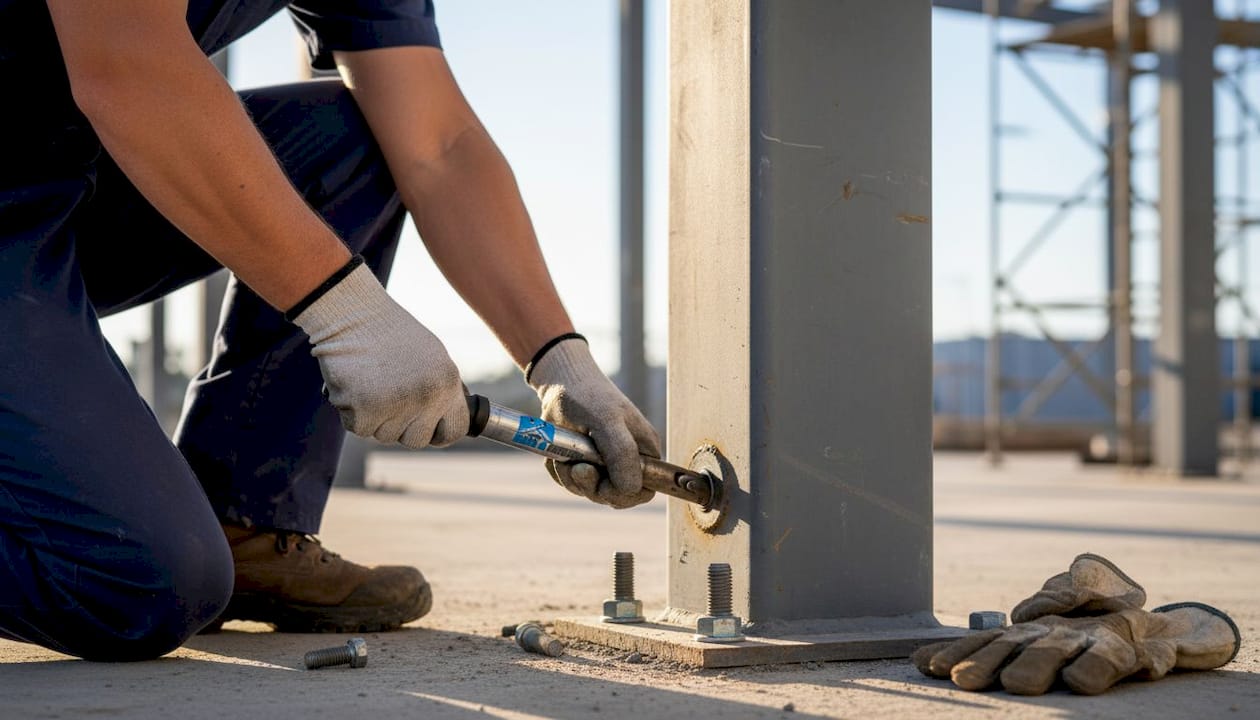
Torque-controlled expansion anchors like the PUMA-X are designed for concrete connections where consistent clamping force is non-negotiable. They expand under a precise torque setting, locking into the substrate without relying on friction alone. These are common in tilt panel work and post-installed anchor applications.
Serrated flanged hex bolts in Class 4.6 and 8.8 grades are built for vibration resistance. The serrations bite into the mating surface, preventing loosening under dynamic loads. As tilt panel hardware requirements confirm, these bolts are specified precisely because standard hex bolts back out under repeated movement.
Shear pins handle lateral forces that standard bolts aren’t designed to carry. In tilt panel brackets and machinery mounts, shear pins absorb the sideways load so the bolts can focus on clamping.
Angle joiner plates distribute load across a wider area, reducing point stress in timber and light steel framing. They’re especially useful where member alignment is imperfect.
Rated shims are often overlooked but are critical for levelling and load transfer. Shims rated to 20 tonnes per AS 3850 ensure that load paths are consistent, not dependent on chance contact.
| Specialty fastening | Application | Key standard | Typical load |
|---|---|---|---|
| Torque-controlled anchor | Tilt panel, concrete | AS 3850 | High tensile |
| Serrated flanged hex bolt | Vibration-prone joints | AS 1111 | Medium to high |
| Shear pin | Lateral load transfer | AS 4100 | Shear-specific |
| Angle joiner plate | Framing connections | AS 1684 | Distributed |
| Rated shim | Levelling, load transfer | AS 3850 | Up to 20 tonnes |
Pro Tip: Always check the technical data sheet for each specialty fastening before ordering. The rated load in a catalogue is a maximum, not a target. Design to a fraction of that figure for real-world safety margins.
For projects involving steel, reviewing metal fastening solutions will help you match the right product family to your substrate. If your project involves heavy structural loads, the load-bearing fasteners guide is worth reading before you spec anything.
How to choose the right specialty fastening for your project
Understanding the types is only half the battle. Here’s how to pick the right one for your next build.
Selecting a specialty fastening comes down to a structured decision process. Skipping steps here is where costly mistakes begin.
- Define the load requirement. Know your design load, including dynamic and static components. A fastening rated for static load only will fail in a vibrating environment.
- Assess the environment. Coastal sites need corrosion-resistant grades. Chemical exposure demands specific coatings or materials. Never assume a standard zinc plate finish is adequate outdoors.
- Check the applicable standard. AS 3850, AS 4100, AS 1684. Each standard specifies minimum requirements. Your certifier will ask for compliance documentation.
- Consider installation constraints. Some specialty fastenings require specific tools or torque wrenches. If your crew doesn’t have the right equipment, factor that into your selection.
- Verify lead times and availability. Specialty fastenings are not always off-the-shelf. Build procurement time into your schedule.
One of the most common misconceptions is that a higher-grade bolt always delivers better performance. It doesn’t. Higher strength bolts like Grade 10.9 and 12.9 actually fatigue faster than Grade 8.8 when subjected to bending or misalignment. Purpose-built tilt panel hardware consistently outperforms generic high-grade bolts in real-world conditions.
| Scenario | Recommended fastening |
|---|---|
| Tilt panel erection | PUMA-X torque anchor, serrated hex bolt |
| Coastal structural steel | Grade 316 stainless hex bolt |
| High-vibration machinery | Serrated flange bolt with locking washer |
| Timber framing, wet area | Hot-dip galvanised joist hanger screws |
Pro Tip: When in doubt between two grades, choose the one specified by the engineer, not the one that seems stronger. Over-specifying can introduce brittleness and reduce ductility in ways that matter under load.
For guidance on long-term performance, the fastener durability guide covers environmental factors in detail. If your project is in the heavy-duty category, heavy duty fasteners explained walks through strength grades and selection criteria clearly.
Best practices for installing specialty fastenings
Once you’ve selected the right hardware, proper installation is just as critical. Here’s how to make sure your work stands the test of time.
Even the best specialty fastening will underperform if it’s installed incorrectly. Torque settings, surface preparation, and inspection are not optional extras. They are part of the product’s rated performance.
Follow these installation steps every time:
- Prepare the substrate. Clean contact surfaces of dust, oil, and debris. For concrete anchors, ensure the hole diameter and depth match the manufacturer’s specification exactly.
- Apply the correct torque. Use a calibrated torque wrench. Under-torquing leaves the connection loose. Over-torquing can strip threads or crack the substrate.
- Check alignment before final tightening. Misaligned fastenings carry unintended bending loads. This is especially critical in tilt panel work where panels can weigh up to 36 tonnes and shims must be rated per AS 3850.
- Inspect after installation. Visual inspection is the minimum. For critical connections, use a torque audit to verify every fastening meets spec.
Here’s a quick installation quality checklist:
- Hole size and depth verified before anchor insertion
- Contact surfaces clean and free of contamination
- Torque wrench calibrated within the last 12 months
- Shims rated and positioned correctly under load-bearing plates
- All fastenings inspected and signed off before concrete pours or cladding covers connections
“Correct shimming and plate seating are not finishing touches. They are structural decisions that affect every load cycle the building will ever experience.”
Pro Tip: Never reuse specialty fastenings that have been torqued to their rated value. Many torque-controlled anchors and high-tension bolts are single-use by design. Reusing them introduces an unknown variable into a system that was engineered to have none.
For a thorough walkthrough of installation processes, the installation guide for fasteners covers common scenarios. The construction fastening tips resource is also worth bookmarking for on-site reference.
The overlooked reality: why engineering the fastening is as important as engineering the structure
Here’s something experienced site foremen know but rarely say out loud: the fastening is often the last thing specified and the first thing blamed when something goes wrong.
Architects and engineers spend months refining structural designs, material selections, and load calculations. Then, in the final procurement stage, fastenings get treated as a commodity line item. Someone substitutes a generic bolt for a rated specialty fastening to save a few dollars per unit. Multiply that across hundreds of connections and you’ve introduced risk at every single joint in the structure.
The uncomfortable truth is that a cheaper or higher-rated fastening is often a false economy. The cost of rework, the cost of a compliance failure, or the reputational cost of a structural issue far exceeds any savings made at the procurement stage.
What the best foremen actually do is account for site reality, not just design intent. Surfaces aren’t always level. Panels don’t always arrive perfectly square. Fastenings that perform well under ideal laboratory conditions need to be selected with real-world misalignment and environmental variability in mind. That’s why professional fastener standards exist: to give you a baseline that holds even when conditions aren’t perfect.
Treat the fastening decision with the same rigour you’d apply to any other structural element. It deserves it.
Find the right specialty fastenings and tools for your next project
At Aussie Nails and Fasteners Warehouse, we stock the specialty fastenings and matching tools that Australian construction professionals and serious DIY enthusiasts actually need on site.
Whether you’re sourcing torque-controlled anchors for a tilt panel job, serrated hex bolts for a vibration-prone frame, or just want expert advice on what suits your specific application, we’ve got you covered. Browse our range of quality fastening tools to make sure your installation matches your specification. Explore our specialty screws for project-specific options, or view the full Aussie Nails and Fasteners Warehouse catalogue to find exactly what your next build requires. Our team is here to help you get it right the first time.
Frequently asked questions
What is the difference between a specialty fastening and a standard fastener?
A specialty fastening is engineered for a specific demanding application, certified to relevant standards, and rated for defined load, vibration, or environmental conditions that a generic fastener cannot reliably meet.
When should I use a specialty fastening instead of a generic bolt?
Use specialty fastenings for tilt panels, high-vibration settings, structural steel connections, or any application where certified performance and heavy load ratings are required by design or regulation.
Does a higher strength bolt always mean better performance?
No. Grade 10.9 and 12.9 bolts fatigue faster than Grade 8.8 when subjected to bending or misalignment, so selecting the right type for the specific application is more important than choosing the highest grade available.
What standards apply to specialty fastenings in Australia?
Key standards include AS 3850 for tilt panel construction, which governs shims rated to 20 tonnes, as well as AS 4100 for structural steel and AS 1684 for timber framing connections.
How big is the specialty and industrial fastener market in Australia?
The Australian fasteners market is valued at AUD 2.6 billion, with construction the dominant segment, driven largely by externally threaded fasteners including bolts and anchors.
Recommended
- Top construction fastening tips for secure, lasting builds – Aussie Nails and Fasteners Warehouse
- Essential fastener types for Australian construction: 8 key picks – Aussie Nails and Fasteners Warehouse
- What makes a professional fastener: quality, standards, and selection – Aussie Nails and Fasteners Warehouse
- Heavy duty fasteners explained: strength, standards, and selection – Aussie Nails and Fasteners Warehouse