



TL;DR:
- Heavy duty fasteners are high-strength devices designed for demanding structural and industrial applications.
- Proper selection, installation, and compliance with Australian standards are crucial for safety and durability.
- Correct substrate preparation and avoiding common installation errors are essential to prevent fastener failure.
Most tradies and keen DIYers assume that grabbing a hefty bolt or a box of screws from the hardware store is enough for a tough job. It isn’t. The difference between a fastener that holds for decades and one that fails under load isn’t always obvious from the shelf, but the consequences can be severe. Structural connections in decks, retaining walls, steel frames, and concrete substrates demand fasteners engineered specifically for those conditions. This guide covers what heavy duty fasteners actually are, which types suit which jobs, how Australian standards apply in practice, and the installation mistakes that turn even the best fastener into a liability.
Table of Contents
- Defining heavy duty fasteners: More than just strong bolts
- Types of heavy duty fasteners and their key uses
- Australian standards and compliance for heavy duty fasteners
- Installation secrets: Avoiding failure and maximising performance
- Mechanical vs chemical anchors: Choosing the right solution
- The real test: What most people miss about heavy duty fasteners
- Find the right heavy duty fasteners and tools for your project
- Frequently asked questions
Key Takeaways
| Point | Details |
|---|---|
| Heavy duty defined | These fasteners are engineered for severe loads and compliance, far surpassing standard screws or bolts. |
| Type and task matching | Choose your fastener—bolt, anchor, or screw—by strength rating, material, and Australian standards for your job. |
| Install with care | Even top-rated bolts will fail if overdriven, under-torqued, or installed in dirty or cracked concrete. |
| Compliance is safety | Always use AS/NZS-compliant products and check markings, especially for structural work. |
| Mechanical vs chemical | Mechanical fasteners suit quick, simple jobs; chemical anchors excel in critical, cracked or seismic-prone sites. |
Defining heavy duty fasteners: More than just strong bolts
Having set the scene for why fastener choice genuinely matters, let’s drill into what actually qualifies as a heavy duty fastener.
The term gets thrown around loosely, but there’s a precise meaning behind it. Heavy duty fasteners are high-strength devices engineered for demanding construction, industrial, and structural applications, capable of withstanding extreme loads, vibrations, and environmental stresses. That’s a very different brief from a standard wood screw or a general-purpose bolt.
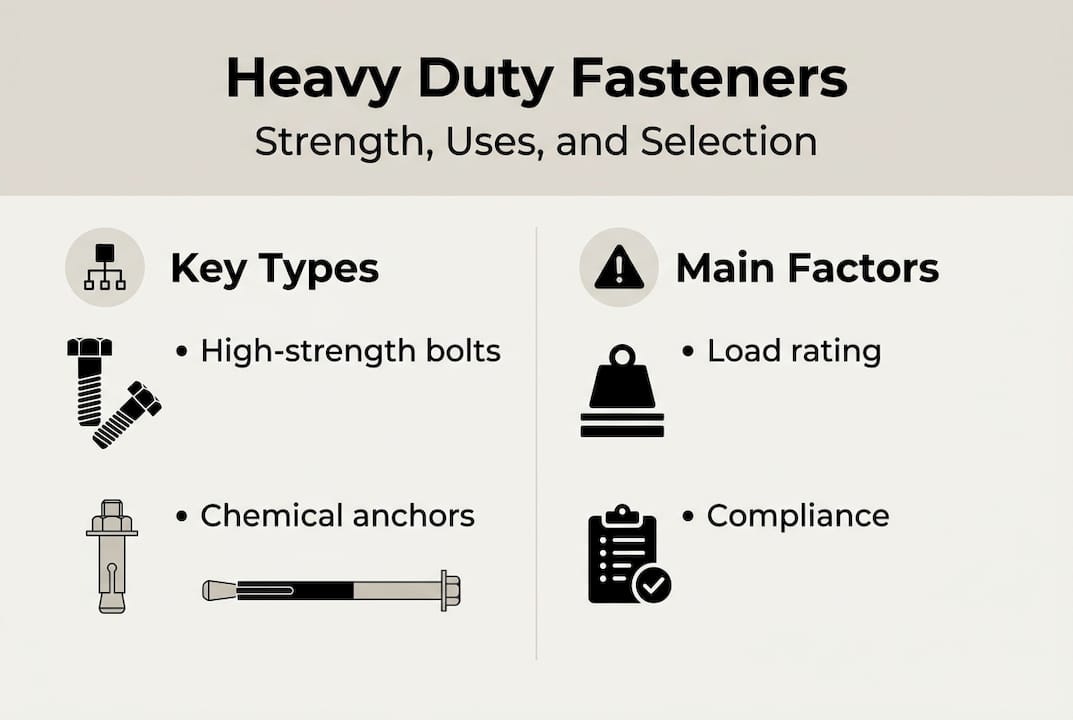
What sets them apart isn’t just raw tensile strength. It’s the combination of material grade, geometric design, surface treatment, and tested performance under real-world conditions. A heavy duty fastener is designed to maintain its clamping force under dynamic loads, resist corrosion in harsh environments, and meet documented compliance requirements. You can explore professional fastener standards to understand how quality is formally defined and verified.
The core types you’ll encounter on Australian construction sites include:
- High-strength structural bolts (grades 8.8, 10.9, 12.9) for steel-to-steel connections
- Expansion anchors such as Dynabolts for medium-load concrete and masonry fixing
- Through bolts for the highest-performance concrete connections
- Chemical anchors for cracked concrete, seismic zones, and edge-sensitive applications
- Masonry screw anchors for lighter structural and non-structural masonry fixings
- Purpose-built structural assemblies including tension control bolt sets
For a broader overview of key fastener types used across Australian projects, it’s worth reviewing the full range before specifying.
Ordinary screws and nails are not substitutes in structural or safety-critical applications. They lack the tensile and shear ratings, the surface treatments, and the tested compliance that heavy duty fixings carry. Using them in the wrong context isn’t just a technical error. It’s a liability.
Material choice matters significantly. Carbon steel suits most interior structural applications. Galvanised steel handles exterior exposure well. For coastal or highly corrosive environments, stainless or coated options are the only sensible choice. Matching material to environment is as important as matching load rating to application.
Remember: A fastener’s grade marking tells you its mechanical properties. Its surface treatment tells you its durability. You need both to be right for the job.
Types of heavy duty fasteners and their key uses
Now that you know what heavy duty fasteners are, let’s break down the most important types and where each excels.
Common types include high-strength bolts across grades 8.8, 10.9, and 12.9, through bolts, Dynabolts, chemical anchors, masonry screws, and structural assemblies. Each has a specific performance profile. Choosing the wrong one for your substrate or load condition is one of the most common and costly mistakes on site.
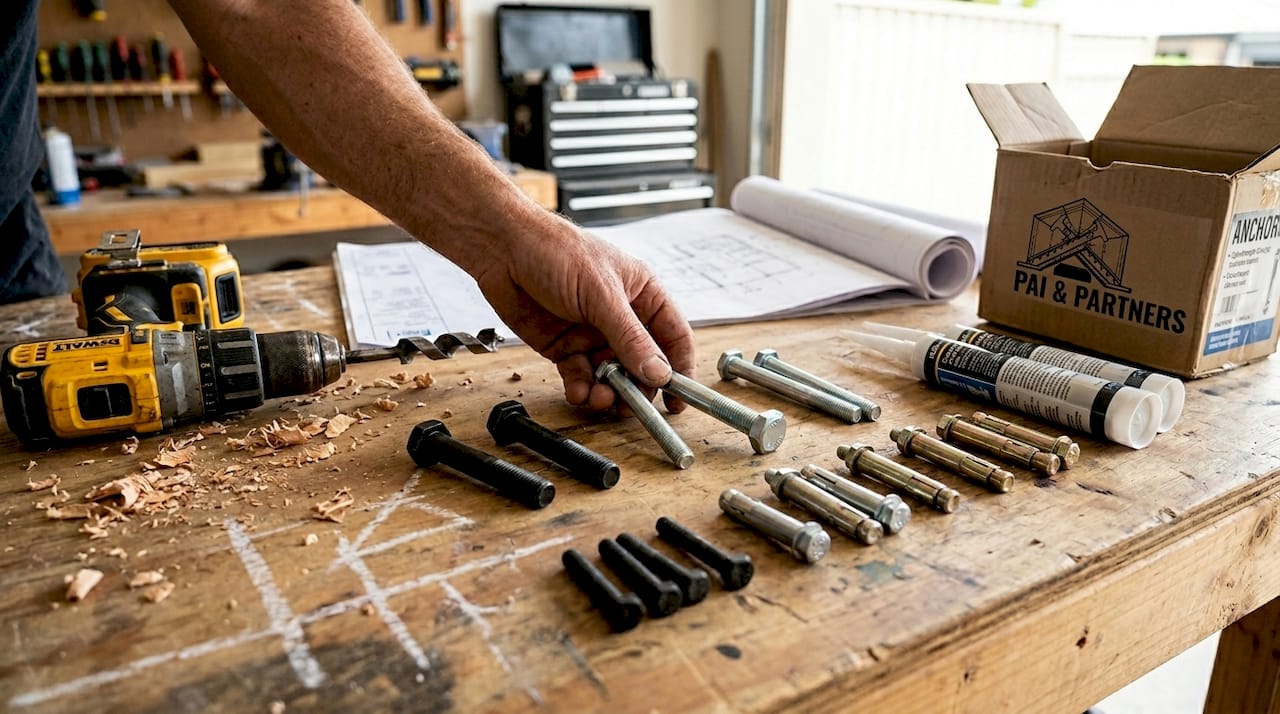
Bolt grades refer to tensile strength. Grade 8.8 offers 800 MPa ultimate tensile strength and suits most structural steel connections. Grade 10.9 steps up to 1000 MPa for higher-load applications. Grade 12.9 reaches 1200 MPa and is used in precision engineering and high-stress mechanical assemblies. For detailed fastener type guidance matched to application, it pays to consult a reliable reference before specifying.
| Fastener type | Load rating | Best application | Key install note |
|---|---|---|---|
| Grade 8.8 bolt | High | Structural steel connections | Torque to specification |
| Grade 10.9 bolt | Very high | Heavy steel framing | Part-turn method recommended |
| Through bolt | Very high | Concrete to steel, highest loads | Full embedment critical |
| Dynabolt (expansion) | Medium | Concrete, masonry, medium loads | No cracked concrete |
| Chemical anchor | High to very high | Cracked concrete, seismic | Cure time required |
| Masonry screw anchor | Low to medium | Non-structural masonry fixing | Correct drill bit essential |
Dynabolts are a practical choice for medium-load applications like handrails, brackets, and equipment mounting. They install quickly and take load immediately. Through bolts are the go-to when you need the highest performance in concrete, particularly for structural connections where load transfer is critical. For load-bearing fastener advice specific to Australian conditions, it’s worth reviewing before finalising your specification.
The Thunderbolt Pro is one example of a through bolt with documented performance data for Australian structural applications, including compatibility with Bluescope steel framing systems.
Pro Tip: Over-specifying grade 12.9 bolts where ductility is needed can actually reduce safety. High-strength grades are less ductile and can fracture suddenly under shock loads rather than deforming gradually. Match the grade to the actual requirement.
Australian standards and compliance for heavy duty fasteners
The right fastener must also be legally and structurally compliant. Here’s how Australian standards come into play.
Australian fastener compliance is governed by standards including AS/NZS 1252 for structural bolting assemblies, AS 5216 for post-installed anchors in concrete, and AS/NZS 4291 for the mechanical properties of fasteners. These aren’t optional guidelines. They’re the baseline for any structural or safety-critical application.
| Standard | What it covers | Where it applies |
|---|---|---|
| AS/NZS 1252 | Structural bolt assemblies, nuts, washers | Steel frame construction |
| AS/NZS 4291 | Mechanical properties of bolts and screws | General structural fastening |
| AS 5216 | Post-installed anchors in concrete | Concrete anchor design and install |
For a deeper look at Australian bolt grades and materials, the markings on compliant fasteners tell you the grade, origin, and standard they meet.
How to check fastener compliance on site:
- Look for the grade marking stamped on the bolt head or anchor body
- Confirm the marking matches the specification in your drawings or engineer’s notes
- Request a test certificate or compliance documentation from your supplier
- Check that the supplier is reputable and sources from known manufacturers
- For critical fixings, verify pull-test requirements with your engineer before installation
Non-compliant fasteners are a genuine risk. Counterfeit or substandard bolts have been found on Australian sites, and they can look identical to the real thing. The only protection is buying from trusted suppliers with documented quality assurance. Understanding fastener durability requirements for Australian conditions is also essential when specifying for coastal or industrial environments.
Pro Tip: For coastal or marine environments, specify 316-grade stainless steel as a minimum. Standard 304 stainless is not sufficient within 500 metres of the ocean. And always confirm pull-test requirements with your structural engineer for any critical anchor installation.
Installation secrets: Avoiding failure and maximising performance
Choosing a strong fastener is useless if it’s installed poorly. Let’s make sure your fixings perform as they should.
Proper installation is where most fastener failures actually originate. The fastener itself is rarely the problem. The process is. Bolts use torque to induce preload, with an M20 grade 8.8 bolt requiring roughly 370 to 410 Nm when dry. The part-turn method is standard for structural bolts. Anchors require precise drilling, thorough hole cleaning, and no overdriving. Each step matters.
Step-by-step installation checklist:
- Select the correct drill bit diameter and depth for the anchor specification
- Drill to the required embedment depth, no shallower
- Clean the hole thoroughly with a brush and compressed air, twice through
- Insert the anchor without overdriving or cross-threading
- Apply torque to the manufacturer’s specified value using a calibrated torque wrench
- Verify embedment and check for any movement or spin
Cracked concrete deserves special attention. Cracked concrete can reduce anchor capacity by 30 to 70 percent depending on crack width and anchor type. Chemical anchors maintain over 80 percent of their rated capacity in cracked concrete, making them the right choice for seismic categories C1 and C2 under AS 5216. Mechanical expansion anchors are often not approved for cracked concrete at all.
For more detailed fastener installation guidance specific to Australian conditions, it’s worth reviewing before tackling any structural fixing job. You can also improve your overall fastening workflow by planning the installation sequence before you start drilling. Torque control details for common bolt sizes are also a useful reference to keep on site.
Pro Tip: On any large structural job, pull-test one to two percent of your anchors after installation. It takes minutes and gives you documented evidence that your fixings are performing to specification.
Mechanical vs chemical anchors: Choosing the right solution
Let’s put two major anchor types head-to-head to make sense of when each is right for you.
Mechanical anchors offer immediate load capacity and faster installation, while chemical anchors deliver higher capacity in cracked or dynamic substrates but require cure time. Neither is universally superior. The right choice depends entirely on your substrate condition, load requirements, and project timeline.
| Factor | Mechanical anchor | Chemical anchor |
|---|---|---|
| Install speed | Fast, immediate load | Slower, cure time required |
| Cracked concrete | Limited or not approved | Approved, high performance |
| Seismic suitability | Limited | Suitable for C1/C2 categories |
| Load capacity | Medium to high | High to very high |
| Cost | Lower | Higher |
Mechanical anchors are ideal when you need to work quickly, the substrate is uncracked, and loads are moderate. Think equipment mounting, non-structural brackets, and temporary fixings.
Chemical anchors are the right call when:
- The substrate is cracked or of uncertain condition
- Seismic design categories apply
- Edge distances are tight and splitting risk is a concern
- You need maximum tension or shear capacity
For seismic anchor design requirements, Hilti’s engineering resources provide detailed guidance on category-specific selection under Australian codes.
Key insight: Ductility can matter as much as raw strength. In seismic applications, an anchor that deforms gradually under overload is often safer than one that fails suddenly at a higher load. Don’t over-specify for strength at the expense of ductility.
When something goes wrong on site, fastening problem-solving resources can help you diagnose the cause quickly and avoid repeating the error.
The real test: What most people miss about heavy duty fasteners
Specs rarely tell the whole story. Here’s the hard-won perspective that experienced tradies wish they’d understood sooner.
A fastener’s data sheet shows what it can do under ideal laboratory conditions. Your job site is not a laboratory. Substrate variability, temperature, moisture, and the quality of the installation itself all affect real-world performance. We’ve seen AS-marked products from reputable suppliers outperform higher-rated alternatives from unknown sources, simply because the quality control behind the marking was genuine.
Trades should insist on trade-grade fastener qualities and randomly test fixings on structural jobs. Not because you distrust the product, but because site conditions vary and documentation protects you.
For DIYers, the single most common failure point isn’t the fastener. It’s substrate preparation. Dusty holes, shallow embedment, and incorrect drill sizing turn even the best anchor into a liability. Slow down on the prep and the rest of the job takes care of itself.
Pro Tip: Document your anchor testing on structural jobs. A simple photo log of torque wrench readings and pull-test results takes minutes and provides real protection if questions arise later.
Find the right heavy duty fasteners and tools for your project
Ready to make the right choice for your next build or repair project?
At Aussie Nails and Fasteners Warehouse, we stock a wide range of AS-compliant heavy duty fasteners suited to professional construction and serious DIY work across Australia. Whether you need structural bolts, anchors, or purpose-built assemblies, our range is sourced from trusted brands with verified quality assurance.
Browse our screw selection for structural and general-purpose applications, or explore our fastener tools to ensure you have the right equipment for precise, compliant installation. Our full fastener range covers everything from expansion anchors to chemical fixing systems, all backed by our commitment to quality and Australian compliance. If you’re unsure what you need, our team is ready to help you specify the right product for your substrate, load, and environment.
Frequently asked questions
What makes a fastener ‘heavy duty’?
Heavy duty fasteners are high-strength devices engineered for demanding construction, industrial, and structural applications. They exceed the strength, durability, and compliance requirements of standard fixings through verified material grades, surface treatments, and tested performance data.
How do Australian standards affect fastener selection?
Australian standards such as AS/NZS 1252, AS 5216, and AS/NZS 4291 set minimum quality and performance benchmarks for safety-critical fastening. Always select AS/NZS-compliant products for structural and load-bearing applications to ensure legal and structural accountability.
What are common installation mistakes with heavy duty fasteners?
The most frequent errors are overdriving anchors, insufficient hole cleaning, and applying incorrect torque. Anchors require precise drilling, thorough cleaning, and torque to the manufacturer’s specified value. Each shortcut compounds the risk of connection failure.
When should I use a chemical anchor instead of a mechanical one?
Choose chemical anchors for cracked or seismic concrete and where higher tension or shear capacity is needed. Chemical anchors maintain over 80 percent capacity in cracked concrete, while mechanical expansion anchors are often not approved for those conditions at all.
Recommended
- What makes a professional fastener: quality, standards, and selection – Aussie Nails and Fasteners Warehouse
- Load-bearing fasteners guide for Australian construction – Aussie Nails and Fasteners Warehouse
- Trade-grade fasteners: 5 essential qualities explained – Aussie Nails and Fasteners Warehouse
- Understanding fastener gauge: a practical guide for construction – Aussie Nails and Fasteners Warehouse