



TL;DR:
- Fastener choice significantly impacts construction sustainability through material origin, coating, and durability. Eco-friendly options like Eco Anchors eliminate concrete and reduce site disturbance, enhancing environmental performance. Proper selection and installation of high-quality, recycled-content fasteners extend lifespan and minimize waste.
Most builders assume that because a screw is small, its environmental footprint is negligible. That assumption is costing the construction industry far more than anyone realises. The reality is that fastener choice, from material to coating to lifespan, directly shapes the sustainability profile of any build. Whether you’re framing a deck in Queensland or anchoring a retaining wall in Victoria, the fasteners you reach for have measurable consequences for carbon emissions, waste generation, and long-term structural integrity. This article breaks down the science, the alternatives, and the practical steps you need to make genuinely sustainable fastening decisions on Australian projects.
Table of Contents
- Why fastener choice matters for sustainability
- Concrete-free alternatives: Eco Anchors explained
- Comparing eco-friendly fastener solutions
- Applying eco-friendly fasteners in Australian projects
- What most builders miss with eco-friendly fasteners
- Explore sustainable fasteners for your next project
- Frequently asked questions
Key Takeaways
| Point | Details |
|---|---|
| Material matters most | Choosing recycled and durable fasteners cuts environmental impact more than any other factor. |
| Eco Anchors offer benefits | Concrete-free Eco Anchors speed up builds and suit sensitive environments, but aren’t right for rocky soils. |
| Quality prevents waste | High-quality fasteners reduce failure, minimise repair costs, and lower embodied carbon over a project’s life. |
| Automation lowers impact | Manufacturing automation reduces fastener energy consumption by up to 27%. |
Why fastener choice matters for sustainability
Fasteners are rarely the first thing that comes to mind in a sustainability conversation. Insulation, timber certification, and solar panels tend to dominate. But when you consider that a single residential build can use tens of thousands of individual fasteners, the cumulative environmental impact becomes impossible to ignore.
Life-cycle analysis (LCA) is the method researchers use to measure that impact across every stage of a product’s existence, from raw material extraction through manufacturing, use, and disposal. Recent fastener LCA benchmarks confirm that material selection and coating type dominate global warming potential (GWP), with recycled content and automated manufacturing significantly reducing those figures. Automation alone can cut energy use by up to 27%, which is a meaningful reduction when you’re talking about millions of fasteners produced annually.
So what does this mean in practice? A few key factors drive the environmental footprint of any fastener:
- Material origin: Virgin steel and aluminium carry far higher embodied carbon than recycled equivalents.
- Coating processes: Electroplating and hot-dip galvanising both consume energy and chemicals, with varying environmental profiles.
- Durability and lifespan: A fastener that fails early forces replacement, generating additional waste and emissions across the entire supply chain.
- End-of-life recyclability: Stainless steel and aluminium are highly recyclable; composite or coated fasteners can be harder to process.
“The single biggest lever you have as a builder or DIYer is choosing a fastener that won’t fail prematurely. Every replacement fastener doubles the environmental cost of that connection.”
Premature failure is a sustainability problem that often goes unacknowledged. When a fastener corrodes or shears under load, you’re not just fixing a structural issue. You’re generating waste, consuming labour, and potentially replacing surrounding materials like timber or cladding that were otherwise sound. Our fastener durability guide covers how to match fastener grade to environmental exposure, which is one of the most effective ways to extend service life.
Understanding professional fastener standards also matters here. Cheap, non-compliant fasteners might save a few dollars upfront but routinely underperform in corrosive coastal environments or high-load applications, leading to exactly the kind of premature failure that undermines sustainable building goals.
Concrete-free alternatives: Eco Anchors explained
Concrete is one of the most carbon-intensive materials in construction, responsible for roughly 8% of global CO2 emissions. Any technology that eliminates concrete from a fastening or foundation application deserves serious attention.
Eco Anchors are a ground anchor system that removes concrete from the equation entirely. According to Eco Anchors information, they are augured directly into soft soils with no excavation required, achieving load capacity up to 12.0kN depending on anchor type and soil conditions. That makes them genuinely viable for a wide range of Australian applications.
Here’s a summary of typical Eco Anchor load capacities to help you assess suitability:
| Anchor type | Typical load capacity | Best application |
|---|---|---|
| Light-duty helix | Up to 3.0kN | Fencing, garden structures |
| Medium-duty helix | Up to 6.5kN | Decking, pergolas, signage |
| Heavy-duty helix | Up to 12.0kN | Retaining structures, boardwalks |
The environmental benefits extend beyond eliminating concrete. Because Eco Anchors require no excavation, site disturbance is minimal, which is critical on sensitive sites like national parks, wetland edges, and heritage areas. They can also be removed and relocated, preserving the integrity of the ground and allowing for reversible construction. That reversibility is something traditional concrete footings simply cannot offer.
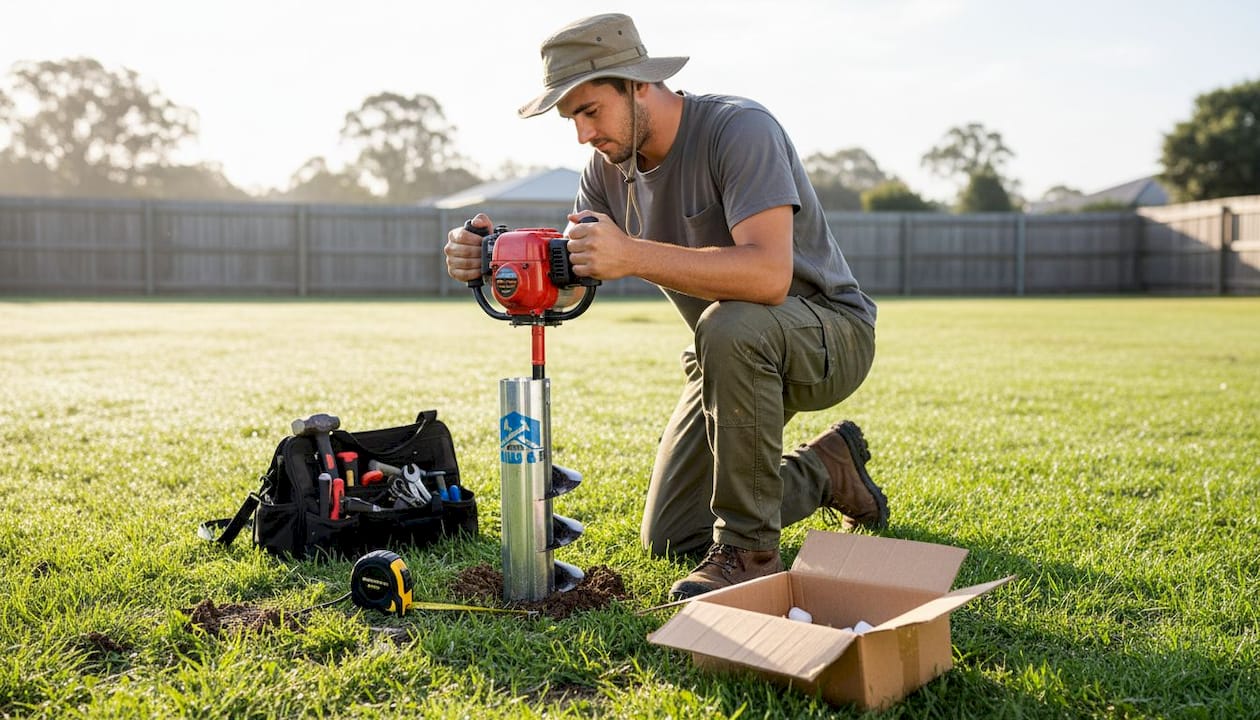
For load-bearing fasteners in soft soil applications, Eco Anchors also reduce transport demands. There’s no need to bring in a concrete mixer, no curing time, and no waiting period before loading. Installation is fast, which reduces on-site labour hours and associated fuel consumption from machinery.
Pro Tip: Before specifying Eco Anchors, always conduct a basic soil assessment. They perform best in sand, clay, and loam. Rocky ground or compacted rubble will prevent proper auguring and compromise holding capacity.
The one genuine limitation is substrate. Eco Anchors are unsuitable for rocky ground, and attempting to install them in hard substrates risks damaging the anchor and achieving no meaningful holding depth. Know your site before you commit to the system.
Comparing eco-friendly fastener solutions
With Eco Anchors in the mix, it helps to see how different fastening approaches compare across the dimensions that matter most for sustainable Australian builds.
| Feature | Traditional fasteners | Eco-friendly fasteners |
|---|---|---|
| Material source | Primarily virgin metals | Recycled content where possible |
| Coating process | Energy-intensive plating | Low-impact or mechanical coatings |
| Durability | Variable, often grade-dependent | Engineered for extended service life |
| Global warming potential | Higher due to material and process | Reduced via recycled content and automation |
| End-of-life | Mixed recyclability | Higher recyclability |
| Concrete dependency | Often required for anchoring | Eliminated with systems like Eco Anchors |

The risks of getting this wrong are real. Premature failure increases waste, and galvanic corrosion can occur when mismatched metals are used together, for example, aluminium fasteners in contact with steel framing or copper-treated timber. That corrosion doesn’t just weaken the connection. It accelerates the degradation of surrounding materials, multiplying the environmental cost.
Here’s what to watch for when selecting eco-friendly alternatives:
- Verify recycled content claims: Ask suppliers for documented material data, not just marketing language.
- Match fastener metal to substrate: Stainless steel in treated pine, hot-dipped galvanised in exposed outdoor applications.
- Check coating compatibility: Some eco-friendly coatings are not suitable for high-humidity or marine environments.
- Avoid mixing metals: Galvanic corrosion is a silent failure mode that undermines both structural integrity and sustainability goals.
Our construction fastening tips go deeper on material compatibility, and if you’re still building your knowledge base, the guide to essential fastener types is a solid starting point for understanding which fastener families suit which applications.
Applying eco-friendly fasteners in Australian projects
Knowing the theory is one thing. Putting it into practice on a real Australian project is another. Here’s a practical framework for integrating eco-friendly fasteners from the planning stage through to installation.
- Assess your site conditions first. Soil type, moisture exposure, proximity to the coast, and substrate material all determine which eco-friendly fastener options are viable. A beachside deck in New South Wales faces very different conditions than an inland pergola in South Australia.
- Select materials based on performance and sustainability together. Don’t sacrifice one for the other. A stainless steel screw with recycled content that lasts 25 years is far more sustainable than a budget alternative that corrodes in five.
- Plan for reversibility where possible. Screws are more sustainable than nails in many applications because they allow disassembly and material recovery at end of life. Eco Anchors extend this principle to ground-level connections.
- Install correctly to maximise lifespan. Pre-drilling in hardwood prevents fastener shear. Using the right torque setting avoids stripping. Proper installation is a sustainability act, not just a quality one.
- Document your choices. For professional builds, keeping records of fastener specifications supports green building certifications and makes future maintenance far more straightforward.
Pro Tip: When working with woodworking fastener types in treated timber, always confirm the fastener’s compatibility with the specific treatment chemical. Some treatments accelerate corrosion in standard galvanised fasteners, requiring stainless steel or hot-dipped alternatives.
For more detailed guidance on technique, our fastener installation tips cover the practical side of getting eco-friendly fasteners to perform as intended. Remember, sub-standard fasteners not only fail faster but generate more waste across the project lifecycle, which is the opposite of what sustainable building demands.
What most builders miss with eco-friendly fasteners
Here’s the uncomfortable truth: many supposedly sustainable builds are undermined by the very fasteners holding them together. We see it regularly. A builder invests in certified timber, low-VOC finishes, and energy-efficient glazing, then reaches for the cheapest box of screws on the shelf because fasteners feel like a minor detail.
They are not a minor detail. The environmental impact undone by a single round of corrosion-driven rework can outweigh months of careful material selection elsewhere. Experienced builders who genuinely care about sustainability treat metal fastening solutions as a core specification decision, not an afterthought.
What separates them from the rest is a commitment to material compatibility and quality from the start. They understand that a fastener’s sustainability credentials are meaningless if it fails in three years. The best eco-friendly outcome is always a fastener that performs reliably for the full life of the structure, requiring no replacement, no rework, and no additional resource consumption.
Explore sustainable fasteners for your next project
Ready to put these principles into practice? At Aussie Nails and Fasteners Warehouse, we stock a wide range of fastening solutions suited to sustainable Australian builds, from corrosion-resistant screws through to specialist anchoring systems.
Browse our screws collection to find options matched to your substrate, environment, and sustainability goals. If you need the right equipment to drive them accurately and efficiently, our tools collection covers pneumatic and power fastening tools from trusted brands including JITOOL, APlus, and Supco. Our team is here to help you make informed choices that hold up over the long term, for your project and for the environment.
Frequently asked questions
What makes a fastener eco-friendly?
Eco-friendly fasteners use recycled materials, efficient manufacturing processes, and offer high durability to reduce waste and environmental impact. LCA benchmarks confirm that material and coating choices dominate global warming potential, making these decisions the most impactful ones you can make.
Are Eco Anchors suitable for all Australian construction sites?
Eco Anchors perform best in soft soils such as sand and clay, but are unsuitable for rocky ground or hard substrates where auguring is not possible. Always assess soil conditions before specifying them.
How can I avoid premature fastener failure in sustainable builds?
Select high-quality fasteners matched to your substrate and environment, avoid mismatched metals that cause galvanic corrosion risk, and follow expert installation advice to maximise service life and minimise waste.
Does automation really reduce the environmental impact of fasteners?
Yes. Automated manufacturing can cut energy use by up to 27%, directly lowering the global warming potential of fasteners produced at scale.
Recommended
- Understand fastener durability: Build stronger Australian projects – Aussie Nails and Fasteners Warehouse
- Top construction fastening tips for secure, lasting builds – Aussie Nails and Fasteners Warehouse
- Best metal fastening solutions for Australian projects 2026 – Aussie Nails and Fasteners Warehouse
- Essential fastener types for Australian construction: 8 key picks – Aussie Nails and Fasteners Warehouse