



TL;DR:
- Australia’s harsh climate makes stainless steel fasteners essential for durability and corrosion resistance.
- Long-term cost savings outweigh higher upfront prices due to reduced replacement and maintenance.
- Proper installation techniques, including thread cleaning and anti-seize, prevent galling and ensure fastener performance.
Rusted fasteners on a build that’s barely a few years old is one of the most frustrating problems a tradie or DIYer can face. You did everything right, or so you thought, yet the screws are weeping rust, the deck boards are staining, and the fixings are backing out. The truth is, Australia’s climate is genuinely brutal on standard fasteners, and the material you choose matters far more than most people realise. Stainless steel fasteners aren’t a premium indulgence; they’re a practical necessity for anyone who wants their work to last, stay safe, and look good for decades.
Table of Contents
- What makes stainless steel fasteners different?
- Why corrosion resistance matters in Australia
- The cost factor: up-front vs long-term value
- Avoiding installation pitfalls: what pros and DIYers need to know
- A hard-won lesson: why you can’t cut corners on fastener quality
- Get the right fasteners for your next project
- Frequently asked questions
Key Takeaways
| Point | Details |
|---|---|
| Unmatched corrosion resistance | Stainless steel fasteners outlast others, especially in Australia’s harsh climates. |
| Long-term savings | The higher upfront price is offset by years of maintenance-free, reliable service. |
| Proper installation matters | Following expert installation advice avoids common issues like galling and ensures long life. |
| Choose quality first | Cutting corners on fasteners leads to expensive failures and avoidable repairs. |
What makes stainless steel fasteners different?
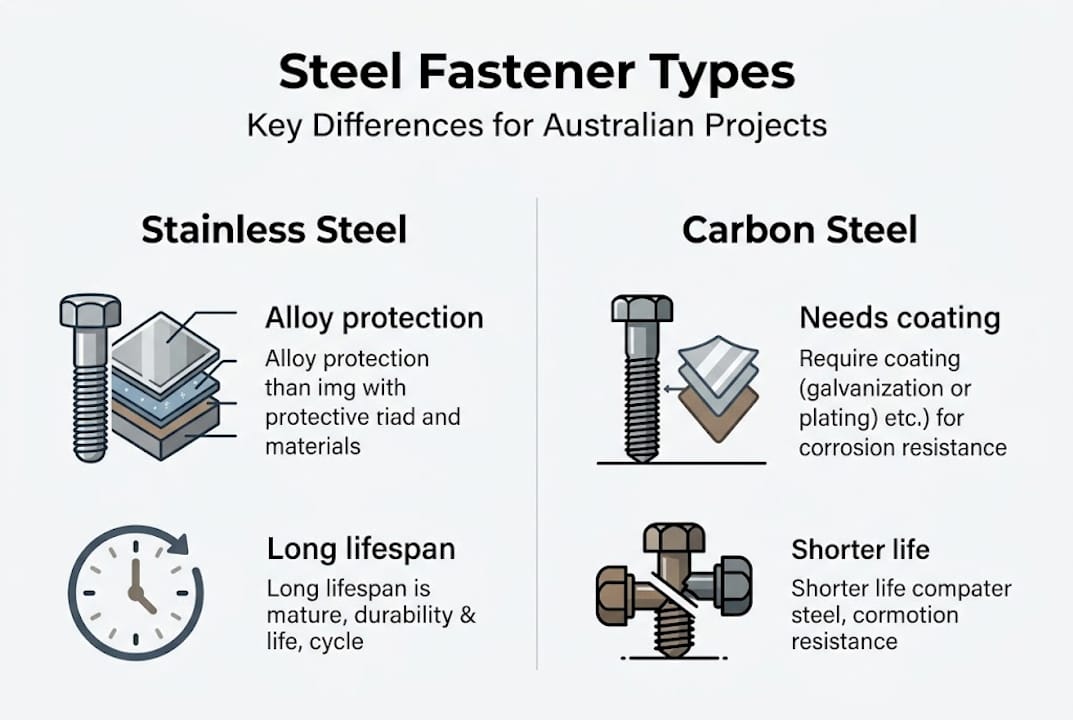
Stainless steel isn’t just shiny steel. It’s an alloy, typically iron combined with a minimum of 10.5% chromium, and that chromium content is the real secret. When exposed to oxygen, chromium forms a thin, invisible layer of chromium oxide on the surface. This passive layer self-repairs if scratched, which means the corrosion protection is built directly into the metal rather than applied as a coating that can chip or wear away.
Compare that to carbon steel fasteners, which rely on coatings or plating for protection. Once that coating is breached during installation or through wear, the bare steel underneath starts corroding immediately. Galvanised fasteners are a step up, using a zinc coating to slow rust, but in salty coastal air or high-humidity environments, the zinc sacrifices itself over time and corrosion still wins. Understanding the essential fastener types available in Australia helps clarify why material selection is so critical before you even start a project.
| Feature | Stainless steel | Carbon steel | Galvanised steel |
|---|---|---|---|
| Corrosion resistance | Excellent | Poor (uncoated) | Moderate |
| Strength | High | Very high | High |
| Coastal suitability | Excellent (316 grade) | Poor | Moderate |
| Maintenance required | Very low | High | Low to moderate |
| Upfront cost | Higher | Lowest | Moderate |
| Service life | 20-50+ years | 5-15 years | 10-25 years |
| Recyclability | 100% | Partial | Partial |
One figure that rarely gets enough attention is sustainability. 100% recyclable, stainless steel has one of the highest recycling rates of any construction material, which matters for builders chasing green certifications or simply wanting to reduce waste on site.
The numbers speak clearly: stainless steel fasteners cost 2-4x more upfront than carbon steel alternatives, yet their low maintenance requirements and elimination of rust-related replacements make them the lower-cost option over a 20-year build life.
For professionals quoting long-term projects, that’s a compelling argument to put in front of a client. For DIYers, it means fewer trips back to the hardware store and no unsightly rust bleed on your new fence or deck.
Why corrosion resistance matters in Australia
Australia is not a gentle environment for metal. The combination of UV intensity, salt-laden coastal air, tropical humidity in the north, and the wet-dry extremes of inland regions creates conditions that accelerate corrosion dramatically compared to temperate climates elsewhere in the world.
Within just a few kilometres of the coastline, salt particles carried on the wind deposit on every exposed surface. Carbon steel can begin visibly rusting within months in these conditions. The fastener durability guide for Australian projects highlights just how quickly the wrong material choice translates into structural compromise.
Here are the project types where corrosion risk is highest and stainless steel is essentially non-negotiable:
- Decking and outdoor structures within 5 kilometres of the ocean
- Roofing and cladding exposed to rain, condensation, and UV
- Fencing set into soil or concrete, where moisture contact is constant
- Marine and waterfront applications including jetties, boat sheds, and pool surrounds
- Urban builds where industrial pollution accelerates atmospheric corrosion
A useful stat: stainless steel fasteners in coastal environments can outlast galvanised equivalents by a factor of three to five, depending on proximity to the water and grade selection.
Grade selection is where many builders make an avoidable mistake. Grade 304 stainless steel is suitable for most inland and sheltered applications. It provides excellent general corrosion resistance and handles humidity well. Grade 316, however, adds molybdenum to the alloy, which dramatically improves resistance to chloride attack, the kind caused by saltwater and pool chemicals. For anything within 500 metres of the ocean, or any pool-adjacent project, 316 is the only sensible choice.
Pro Tip: If you’re unsure which grade to specify, default to 316 for exterior applications near the coast. The price difference between 304 and 316 fasteners is minor compared to the cost of replacing corroded fixings three years into a job. Check our fastening tips for lasting builds for a practical grade selector based on project type.
Carbon steel is stronger for high-load dry interiors, but it fails quickly outdoors, while stainless steel balances strength and corrosion resistance for longevity in humid and salty Australian conditions.
The cost factor: up-front vs long-term value
Let’s be direct: stainless steel fasteners cost more at the point of purchase. Depending on size and grade, you’re typically looking at 2-4x the price of equivalent carbon steel options. For large projects involving thousands of fasteners, that difference adds up quickly and it’s often the first thing a budget-conscious client or project manager pushes back on.
But that framing ignores the real cost equation. Consider what happens when cheaper fasteners fail.
| Cost category | Stainless steel | Carbon/galvanised steel |
|---|---|---|
| Upfront cost per 100 fasteners | Higher | Lower |
| Replacement at 5 years | Unlikely | Probable in coastal areas |
| Replacement at 10 years | Very unlikely | Near certain outdoors |
| Rust stain remediation | None | Moderate to high |
| Labour for re-fastening | None | Significant |
| Total 20-year cost | Lower | Higher |
Here’s how the long-term value stacks up in practice:
- No replacement cost. Stainless fasteners in the right grade rarely need replacing within the life of the structure.
- No rust staining. Iron oxide bleed from carbon steel ruins paintwork, stains timber, and damages aesthetics.
- No structural rework. Corroded fasteners can cause boards to lift, joints to fail, and entire sections to need rebuilding.
- Lower insurance risk. Structural failures from corroded fixings can carry liability implications for builders and owners alike.
- Higher resale value. Properties built with quality materials command better sale prices and pass inspections more easily.
Pro Tip: When presenting a stainless steel specification to a client who balks at the cost, frame it as an insurance policy with a guaranteed payout. The extra spend today eliminates a near-certain repair bill in five to ten years. For detailed guidance on specifying fasteners by load requirement, the load-bearing fasteners guide is a practical starting point.
Avoiding installation pitfalls: what pros and DIYers need to know
Stainless steel fasteners perform brilliantly when installed correctly. But there’s a common problem that catches out even experienced tradies: galling.
Galling is a form of thread seizure that happens when two stainless steel surfaces under pressure weld together due to friction during installation. The ductile nature of stainless steel means the threads can literally fuse, leaving you with a fastener that’s impossible to remove without damage. Stainless steel is prone to galling due to its ductility, and the risk increases significantly with larger fasteners, particularly M16 and above.
Follow these steps to prevent galling and get the best results from your stainless fasteners:
- Clean threads before installation. Dirt, grit, or metal shavings dramatically increase friction and galling risk.
- Apply anti-seize lubricant. A small amount on the threads before installation is the single most effective prevention method.
- Tighten slowly and steadily. High-speed power tools generate heat and increase the chance of thread seizure. Use a low-torque setting.
- Use calibrated torque. Stainless fasteners have specific torque ratings. Over-tightening can cause galling even with lubrication.
- Consider dissimilar metals for nuts and bolts. Pairing a stainless bolt with a silicon bronze nut, for example, reduces galling risk significantly compared to full stainless pairings.
Pro Tip: For M16 fasteners and larger, always use a torque wrench and apply anti-seize as standard practice, not as an afterthought. The time saved by skipping this step never outweighs the time lost dealing with a seized fastener mid-installation. Review the fastener installation tips for a full breakdown of correct technique by fastener type.
Expert advice: Never assume that because two components are both stainless they’ll play nicely together under torque. Grade mismatches, thread condition, and installation speed all affect galling risk. Treat every large stainless installation as if galling is the default outcome unless you actively prevent it.
A hard-won lesson: why you can’t cut corners on fastener quality
After years of supplying fasteners to builders, contractors, and dedicated DIYers right across Australia, one truth comes up again and again: the jobs that go wrong almost always come down to a material compromise that seemed insignificant at the time.
There’s a common mindset in construction that says ‘good enough is good enough.’ And for many decisions, that’s reasonable. But fasteners are the one component in any build that holds everything else together, literally. When they fail, nothing else matters.
We’d challenge the idea that professional fastener standards are only for high-end or commercial work. Every deck, every fence, every roof needs fasteners that will perform for the life of the structure. Australia’s environment doesn’t give cheap materials a pass just because the project was a modest suburban renovation.
The real cost of a callback, a warranty repair, or worse, a structural failure is never smaller than the cost of specifying correctly in the first place. Invest in quality upfront. Your reputation, and your clients’ safety, depends on it.
Get the right fasteners for your next project
Now that you know what to look for, the next step is sourcing fasteners you can trust for the job at hand.
At Aussie Nails and Fasteners, we stock an extensive range of stainless steel screws in both 304 and 316 grades, suitable for every application from coastal decking to structural roofing. We also carry a full selection of fastener tools to make installation faster, safer, and more accurate. Whether you’re a tradie pricing a large job or a DIY enthusiast tackling a weekend project, our team is ready to help you choose the right product. Get in touch or browse our range online today.
Frequently asked questions
Are stainless steel fasteners always rust-proof?
Stainless steel is highly corrosion-resistant but not completely rust-proof. Correct grade selection and proper installation are essential to achieving the best long-term performance, particularly in humid or salty Australian environments.
Why are stainless steel fasteners more expensive?
Their higher price reflects the quality of the alloy, long service life, and extremely low maintenance requirements. The 2-4x upfront cost over carbon steel is consistently offset by avoided replacement and repair costs over the life of any outdoor structure.
How can I prevent galling when installing stainless steel fasteners?
Apply anti-seize lubricant to threads, tighten slowly using correct torque, and where possible pair dissimilar metals for nuts and bolts. Lubricating threads before installation is the single most effective step to prevent thread seizure.
When should I use 316 stainless steel fasteners?
Use 316 for any coastal, marine, or highly corrosive environment, including pool surrounds and beachside structures. Grade 304 balances strength and corrosion effectively for most inland and sheltered applications where chloride exposure is low.
Recommended
- Essential fastener types for Australian construction: 8 key picks – Aussie Nails and Fasteners Warehouse
- Best metal fastening solutions for Australian projects 2026 – Aussie Nails and Fasteners Warehouse
- Understand fastener durability: Build stronger Australian projects – Aussie Nails and Fasteners Warehouse
- Best woodworking fastener types for Australian projects – Aussie Nails and Fasteners Warehouse