



TL;DR:
- Thread type determines screw grip, speed, and holding power across materials.
- Coarse threads excel in softwoods and thin metals, while fine threads suit hard materials.
- Compliance with Australian standards and correct thread selection ensure structural safety and avoid failures.
Grab two screws from a toolbox and they might look almost identical, yet drive one into pine framing and the other into a steel bracket and you will notice an immediate difference in grip, speed, and holding power. Thread type is the hidden variable behind that difference. Coarse threads outperform fine by 20 to 30% in softwoods, yet many builders and renovators still choose screws by size alone. This guide walks you through what thread type actually means, how it shapes performance across different materials, what Australian Standards require, and how to make the right call every time you reach for the drill.
Table of Contents
- The basics: What is thread type in screws?
- How thread choice affects performance
- Australian standards and regulations: Why they guide your screw choice
- Application in the field: Matching thread type to project needs
- Common myths and pitfalls when choosing screw threads
- Our perspective: Why mastering thread type sets you apart
- Find the right screws for your next project
- Frequently asked questions
Key Takeaways
| Point | Details |
|---|---|
| Thread type affects strength | Choosing coarse or fine threads directly impacts grip, load, and safety. |
| Standards simplify selection | Australian Standards specify the default thread types for common projects. |
| Match thread to material | Coarse threads suit softwoods and thin metals; fine threads excel in hardwoods or precision jobs. |
| Avoid myths and shortcuts | Misunderstandings about threads lead to weak, non-compliant builds. |
The basics: What is thread type in screws?
Thread type describes the geometry of the spiral ridge wound around a screw’s shank. Three measurements define it: pitch (the distance between adjacent threads), depth (how far the thread projects from the shank), and profile (the shape of the thread cross-section). Together these determine how a screw bites into a material, how fast it drives, and how well it holds under load.
In Australia, metric coarse threads conform to AS 1275 and dominate general construction. Fine metric threads appear in specialised applications such as precision machinery, automotive components, and assemblies subject to vibration. Understanding fastener terminology basics is the first step to reading a product spec sheet with confidence.
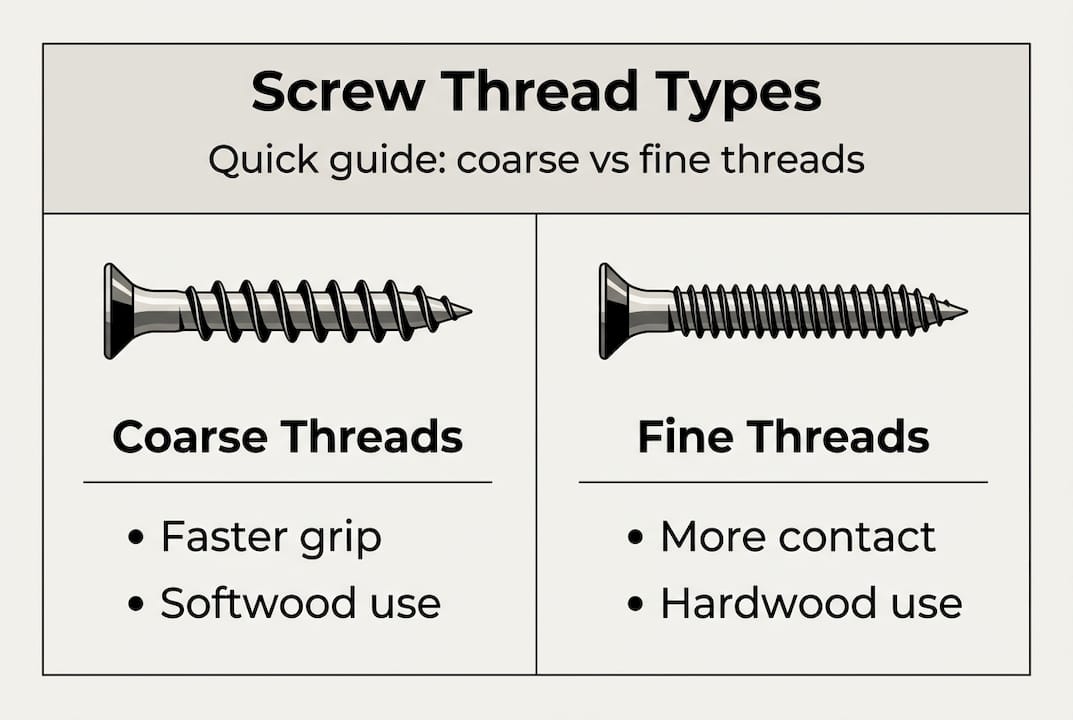
The physical differences between coarse and fine threads are easy to see once you know what to look for. Coarse threads have a larger pitch, fewer threads per unit length, and deeper engagement into the substrate; fine threads have a smaller pitch, more threads per unit length, and shallower engagement.
| Characteristic | Coarse thread | Fine thread |
|---|---|---|
| Threads per inch (TPI) | 8 to 18 (typical) | 24 to 32 (typical) |
| Pitch | Larger | Smaller |
| Thread depth | Deeper | Shallower |
| Material engagement | High | Moderate |
| Drive speed | Faster | Slower |
Key points to remember:
- Coarse threads remove material faster and are more forgiving when driving into uneven grain
- Fine threads create more contact points and resist loosening under vibration
- Pitch is measured in millimetres for metric screws (e.g., M8 x 1.25 means 1.25 mm between threads)
How thread choice affects performance
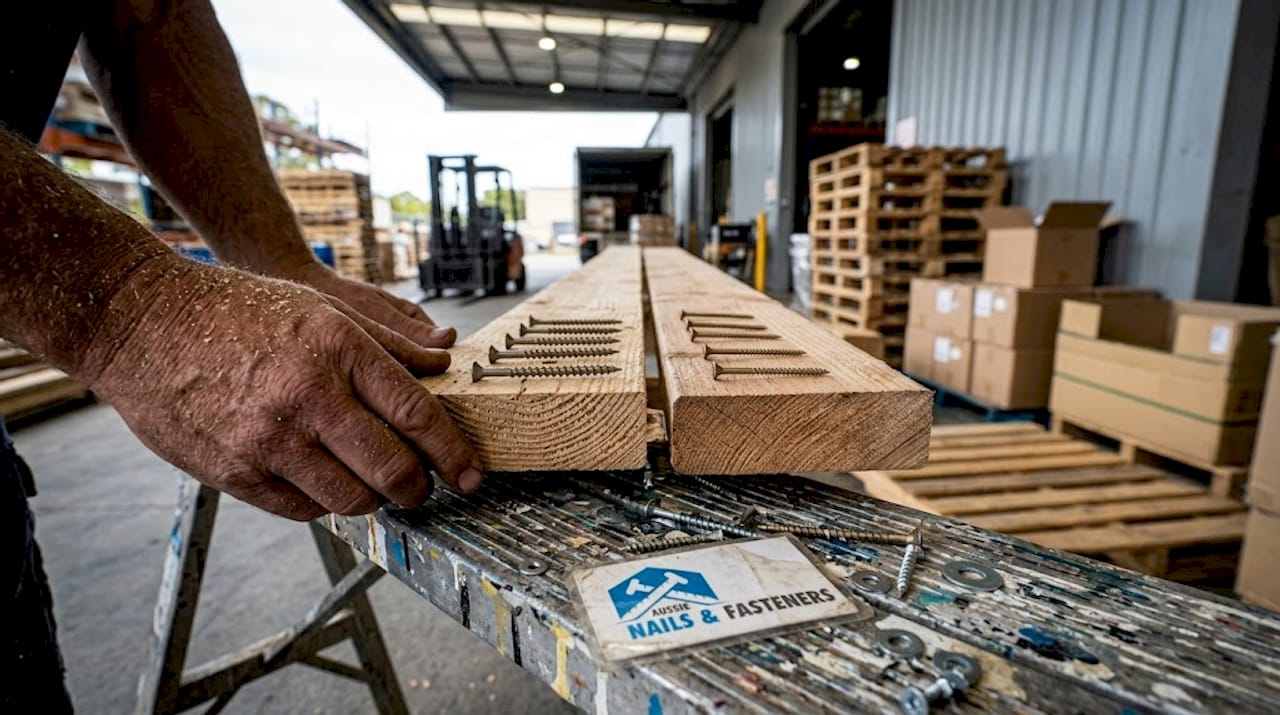
Picking the wrong thread type is one of the most common and costly mistakes on a build. Coarse threads in softwoods and thin metals deliver better grip, higher pull-out strength, faster installation, and lower stripping risk. Fine threads shine in hardwood, thick steel, and precision assemblies where controlled torque matters.
Here is how that plays out across common materials:
| Material | Best thread type | Why |
|---|---|---|
| Softwood (pine, cypress) | Coarse | Deep bite, high withdrawal strength |
| Hardwood (ironbark, spotted gum) | Fine or coarse (pilot hole needed) | More thread contact, less splitting |
| MDF / particleboard | Coarse | Wide threads resist pull-through |
| Thin sheet metal | Fine | More threads in contact with thin stock |
| Thick structural steel | Coarse | Fast engagement, strong hold |
| Plastic components | Coarse (self-tapping) | Wide spacing prevents cracking |
Common scenarios where thread mis-selection leads to failure:
- Using fine threads in pine framing: screws drive slowly, heat up, and often strip before reaching full torque
- Using coarse threads in thin sheet metal: too few threads engage the material, reducing clamp force significantly
- Over-driving fine threads in MDF: shallow engagement crushes the fibres and pulls straight through under load
- Applying coarse screws in high-vibration machinery: they work loose over time because the wide pitch offers less resistance to rotational movement
For practical guidance on choosing fastening tips that suit structural loads, our blog covers a range of real-world scenarios. If you are working with timber specifically, our overview of wood screw types walks through species-specific recommendations.
Pro Tip: Always check the material hardness before selecting thread type. A quick Janka rating lookup for the timber you are working with can save a ruined panel or a stripped screw hole.
Australian standards and regulations: Why they guide your screw choice
Beyond performance, thread selection carries a compliance dimension that matters most on regulated projects. In Australia, metric coarse threads under AS 1275 and AS 1721 are the default for general construction, while fine threads are reserved for precision or vibration-heavy applications.
AS 1275 covers metric screw thread profiles and tolerances. AS 1721 addresses thread gauging systems. Together they ensure that screws, bolts, and nuts from different manufacturers fit together predictably. A fastener that falls outside these tolerances can slip under inspection, creating liability for the builder and safety risks for the occupant.
Non-compliant fastener selection is among the leading causes of failed structural inspections in residential construction across Australia, with thread mismatch flagged in a significant proportion of defect reports reviewed by certifiers.
This is not a theoretical concern. Certifiers and building inspectors in Australia do check fastener specifications, particularly on structural connections, decking, and cladding fixings. Choosing the wrong thread type can mean rework, delays, and in serious cases, personal liability.
For broader guidance on fastener grades for compliance, the grade and thread type work together to define suitability. Our rundown of essential fastener types also helps you cross-reference standard applications.
Top compliance tips:
- Always specify thread type on plans and material schedules for regulated builds
- Keep product data sheets for the screws used; inspectors may ask for them
- Never substitute a fine thread screw for a coarse thread screw in a structural connection without engineering sign-off
- Match thread class (tolerance grade) to the application; general construction typically uses 6H/6g class
Application in the field: Matching thread type to project needs
Knowing your standards is one thing; applying that knowledge under pressure on-site is another. Here is a straightforward process for choosing the right thread type before you drive a single screw.
- Identify the substrate. Is it softwood, hardwood, sheet metal, or engineered board? Each calls for a different thread geometry.
- Assess the load type. Static load? Go coarse in timber. Dynamic or vibrating load? Fine threads or locking fasteners are worth considering.
- Check the relevant standard. For structural work, confirm whether AS 1275 or a product-specific standard applies.
- Consider engagement length. With short engagement, the first 2 to 3 threads carry 70 to 80% of the load, so thread type and depth matter enormously when you cannot drive a long screw.
- Select and test. Drive a test screw into offcut material before committing to a full run.
Real-world examples:
- Decking in pine: Coarse thread, Type 17 point, 65 to 75 mm length. Drives fast, grips well, resists seasonal movement.
- Sheet metal fixing: Fine thread, self-drilling point, matched to metal gauge. More thread contact, clean finish.
- Hardwood cabinetry: Pre-drill with a pilot hole, then use a coarse or fine thread depending on thickness. Fine threads in dense hardwood reduce splitting.
Red flags that suggest a thread mismatch in existing work:
- Screw heads sitting proud after full drive (stripped threads)
- Visible gaps at joints that were initially tight
- Squeaking or movement in a previously rigid structure
- Rust tracks running from screw heads in treated timber (wrong material grade combined with wrong thread)
For load-bearing fastener advice on critical connections, always consult engineering specifications alongside thread selection.
Pro Tip: When in doubt, default to standard coarse thread for compliance and safety on general timber builds. It is the thread type Australian Standards are written around.
Common myths and pitfalls when choosing screw threads
Even experienced tradespeople carry assumptions about screw threads that simply are not accurate. Getting these wrong can compromise a job silently, with failures appearing months or years after completion.
Myth 1: All threads hold the same. Incorrect. Thread geometry directly affects withdrawal strength, drive speed, and stripping resistance. The difference can be significant enough to cause structural failure under load.
Myth 2: Fine is always stronger. Fine threads have more contact points, but that does not automatically translate to higher holding power in all materials. In soft substrates, the shallow profile of fine threads can pull through under load.
Myth 3: Standards are optional for small jobs. Even a small deck or pergola can be subject to council inspection in Australia, and a non-compliant fastener creates personal liability for the installer.
Pitfall: Ignoring engagement length. The first 2 to 3 threads bear the majority of load under short engagement, a fact misunderstood by many. If your screw is not fully engaged, the thread type you chose matters even more than in a fully engaged connection.
Consequences in the field:
- Stripped threads in MDF shelving that collapses under normal use
- Sheet metal fixings that pull free in wind events because fine threads never fully engaged thin gauge steel
- Structural connections rejected at inspection, triggering costly rework
- Callbacks and reputational damage for trades who overlooked thread basics
For guidance on heavy duty fastener selection in demanding applications, thread type is just one part of a broader specification decision.
Pro Tip: Check your engagement length before finalising screw selection. If you are driving into a thin substrate or short connection, a coarse thread with deeper bite will compensate for limited depth far better than a fine thread will.
Our perspective: Why mastering thread type sets you apart
After years of supplying fasteners to builders, cabinet makers, and serious DIYers across Australia, we have seen one pattern repeat itself. The professionals who rarely have callbacks are the ones who treat thread selection as deliberately as they treat timber selection or structural design. They are not guessing; they are matching.
Most advice online stops at coarse versus fine. What gets left out is the interplay between engagement length, substrate hardness, and the standard that governs the connection. That gap is where good work becomes professional fastener selection worth standing behind.
The single biggest lesson from years in this trade: the right screw driven correctly into the right substrate rarely fails. When something does fail, the answer almost always traces back to a mismatch between thread type and material, or a shortcut taken under time pressure. Thread type is not a minor detail. It is a foundational decision, and understanding it is what separates builds that last decades from ones that quietly deteriorate.
Find the right screws for your next project
Now that you understand how thread type shapes every joint and connection in your build, the next step is putting that knowledge to work with screws you can trust. At Aussie Nails and Fasteners Warehouse, we stock an extensive range of quality screws suited to timber, metal, masonry, and engineered board applications across Australian conditions.
Not sure which thread is right for your specific project? Our team is here to help you choose the correct specification the first time. Browse our tools for screwing to pair the right driver with your fasteners, and explore the full range of fastening solutions from trusted brands including JITOOL, APlus, and Supco. Compliance-ready, project-proven, and backed by genuine Australian expertise.
Frequently asked questions
What is the main difference between coarse and fine thread screws?
Coarse threads have fewer, deeper threads for faster grip in soft materials, while fine threads have more threads per unit length for better precision and holding power in hard or thin materials.
Which thread type is best for softwood?
Coarse thread screws are the best choice for softwoods like pine, providing 20 to 30% better pull-out strength and faster installation with less stripping risk.
Are there regulations in Australia about which thread to use?
Yes. AS 1275 and AS 1721 specify metric thread standards for Australian construction, with coarse threads as the default for general-purpose fastening.
Does short engagement affect how much load a screw can take?
Absolutely. When engagement is short, the first 2 to 3 threads carry 70 to 80% of the total load, making thread type and depth especially critical in thin substrates.
What happens if I use the wrong thread type?
Using the wrong thread can result in weak joints, stripped holes, and failed compliance inspections, particularly on regulated projects where fastener specifications are checked by certifiers.
Recommended
- Fastener grades explained: A practical guide for Aussie builds – Aussie Nails and Fasteners Warehouse
- Top construction fastening tips for secure, lasting builds – Aussie Nails and Fasteners Warehouse
- Understand industry fastener terminology for better builds – Aussie Nails and Fasteners Warehouse
- How to install screws for strong, secure results every time – Aussie Nails and Fasteners Warehouse