



TL;DR:
- High tensile screws are made from alloy steel and heat-treated for superior load capacity.
- Proper selection and installation of high tensile screws ensure long-lasting, vibration-resistant joints.
- Using the correct grade and following safety practices prevents brittleness and hydrogen embrittlement risks.
Most builders assume one screw is as good as another. Grab a handful from the bin, drive them in, and move on. But that assumption has quietly caused joint failures, structural callbacks, and costly remediation on Aussie job sites across the country. High tensile screws are fundamentally different from standard hardware, engineered to carry loads and resist forces that would destroy an ordinary fastener within months. Whether you’re framing a deck, bolting steel sections on a commercial build, or tackling a heavy timber connection, understanding which screw grade to reach for is the difference between a build that lasts and one that doesn’t.
Table of Contents
- What makes a screw high tensile?
- Key benefits of high tensile screws in construction
- Trade-offs, risks, and how to mitigate them
- When and where high tensile screws make the difference
- Our take: What most builders get wrong about high tensile screws
- Get the right high tensile screws and advice for your next project
- Frequently asked questions
Key Takeaways
| Point | Details |
|---|---|
| Superior strength | High tensile screws handle far greater forces than standard fasteners, making your builds safer. |
| Vibration and fatigue resistance | They form friction-grip joints that hold tight, even under movement and dynamic loads. |
| Consider grade and risk | Choosing the right screw grade avoids both over-specification and safety risks. |
| Mitigate brittle failures | Proper selection, coating, and treatment reduce embrittlement and maximise lifespan. |
What makes a screw high tensile?
Not all screws that look similar perform the same. The term “high tensile” refers to a fastener’s minimum tensile strength, which is the maximum stress it can withstand before breaking. Standard screws are typically made from low or medium carbon steel with little or no heat treatment. High tensile screws, by contrast, are manufactured from alloy steel and put through a controlled heat treatment process to dramatically increase their strength.
The grade marking system tells you exactly what you’re getting. You’ll see numbers like 8.8, 10.9, and 12.9 stamped on the head of a bolt or screw. The first number indicates 1/100th of the nominal tensile strength in megapascals (MPa). The second number, when multiplied by the first, gives you the yield strength ratio. So a Grade 8.8 screw has a tensile strength of around 800 MPa and a yield strength of roughly 640 MPa. Grade 10.9 pushes that to 1000 MPa tensile and 900 MPa yield. In practice, Grade 10.9 provides 30% more preload capacity than Grade 8.8 for the same diameter.
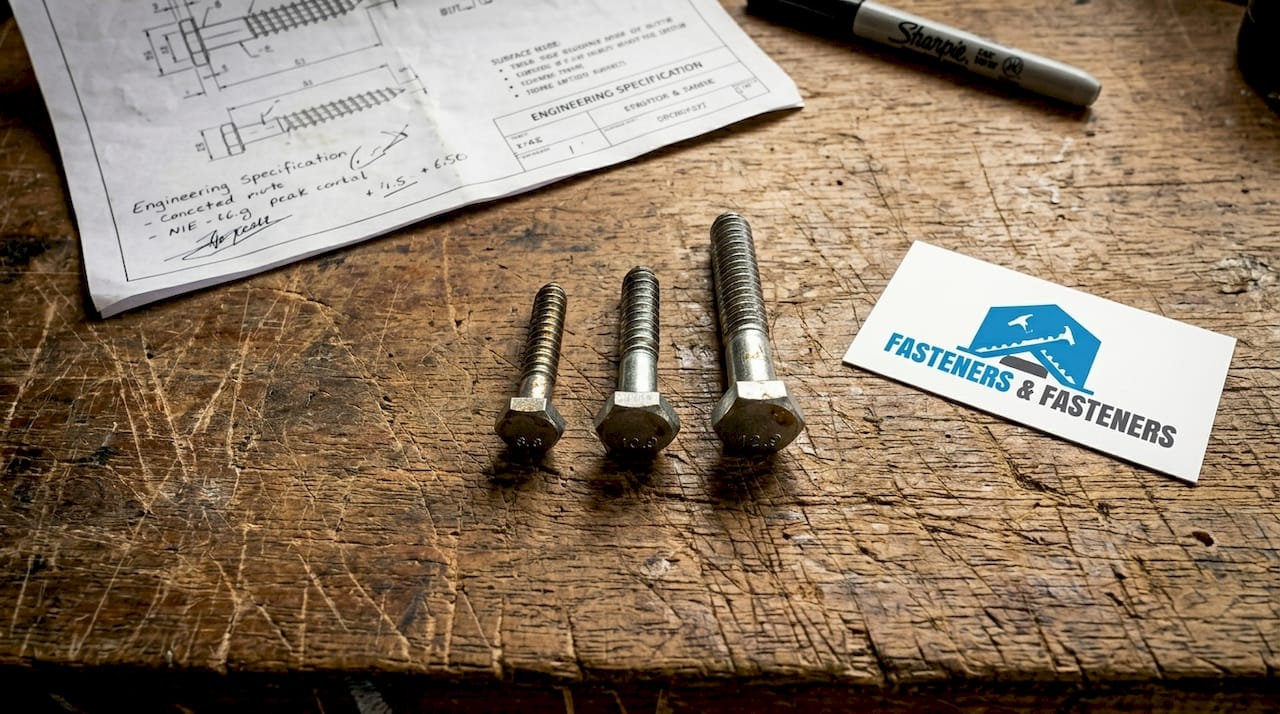
Heat treatment is what unlocks these numbers. The steel is hardened by heating to a specific temperature and then quenched, followed by tempering to reduce brittleness. The result is a screw with a finer grain structure that holds together under stress far better than an untreated equivalent. High tensile screws also look different. Grade 8.8 screws are typically a grey-black finish, while Grade 10.9 is darker and Grade 12.9 appears almost black. Always check the head markings rather than relying on colour alone.
To understand which grades apply to which applications, it helps to check a reliable fastener grades guide before specifying for a structural build. Australian engineering specs and building codes frequently require documented grade compliance for structural connections, so never assume a generic screw from an unmarked bucket will pass inspection.
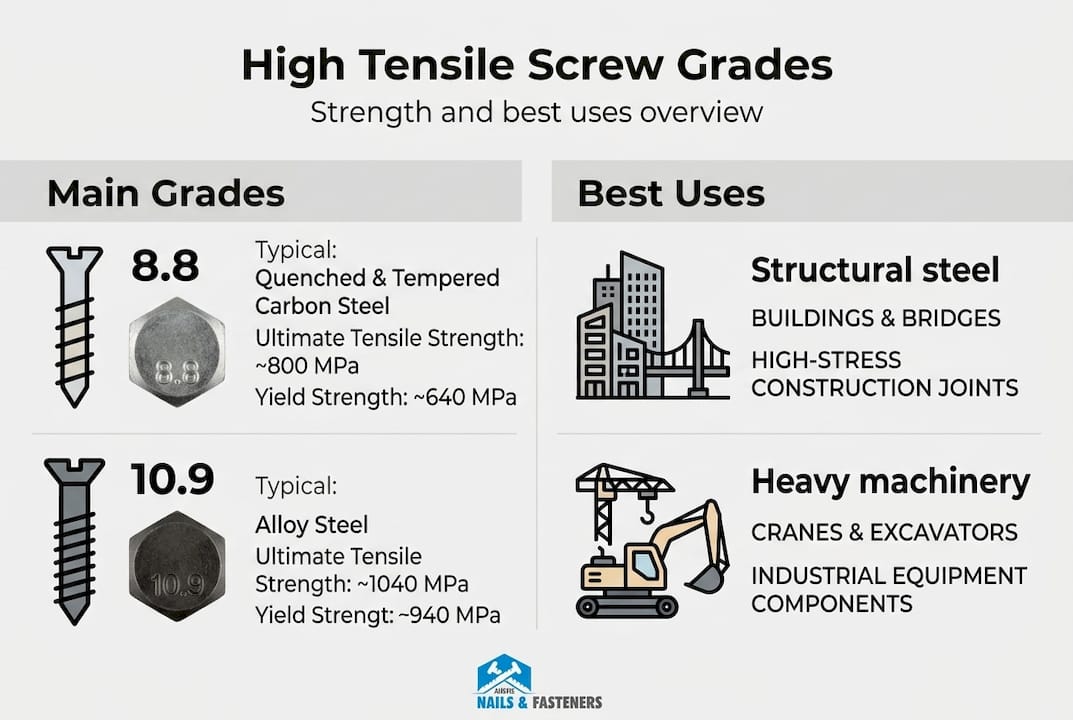
| Property | Standard (Grade 4.6) | High Tensile (Grade 8.8) | High Tensile (Grade 10.9) |
|---|---|---|---|
| Tensile strength | 400 MPa | 800 MPa | 1000 MPa |
| Yield strength | 240 MPa | 640 MPa | 900 MPa |
| Typical use | Light framing, joinery | Structural steel, heavy timber | Bridges, mining, high-load |
| Heat treated | No | Yes | Yes |
If you’re still working out what gauge suits your application, a fastener gauge guide can clarify which dimensions match your structural requirements.
Key benefits of high tensile screws in construction
Understanding what high tensile means helps, but what difference does it make on the job site? A significant one. The most important advantage isn’t just raw breaking strength. It’s clamping force. When you torque a high tensile screw to its specified value, it stretches slightly, and that elastic tension acts like a spring holding your joint together. Higher clamping force and preload create friction-grip joints that resist vibration and fatigue better than lower-grade fasteners.
This matters enormously in Australian conditions. Structures exposed to wind, traffic, heavy machinery, or thermal cycling are constantly being shaken and stressed. A standard screw can work loose or fatigue crack over time. A properly torqued high tensile screw maintains its grip through all of that movement because the friction between the joined surfaces, not just the screw itself, carries the load.
The numbers back this up. An M12 Grade 10.9 delivers around 84 kN of tensile capacity, which is 25 to 50 percent stronger than its Grade 8.8 equivalent. For a single fastener, that’s a dramatic jump. Multiply that across a bolted connection with dozens of screws and the structural safety margin grows considerably.
“The right grade at the right torque isn’t just about strength. It’s about creating a joint that behaves predictably under load, year after year.”
Pro Tip: For most commercial and heavy residential projects, Grade 10.9 gives you the best balance of strength and ductility. Grade 12.9 is harder but more brittle, making it better suited to controlled environments like machinery assembly rather than on-site construction with variable installation conditions.
If you’re specifying fasteners for a demanding build, reviewing heavy duty fasteners options alongside grade requirements will save you from under or over-engineering the connection. Solid construction fastening tips also help you get maximum performance from whatever grade you choose, and a dedicated fastener durability guide rounds out the picture for long-term performance in Australian climates.
| Grade | Tensile capacity (M12) | Preload vs 8.8 | Best for |
|---|---|---|---|
| 8.8 | ~56 kN | Baseline | Structural steel, general builds |
| 10.9 | ~84 kN | +30 to 50% | Heavy construction, mining |
| 12.9 | ~98 kN | +60%+ | Precision machinery, controlled use |
Trade-offs, risks, and how to mitigate them
The advantages are clear, but high performance comes with responsibility. Here’s what to watch out for. The main trade-off with higher-grade fasteners is reduced ductility. Ductility is a material’s ability to deform before breaking, and it’s actually a safety feature in structural engineering. A ductile joint warns you before it fails. A brittle one doesn’t.
Higher grades like 12.9 reduce elongation to around 8 percent compared to 12 percent for Grade 8.8, which meaningfully increases brittleness in impact and vibration scenarios. Grade 10.9 sits at a more practical middle ground for on-site use.
The other major risk is hydrogen embrittlement. This occurs when atomic hydrogen, introduced during electroplating or acid pickling processes, gets trapped inside the steel. Under sustained load, this hydrogen concentrates at stress points and can cause sudden fracture at loads well below the rated strength. The danger is it can happen days or weeks after installation, with no visible warning. High-strength grades are susceptible to hydrogen embrittlement and should be treated with baking at 200 to 230°C for 8 to 24 hours, or coated using non-electrolytic methods like zinc-flake coating.
Here’s a checklist for safe selection and installation:
- Always source high tensile screws from a traceable, certified supplier.
- Check the head markings match the grade specified in your engineering documents.
- Avoid electroplated coatings on Grade 10.9 or 12.9 unless baking is confirmed.
- Use a calibrated torque wrench. Do not rely on feel or impact driver alone.
- Inspect for corrosion or damage before installation. Do not use screws that show pitting or cracking.
- Never reuse high tensile fasteners that have been fully tensioned. They may have stretched past their elastic range.
Pro Tip: When ordering certified fasteners for structural applications, ask your supplier for the material test certificate. This document traces the batch back to the steel mill and confirms the mechanical properties were independently verified. It’s the kind of paperwork that protects you if an engineer or inspector ever questions the installation.
For applications where surface protection matters, explore specialty fastening choices that are engineered for corrosive or demanding environments.
When and where high tensile screws make the difference
Armed with technical know-how, it’s time to see where these screws truly shine in Australian building. The headline use cases are structural. Bridges, mining equipment, heavy timber connections, steel-to-steel joints, and any application where fatigue or dynamic loading is a factor all call for high tensile fasteners. The M12 Grade 10.9 tensile capacity of approximately 84 kN, being 25 to 50 percent stronger than an 8.8 equivalent, makes it the go-to for these demanding applications.
Here’s a quick breakdown of where grade matters most:
High-risk applications requiring high tensile:
- Structural steel connections in commercial and industrial buildings
- Bridge components and infrastructure fastening
- Mining machinery and heavy plant equipment
- High-load timber connections with engineered joists or LVL beams
- Any connection subject to dynamic or cyclic loading
Lower-risk applications where standard screws may suffice:
- Interior joinery and lightweight cabinet work
- Non-structural cladding and trim
- Temporary formwork and scaffolding (check your scaffolding standards regardless)
- Light-duty bracketing and fixings
Australian Standards such as AS 4100 for steel structures and AS 1720 for timber structures specify minimum fastener grades for structural connections. Engineers will often call up AS/NZS 1110 for property classes of bolts and screws. If your plans carry an engineer’s stamp, the fastener grade is not your call to change. Substituting a lower grade to save a few dollars creates a liability that far outweighs the cost difference.
For a broader view of how to match fasteners to loads, the load-bearing fasteners guide is a practical starting point. The essential fastener types overview helps you understand the full landscape before specifying, and guidance on secure screw installation ensures your chosen grade delivers its full potential once on site.
Our take: What most builders get wrong about high tensile screws
Beyond the technical details, our experience in Australian builds reveals something you won’t read in a spec sheet. The most common mistake isn’t under-specifying. It’s over-specifying, and then installing incorrectly.
Builders reach for Grade 12.9 screws “just to be safe,” paying a premium for brittleness they don’t need while skipping calibrated torquing because they’re running behind schedule. A correctly installed Grade 8.8 will almost always outperform a guessed-tight Grade 12.9. The screw grade is only half the equation.
The uncomfortable truth is that on-site quality control matters more than the number stamped on the fastener head. Were the mating surfaces clean and flat? Was the torque verified? Was the right lubricant used? These variables affect joint performance far more than chasing the highest grade number. For help finding certified products and the right grade for your actual application, the fastener selection guide is a good place to start. Choosing a verified supplier also protects you legally if a connection is ever questioned.
Get the right high tensile screws and advice for your next project
If you’re ready to upgrade your fasteners or want tailored advice, here’s where to go next. At Aussie Nails and Fasteners Warehouse, we stock a wide high tensile screws range from trusted brands, with grades clearly labelled so you always know exactly what you’re buying.
Our team understands Australian building standards and can help you match the right grade to your project without over-engineering or guessing. Browse our quality fastening tools to complement your fastener selection, and visit the full fasteners warehouse for a complete view of screws, nails, staples, and pneumatic solutions. Fast shipping across Australia, competitive pricing, and genuine product support make us the obvious choice for professionals and DIY enthusiasts alike.
Frequently asked questions
What defines a screw as high tensile?
A high tensile screw is made from alloy steel and heat-treated to achieve a minimum tensile strength at a specified grade, typically 8.8 or higher. This allows it to carry significantly greater loads than standard screws, and Grade 10.9 delivers 30% more preload capacity than Grade 8.8 at the same diameter.
Why are high tensile screws better for heavy construction?
High tensile screws generate greater clamping force when torqued, creating friction-grip joints. Higher clamping force and preload means these joints resist vibration and fatigue far better, which is critical for structural, load-bearing, or dynamically loaded connections.
Are there risks or downsides to using high tensile screws?
Yes. Very high grades reduce ductility and increase brittleness, and high-strength grades are susceptible to hydrogen embrittlement from plating processes. Both risks are manageable with correct coating choices, baking procedures, and certified sourcing.
When should I not use high tensile screws?
Avoid high tensile grades in low-load applications where flexibility is an advantage, or wherever the grade exceeds what the engineering specification requires. Higher grades reduce ductility significantly, which can make over-specified connections more brittle than necessary for the actual load conditions.
Recommended
- Top construction fastening tips for secure, lasting builds – Aussie Nails and Fasteners Warehouse
- Understand fastener durability: Build stronger Australian projects – Aussie Nails and Fasteners Warehouse
- How to install screws for strong, secure results every time – Aussie Nails and Fasteners Warehouse
- Heavy duty fasteners explained: strength, standards, and selection – Aussie Nails and Fasteners Warehouse